
TBM Construction Methods Explained: When to Use EPB, Slurry, or Hard Rock Systems
TBM construction methods sit at the center of tunnel risk, cost control, and delivery confidence. A machine that fits the ground can maintain face stability, manage water pressure, and limit wear. A machine that does not fit the ground often turns routine excavation into a sequence of interventions, delays, and redesign decisions. For projects moving through dense cities, weak alluvium, mixed-face geology, or long mountain drives, the choice between EPB, slurry, and hard rock systems is less about preference and more about how geology, groundwater, lining strategy, and logistics interact in practice.
Why TBM selection has become a sharper industry issue
Tunnel programs are growing in complexity. Urban alignments pass under utilities, foundations, and transport corridors. Mountain tunnels face long distances, abrasive rock, and difficult access. Owners also expect tighter schedules and clearer risk allocation.
That is why TBM construction methods now receive more attention at the early evaluation stage. The method influences spoil handling, settlement exposure, intervention frequency, segment performance, and downstream plant requirements.
From the broader heavy-industry perspective, this fits the way TF-Strategy approaches infrastructure intelligence. Physical machine parameters, construction methods, and strategic project demands must be read together, not as separate topics.
The basic logic behind EPB, slurry, and hard rock systems
All TBM construction methods aim to excavate safely and continuously. The difference lies in how the tunnel face is supported, how excavated material is transported, and how the machine reacts to pressure, water, and ground variability.
EPB in simple terms
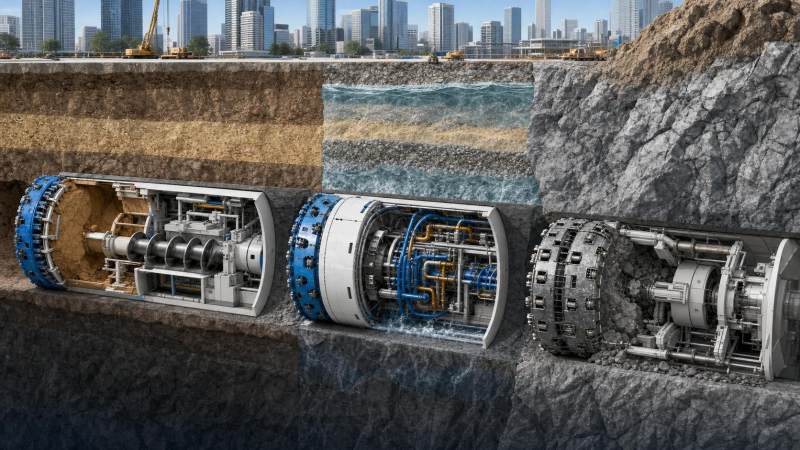
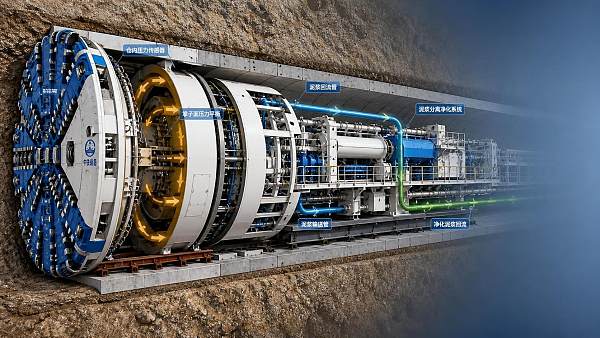
Earth Pressure Balance machines use conditioned spoil inside the chamber to support the face. Screw conveyors regulate discharge. Foam, polymers, and sometimes water help produce a plastic, controllable muck mass.
This approach works best when the excavated soil can be transformed into a stable paste. The method is strongly linked to conditioning quality and pressure control discipline.
How slurry systems differ
Slurry TBMs support the face with pressurized bentonite slurry. Excavated material is removed hydraulically through slurry circuits and separated at the surface by treatment plants.
These TBM construction methods are usually selected when groundwater pressure is high, permeability is significant, or face support needs tighter hydraulic control than EPB can comfortably provide.
Where hard rock TBMs fit
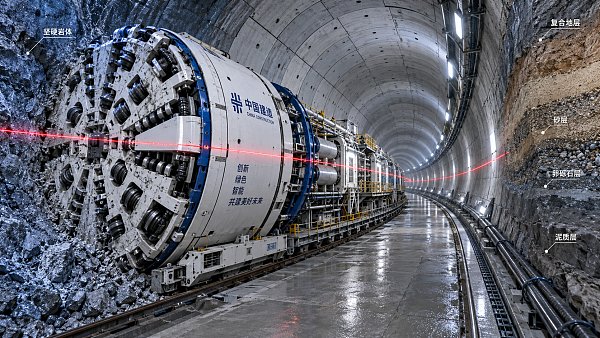
Hard rock systems rely on disc cutters breaking competent rock rather than pressure-balanced soil excavation. They may be open, shielded, or double-shielded, depending on rock quality and support requirements.
In this group of TBM construction methods, the central questions are rock strength, fracturing, abrasivity, squeezing risk, water inflow, and the need for simultaneous support installation.
When EPB is usually the right choice
EPB is often favored for urban soft-ground tunneling with moderate permeability and soils that respond well to conditioning. Clay, silt, sandy silt, and mixed granular soils can be suitable when the chamber can maintain a stable pressure regime.
The strongest case for EPB appears when surface settlement control is critical and spoil logistics need to remain relatively compact. Compared with slurry systems, surface treatment infrastructure can be less extensive.
Still, EPB is not automatically the lower-risk option. Trouble starts when the muck will not form a workable plug, when boulders disrupt screw discharge, or when water inflow overwhelms conditioning assumptions.
- Use EPB where conditioned spoil can reliably hold face pressure.
- Check fines content, plasticity range, and permeability early.
- Review mixed-face exposure, cobbles, and obstruction probability.
- Confirm that additive supply and spoil management are realistic.
Where slurry systems provide stronger control
Slurry TBMs are commonly preferred in water-bearing sands, gravels, and highly permeable formations. They can also perform well under rivers, ports, and coastal zones where hydrostatic pressure dominates the risk picture.
Among TBM construction methods, slurry systems usually offer better face support in coarse ground because the pressure medium is not dependent on turning the excavated soil into a stable paste.
The tradeoff is operational complexity. Separation plants, slurry pipelines, bentonite management, treatment capacity, and environmental handling all become part of the tunneling system, not optional support functions.
This means the machine choice must be evaluated together with the site footprint, disposal routes, water treatment obligations, and plant uptime assumptions. A technically sound TBM can still become a poor project fit if the surface system is constrained.
How to read hard rock suitability beyond UCS numbers
Hard rock decisions are often oversimplified. Uniaxial compressive strength matters, but it does not tell the whole story. Joint spacing, fault zones, in-situ stress, squeezing ground, and cutterhead access strategy may matter just as much.
Open hard rock TBMs can achieve excellent advance rates in stable, competent rock with manageable support demands. Shielded and double-shielded arrangements become more attractive when rock quality changes or lining installation must stay close behind the face.
Cutter consumption is another major issue. Highly abrasive rock can shift project economics quickly. In long drives, intervention duration and spare strategy can influence method choice almost as much as pure penetration performance.
Mixed ground is where many decisions become difficult
Many challenging projects do not sit neatly inside one category. Mixed-face conditions can combine rock at the crown, soft ground at the invert, and groundwater moving through discontinuities. That is where method selection becomes most sensitive.
In these conditions, TBM construction methods should be judged by transition behavior rather than ideal-case behavior. The best question is not which machine performs best in one zone, but which machine remains most controllable across the alignment.
This is also where intelligence-led evaluation adds value. Geological records, cutterhead design assumptions, intervention planning, and segmental lining strategy need to be tested together, not one by one.
Decision points that matter in real project evaluation
A useful evaluation framework looks beyond machine labels. EPB, slurry, and hard rock systems should be reviewed as integrated operating environments.
- Ground model confidence: assess borehole spacing, lab data, and uncertainty zones.
- Hydrogeology: compare expected inflow with actual face support capability.
- Alignment sensitivity: identify structures, settlement limits, and access restrictions.
- Wear exposure: estimate cutter, screw, pipeline, and slurry circuit consumption.
- Surface logistics: test plant footprint, muck disposal, additives, and water treatment.
- Intervention strategy: review compressed-air access, hyperbaric limits, and safe maintenance windows.
Usually, the most defensible decision is the one that remains stable under imperfect information. That often means choosing the method with better tolerance for the project’s most damaging uncertainty, not the highest theoretical advance rate.
Why this matters beyond tunneling alone
TBM construction methods affect the wider infrastructure chain. Lining supply, crane planning, haulage, treatment systems, energy demand, and maintenance logistics all respond to the tunneling method selected.
That broader systems view reflects the intelligence model used by TF-Strategy across heavy equipment sectors. Whether the subject is TBM cutterhead material, mining haulage efficiency, or lifting strategy, value comes from connecting machine behavior with project context.
For tunnel programs, this means the best method decision is rarely isolated inside a geology memo. It belongs inside a coordinated evaluation of risk, support equipment, schedule logic, and lifecycle cost exposure.
A practical next step for comparing TBM construction methods
A sound next move is to build a comparison matrix around the most uncertain ground zones, expected water pressures, spoil behavior, wear assumptions, and surface constraints. Then test EPB, slurry, and hard rock options against the same operating scenarios.
That process usually reveals where a method is genuinely robust and where it depends on optimistic assumptions. In TBM construction methods, clarity comes less from broad labels and more from disciplined matching between geology, machine system, and project execution reality.
When that matching is done well, equipment selection becomes easier to defend, project interfaces become easier to manage, and tunnel performance becomes far more predictable.
Related News
 Sep 21, 2026Industrial Supplier Evaluation: A Risk-Based Scorecard for Quality, Capacity, and DeliveryIndustrial supplier evaluation made practical: use a risk-based scorecard to assess quality, capacity, and delivery reliability, reduce project risk, and select suppliers with confidence.
 Sep 20, 2026Comparing Heavy Equipment Warranty Suppliers: Coverage, Claims, and Downtime RiskSupplier comparison for heavy equipment warranty: evaluate coverage, claims speed, service networks, and downtime risk to protect uptime and project costs.
 Sep 19, 2026Mining Truck Technology Trends: What Fleet Managers Should Prioritize for 2026Mining truck technology trends for 2026: prioritize electrification, autonomy, predictive maintenance, and road intelligence to improve fleet uptime, safety, and cost control.
 Sep 17, 2026How TBM Guidance Technology Maintains Alignment Through Curves and Variable GroundTunnel boring machine guidance technology helps teams maintain precise alignment through curves and variable ground, reducing risk, improving lining accuracy, and protecting schedules.
Geological Boring Fellow
Weekly Insights
Stay ahead with our curated technology reports delivered every Monday.