
Construction Methodology Explained: How to Choose the Right Approach for Complex Projects
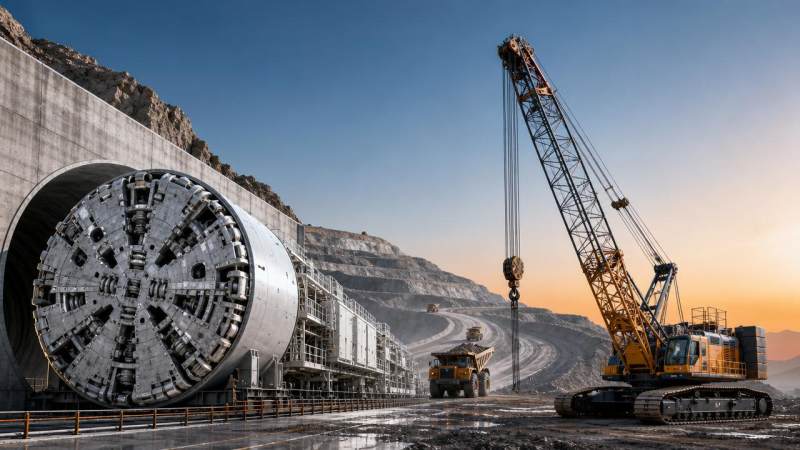
Construction methodology matters most when project conditions stop being standard
Construction methodology is often treated like a scheduling choice. In complex heavy-industry work, that view is too narrow.
The selected approach shapes exposure to geotechnical risk, machine utilization, lift stability, haul efficiency, and downstream rework.
That is why construction methodology deserves the same scrutiny as equipment specification and commercial planning.
In practice, the right answer changes with terrain, material behavior, access constraints, weather windows, and tolerance requirements.
A tunnel crossing mixed ground cannot be judged like an open-pit expansion. A wind turbine lift is not managed like highway paving.
This is where TF-Strategy’s perspective is useful. Heavy equipment data only becomes meaningful when linked to real construction methodology decisions.
Across TBM, mining, lifting, and road machinery, the question is rarely which machine looks strongest on paper.
The better question is which construction methodology fits the physical site, the delivery objective, and the operational risk profile.
Why similar projects still require different construction methodology choices
Many projects appear comparable at tender stage, yet their execution logic differs sharply once site data is reviewed.
Geology is one reason. Competent rock, fractured strata, saturated soils, and abrasive formations demand different excavation behavior and support timing.
Logistics is another. Restricted laydown areas can eliminate otherwise efficient equipment sequences.
Then there is tolerance sensitivity. Some works absorb minor deviation. Others punish it through alignment drift, lift instability, or pavement defects.
A workable construction methodology therefore balances five interacting variables:
- ground or material condition
- equipment capability under actual load
- site access and spatial limitation
- safety margin during peak operations
- lifecycle cost, not only upfront cost
When one of these variables changes, the preferred construction methodology can change with it.
In tunneling, the right approach starts with ground behavior rather than machine size
TBM projects show clearly why construction methodology cannot be reduced to equipment selection alone.
For urban tunneling, settlement control often outranks pure advance rate. The methodology must protect adjacent utilities, buildings, and transport assets.
That usually favors tightly controlled face pressure, disciplined spoil management, and precise segment installation sequencing.
Mountain tunnel conditions shift the emphasis. Longer drives, variable rock classes, and water ingress can make intervention planning more important.
In these settings, construction methodology should account for cutter wear strategy, rescue access, and contingency support installation.
A common mistake is to compare TBM diameter and thrust without testing the full methodology against mixed-face conditions.
If transition zones are underestimated, production losses may come from stoppages rather than insufficient machine power.
More robust evaluation usually asks three practical questions:
- How stable is the face across the full alignment, not just at launch?
- What support sequence is realistic when water, fines, or abrasivity increase?
- How much downtime is acceptable before schedule claims begin to escalate?
Open-pit mining needs a construction methodology built around continuity
In open-pit mining, the best construction methodology is usually the one that protects continuous movement.
Ultra-large excavators and mining dump trucks deliver value only when bench design, haul road geometry, and maintenance intervals remain synchronized.
A fragmented methodology creates idle trucks, queueing at loading points, and unstable cycle times.
Conditions become tougher at high altitude or in extreme temperatures. Payload assumptions may remain unchanged, but engine response, tire wear, and braking margins do not.
In this environment, construction methodology must include route gradient control, dust suppression, and weather-triggered dispatch adjustments.
There is also a growing methodological shift toward remote operation and electrification.
That shift is not just technological. It changes charging logic, maintenance windows, communications redundancy, and staffing patterns around the pit.
Where the main decision points differ across heavy project settings
Large lifting projects are decided by method sequence before the crane arrives
For crawler cranes in wind, nuclear, and petrochemical work, construction methodology is often won or lost in preparation.
Lift charts matter, but site bearing capacity, tail swing clearance, transport route, and assembly sequence often decide feasibility first.
This is especially true when components are long, flexible, or sensitive to wind-induced movement.
A practical methodology for mega-lifts should define not only the peak lift, but every intermediate condition.
That includes crane mobilization, mat placement, partial assembly, test lifts, communication protocol, and abort criteria.
One frequent misjudgment is assuming two similar lifts share the same construction methodology because the tonnage looks close.
In reality, boom configuration, radius variation, and component center of gravity can change the whole risk picture.
Road construction rewards methodology discipline more than headline equipment capacity
Large road machinery operates in a different rhythm, but the construction methodology question remains the same: what keeps quality stable over distance?
On high-speed networks and smart highways, paving quality depends on material delivery consistency, machine coordination, and compaction timing.
A strong paver cannot compensate for segregated mix or poor rolling sequence.
This is where methodology becomes operationally detailed. Temperature loss, lane closure duration, and sensor integration must be considered together.
When project teams adopt digital monitoring, the benefit comes only if the construction methodology includes response rules for deviations.
Without that link, data collection looks advanced but does not improve field decisions.
The most costly errors usually come from treating different scenarios as interchangeable
Some errors repeat across sectors, even when the equipment is completely different.
- Choosing a construction methodology from nominal output instead of actual site constraints.
- Evaluating capex without modeling maintenance access, spare parts, and wear rates.
- Assuming short-term productivity gains outweigh long-term instability.
- Ignoring transition conditions such as mixed geology, weather shifts, or changing haul distances.
- Using a proven methodology from another region without checking standards, labor practices, and logistics support.
These mistakes are expensive because they appear rational during planning. Their weakness only shows up under operating pressure.
A more reliable way to choose construction methodology before commitment
A defensible construction methodology should be tested against the project’s hardest operating moments, not its average conditions.
Before finalizing the approach, it helps to verify the following:
- Identify the condition most likely to interrupt production or safety.
- Check whether equipment performance data reflects altitude, temperature, gradient, or abrasive wear.
- Map the sequence dependencies between excavation, transport, support, lifting, or paving.
- Estimate TCO using downtime and intervention frequency, not fuel or purchase cost alone.
- Confirm whether digital tools change the method itself or merely add reporting.
This is also where strategic intelligence adds value. Tender data, material trends, and fleet evolution can reshape methodology assumptions early.
For example, cutter head material shifts affect tunneling interventions. Electric haulage changes mine infrastructure logic. Remote control alters staffing and safety design.
Good decisions come from matching method, machine, and risk horizon
The best construction methodology is rarely the most aggressive or the most conservative.
It is the approach that remains stable when geology changes, lifts become sensitive, haul cycles stretch, or quality tolerances tighten.
In heavy infrastructure, sound judgment comes from connecting physical parameters with execution reality.
That means comparing scenarios carefully, defining the limiting conditions, and checking whether the chosen construction methodology still works when pressure rises.
A practical next step is to build a scenario-based review sheet for each project section.
List the ground condition, equipment limits, sequence dependencies, maintenance burden, and failure consequences side by side.
That simple discipline makes construction methodology selection more transparent, more defensible, and far less vulnerable to costly assumptions.
Related News
 Oct 19, 2026Sizing Industrial Hydraulic Power Packs: Pressure, Flow, and Duty CycleSize industrial hydraulic power packs with confidence. Learn how pressure, flow, and duty cycle affect performance, energy costs, and heat control—and avoid costly sizing mistakes.
 Oct 18, 2026How Equipment Specifications Affect Purchase, Installation, and Operating CostsExplore equipment specification planning cost factors that shape purchase, installation, and operating budgets. Compare lifecycle costs, avoid oversizing, and buy with confidence.
 Oct 17, 2026Tunnel Boring Machine Supplier List: Compare TBM Types and Service CoverageExplore our tunnel boring machinery supplier list to compare EPB, slurry and hard rock TBMs, assess service coverage and lifecycle costs, and build a smarter procurement shortlist.
 Oct 16, 2026Heavy-Duty Petrochemical Lifting: Selecting Cranes by Load, Radius, and Site AccessExplore heavy-duty petrochemical lifting solutions. Compare cranes by load, radius, site access, and ground support to reduce project risk and optimize lifting costs.

Ms. Elena Rodriguez
Weekly Insights
Stay ahead with our curated technology reports delivered every Monday.