
TBM Tooling Price Guide: What Affects Cost and How Buyers Can Compare Quotes
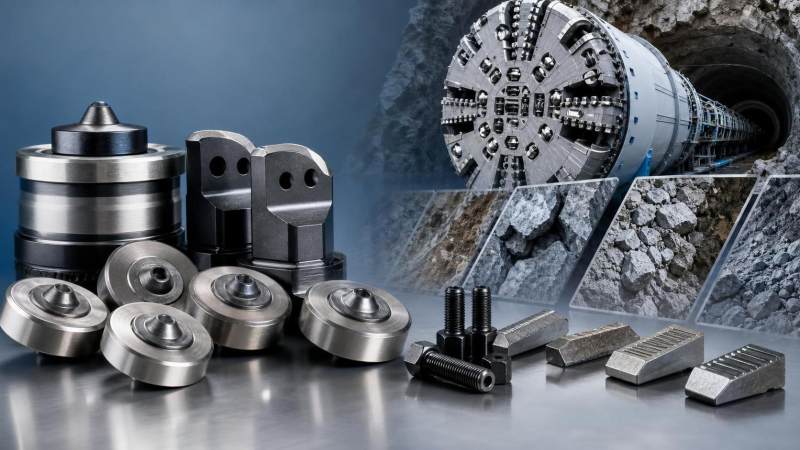
Why does TBM tooling price vary so much from one quote to another?
TBM tooling price rarely moves in a narrow band.
Two suppliers may appear to offer the same cutterhead tools, yet their cost logic can be very different.
The biggest reason is that tooling sits between geology and machine performance.
If rock strength, abrasivity, water inflow, and expected advance rate change, the tooling package changes with them.
That is why TBM tooling price should never be judged as a simple catalog number.
In practice, the quote reflects a technical assumption about wear life, intervention frequency, and downtime exposure.
A lower upfront number may hide faster cutter consumption or weaker ring durability.
A higher quote may include metallurgy upgrades, testing records, or stronger support during difficult boring sections.
For teams watching heavy equipment markets through sources like TF-Strategy, this pattern is familiar.
Across mining, lifting, and tunneling, component pricing often follows operating risk more than simple manufacturing cost.
So the real question is not only, “What is the TBM tooling price?”
It is also, “What performance promise is built into that price?”
Which cost drivers usually explain a higher or lower TBM tooling price?
Several factors shape TBM tooling price, and they do not carry equal weight.
Geology is usually the first filter.
Hard, abrasive, fractured, or mixed ground conditions push tooling specifications upward.
That affects cutter diameter, bearing design, sealing performance, and wear protection layout.
Material grade is the next major driver.
Heat treatment consistency, alloy composition, and weld overlay quality can change usable life materially.
Customization also matters more than many expect.
Non-standard housings, scraper geometry, or site-specific mounting arrangements add engineering and machining cost.
Lead time is another hidden lever.
Expedited production, special forging slots, and emergency logistics can lift the quote quickly.
Then there is supplier capability.
A quote backed by traceable inspection data, field failure analysis, and service inventory often costs more.
Still, that premium may reduce total project loss.
- Ground condition severity and expected wear rate.
- Disc cutter specification, ring hardness, and bearing arrangement.
- Steel grade, forging quality, heat treatment, and coating options.
- Customization level for cutterhead layout or mixed-face conditions.
- Required documentation, testing reports, and standards compliance.
- Spare package depth, delivery commitment, and field response support.
When these factors are clear, TBM tooling price becomes easier to interpret.
When they are vague, quote comparison becomes unreliable.
Are buyers comparing like for like, or just comparing numbers?
This is where many sourcing mistakes begin.
A quote that looks cheaper may exclude wear indicators, seals, adapters, packing, or commissioning support.
Another supplier may include them as standard.
The result is a misleading TBM tooling price comparison.
A better approach is to normalize the offers before judging them.
Ask each supplier to confirm the same technical and commercial checkpoints.
This type of comparison is especially useful when the market is tight.
Raw material volatility and project clustering can distort apparent price gaps.
A normalized table keeps the decision anchored to facts.
When does the lowest TBM tooling price become the most expensive option?
Usually when tooling wear is underestimated.
Disc cutter replacement in difficult ground is not just a parts event.
It may involve chamber access, pressure management, labor exposure, and lost boring time.
That means a low TBM tooling price can trigger a high operational penalty.
This is more common in long drives, variable geology, and high-availability schedules.
In those cases, wear life predictability matters almost as much as unit cost.
Another risk appears when suppliers price aggressively but cannot hold delivery commitments.
A delayed spare package can interrupt progress at the worst moment.
The same logic is visible across heavy industries tracked by intelligence platforms like TF-Strategy.
Whether the asset is a crawler crane or a mining truck, weak component reliability distorts total cost fast.
A practical review should include these risk questions:
- How many meters of advance does the quoted tooling life assume?
- What field record supports that assumption?
- How quickly can critical replacements be dispatched?
- What failures are covered by warranty, and what is excluded?
- How much downtime cost was considered during evaluation?
If these answers are unclear, the quoted TBM tooling price is incomplete.
What should be included in a serious quote review before approval?
A disciplined review goes beyond item price and discount rate.
It should connect tooling cost to project timing, intervention strategy, and tunnel risk profile.
More complete quote reviews usually examine three layers together.
Technical fit
Check whether the tooling design matches the expected ground envelope, not just average geology.
Mixed sections often cause the most expensive surprises.
Commercial clarity
Review Incoterms, packaging, taxes, payment milestones, and replacement terms.
A competitive TBM tooling price can lose value if delivery responsibility is unclear.
Lifecycle support
Confirm spare forecasting, technical response time, wear monitoring, and root-cause analysis capability.
This is where experienced suppliers often justify a premium.
In actual application, the more useful judgment method is simple.
Estimate the tooling cost per meter of reliable advance, not only the purchase cost per unit.
That creates a stronger basis for comparing TBM tooling price across different offers.
How can buyers turn TBM tooling price data into a better sourcing decision?
Start by building one common quote sheet for all bidders.
Use the same geology summary, wear assumptions, spare ratio, and delivery window.
That removes much of the noise around TBM tooling price.
Then score each offer on more than cost.
- Price competitiveness against normalized scope.
- Expected wear life and evidence quality.
- Lead time reliability and emergency supply plan.
- Quality traceability and manufacturing consistency.
- Service support during difficult boring stages.
It also helps to monitor market intelligence beyond the immediate tender.
Reports that connect component evolution, raw material movement, and project demand can sharpen timing decisions.
That is one reason sector intelligence platforms remain relevant in heavy equipment sourcing.
They help translate engineering detail into commercial judgment.
In the end, TBM tooling price should be read as a performance signal, a risk signal, and a supply signal.
If the next step is to compare active offers, organize them around scope, geology fit, wear life, lead time, and support depth.
That framework usually produces a more defensible sourcing outcome than choosing the lowest number alone.
Related News
 Oct 19, 2026Sizing Industrial Hydraulic Power Packs: Pressure, Flow, and Duty CycleSize industrial hydraulic power packs with confidence. Learn how pressure, flow, and duty cycle affect performance, energy costs, and heat control—and avoid costly sizing mistakes.
 Oct 18, 2026How Equipment Specifications Affect Purchase, Installation, and Operating CostsExplore equipment specification planning cost factors that shape purchase, installation, and operating budgets. Compare lifecycle costs, avoid oversizing, and buy with confidence.
 Oct 17, 2026Tunnel Boring Machine Supplier List: Compare TBM Types and Service CoverageExplore our tunnel boring machinery supplier list to compare EPB, slurry and hard rock TBMs, assess service coverage and lifecycle costs, and build a smarter procurement shortlist.
 Oct 16, 2026Heavy-Duty Petrochemical Lifting: Selecting Cranes by Load, Radius, and Site AccessExplore heavy-duty petrochemical lifting solutions. Compare cranes by load, radius, site access, and ground support to reduce project risk and optimize lifting costs.

Ms. Elena Rodriguez
Weekly Insights
Stay ahead with our curated technology reports delivered every Monday.