
Construction Safety Training Requirements: What Supervisors Should Cover On Site
Why does construction safety training still fail on well-funded projects?
Construction safety training often breaks down for a simple reason: crews hear rules, but they do not always connect them to the exact risks in front of them.
That gap becomes expensive on sites using crawler cranes, road machinery, excavation fleets, or support systems around tunneling and mining operations.
A strong program is less about classroom volume and more about repeatable site behavior.
Supervisors need to translate standards into daily checks, task-specific briefings, and visible interventions before unsafe habits become normal.
In practice, effective construction safety training protects schedule, equipment uptime, insurance performance, and workforce stability at the same time.
That is especially true in heavy industry, where a single lifting error, blind-spot incident, or ground failure can disrupt an entire project chain.
From the perspective of TF-Strategy, safety is closely linked to machine capability, work sequencing, and operating discipline, not just compliance paperwork.
What should construction safety training actually cover on site?
The core of construction safety training should match the tasks being performed that day, the equipment involved, and the environmental conditions on site.
General orientation matters, but supervisors usually need something more practical and immediate.
A useful on-site training routine should include these subjects:
- Hazard identification for the specific work zone, including overhead, underground, mobile, and energy-related risks.
- Safe use limits for tools, machines, lifting gear, access systems, and temporary works.
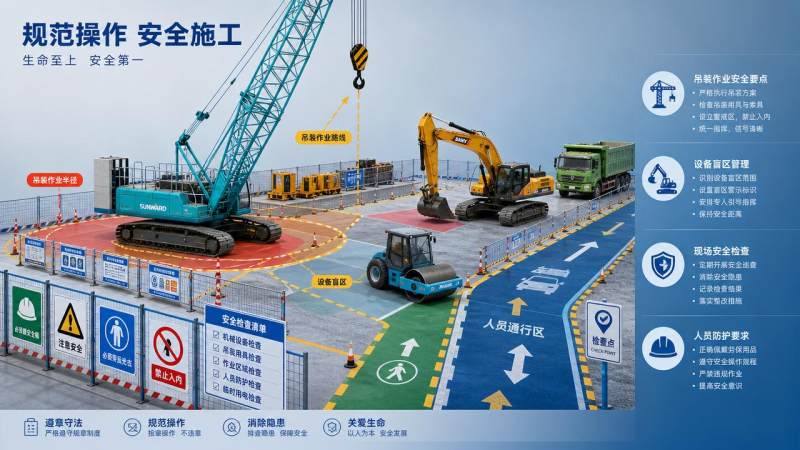
- Traffic management, exclusion zones, and pedestrian separation around moving equipment.
- Emergency response, reporting lines, and stop-work authority.
- Communication methods, especially hand signals, radio use, and permit handover.
- PPE expectations, fit, and replacement triggers.
Need to cover everything at once? Usually not.
Better construction safety training is layered.
Orientation introduces site rules, while toolbox talks, pre-task briefings, and refresher sessions reinforce the exact controls needed for current work.
On heavy equipment projects, supervisors should also explain why machine parameters matter.
Load charts, swing radius, slope limits, braking distance, and visibility constraints are safety topics, not only operating topics.
A quick judgment table for daily training priorities
The table below helps decide what construction safety training needs immediate attention before a shift starts.
Which hazards do supervisors most often undertrain?
The obvious hazards usually receive attention.
The weaker area is often the interaction between tasks, machines, and changing site conditions.
For example, crews may understand crane basics but overlook the effect of soft ground after rain.
They may know vehicle routes, yet miss how reversing patterns change once materials are relocated.
Construction safety training should therefore go beyond static hazards and address dynamic risk.
Commonly undertrained issues include line-of-fire exposure, blind spots, simultaneous operations, and unauthorized shortcuts around barriers or permits.
On projects involving open-pit mining support, large road machinery, or TBM logistics, interfaces create serious exposure.
Haul roads, maintenance bays, fueling points, and staging areas all require different controls.
Another gap is energy isolation.
People may recognize lockout rules in theory, while still failing to verify residual pressure, stored rotation, or suspended load risk.
This is where supervisors need to slow down the task, confirm understanding, and ask people to explain controls back in their own words.
How detailed should equipment-related construction safety training be?
It should be detailed enough to prevent bad assumptions, but focused enough to remain usable during real work.
Supervisors do not need to turn every briefing into a technical manual.
They do need to cover machine-specific operating boundaries that affect safety decisions.
For crawler cranes, that means ground bearing pressure, rigging compatibility, radius changes, and weather limits.
For excavators and mining fleets, it includes berm standards, travel routes, proximity alarms, and safe interaction with light vehicles.
For TBM support activities, construction safety training should address segment handling, slurry or spoil management, maintenance access, and confined work interfaces.
This is where intelligence-led safety becomes valuable.
TF-Strategy regularly tracks how machine design, remote control systems, and material upgrades change operational risk profiles.
That broader perspective matters because training content should evolve with equipment capability.
If a project adopts digital monitoring, camera systems, or semi-automated functions, crews still need clear instruction on limits, alarms, and manual override behavior.
What usually deserves a refresher?
- Pre-use inspection points that operators start skipping under time pressure.
- Tag line use, rigging checks, and suspended load exclusion rules.
- Pedestrian control near reversing or slewing equipment.
- Shutdown, isolation, and restart communication.
- Weather response triggers for wind, dust, heat, and reduced visibility.
What makes training stick instead of becoming a paperwork exercise?
The answer is repetition tied to decisions people actually make.
Construction safety training becomes effective when it is brief, relevant, and immediately applied in the field.
Long sessions can create the impression of compliance, while short targeted sessions create memory and action.
A practical approach is to connect every briefing to a visible control.
If the topic is lifting, the crew should see the load path, the barricade line, and the signal plan.
If the topic is excavation, they should review spoil placement, access edges, and utility markings on location.
One more point is often missed: feedback loops.
Supervisors should use near misses, inspection findings, and maintenance events to reshape future construction safety training.
That creates a living program instead of a static binder.
Where projects rely on high-value heavy equipment, this feedback is even more useful because operational deviations often appear before an incident occurs.
How can supervisors tell whether construction safety training is really working?
Completion records are necessary, but they are not enough.
A better test is whether the crew can recognize changing hazards and adjust behavior without waiting for correction.
Useful indicators are usually operational, not administrative.
- Fewer repeat observations for the same unsafe act.
- Cleaner permit handovers and stronger pre-task discussions.
- Better housekeeping in access routes and plant interaction zones.
- Earlier reporting of hazards, near misses, and equipment defects.
- More consistent use of stop-work authority when conditions change.
If incidents keep clustering around the same task, the issue is rarely just worker attention.
More often, construction safety training is too generic, too infrequent, or disconnected from actual sequencing.
Supervisors should review training content whenever methods, crews, or equipment configurations change.
That review is especially important on globally sourced projects, where standards, language habits, and machine interfaces may differ.
A useful next step is to map the top five site risks, align each one with a briefing topic, and verify the controls during the same shift.
When training, machine limits, and field supervision work together, safer performance stops being aspirational and becomes measurable.
Related News
 Oct 23, 2026Selecting Lifting Equipment for Nuclear Component Transport: Key Safety CriteriaSelecting lifting machinery for nuclear component transport? Discover essential safety criteria, load control checks, and supplier requirements to guide confident procurement.
 Oct 22, 2026Tunnel Boring Machines in Southeast Asia: EPB vs. Slurry for Soft GroundCompare tunnel boring machines Southeast Asia projects rely on: EPB vs. slurry for soft ground. Discover how groundwater, settlement risks, and spoil handling shape the right choice.
 Oct 21, 2026Choosing Tunneling Equipment for the Middle East: Rock, Soil, and GroundwaterCompare underground tunneling equipment Middle East projects need. Explore rock, soil, groundwater, and TBM options to reduce risk and make confident procurement decisions.
 Oct 20, 2026Which Heavy Machinery Maintenance Standards Apply to Your Construction Fleet?Discover which heavy machinery maintenance standards apply to your fleet. Clarify legal duties, OEM requirements, and inspection rules to reduce risk and keep equipment ready for work.
Related News

Ms. Elena Rodriguez
Weekly Insights
Stay ahead with our curated technology reports delivered every Monday.