
Extreme Temperature Mining: Equipment Risks, Cold-Start Issues, and Heat Protection
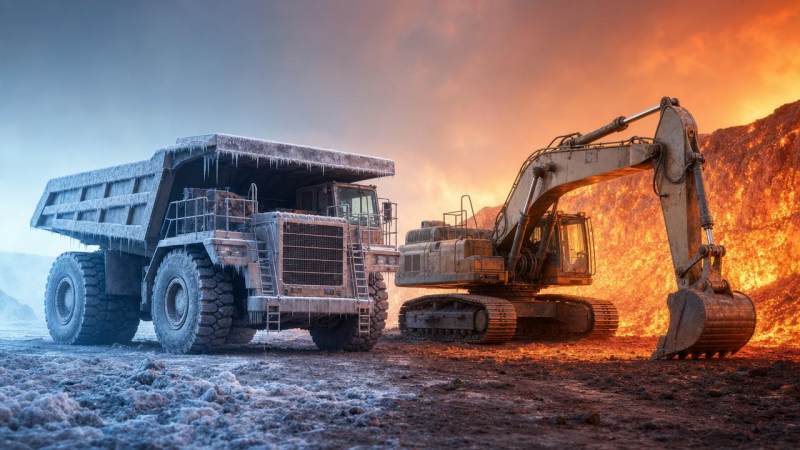
Extreme temperature mining: why does reliability break down so quickly?
Extreme temperature mining pushes heavy equipment beyond normal duty cycles, and failures rarely begin with one dramatic event.
More often, cold-start resistance, heat saturation, and material fatigue build quietly until downtime arrives at the worst moment.
That is why this topic matters across open-pit fleets, support vehicles, hydraulic systems, and remote service planning.
In practical terms, extreme temperature mining is not only about weather.
It is about how low or high ambient conditions change viscosity, battery behavior, sealing pressure, hose flexibility, tire integrity, and cooling balance.
A machine that runs smoothly at moderate temperatures can become sluggish at dawn in arctic cold or thermally unstable in a dusty summer pit.
TF-Strategy follows these patterns closely because physical parameters and operating strategy are inseparable in global heavy industry.
Across mining dump trucks, ultra-large excavators, and related field systems, temperature stress shapes TCO, uptime, and safety margins more than many teams expect.
What usually fails first in extreme cold or extreme heat?
The first weak point depends on the machine, but the early warning pattern is surprisingly consistent.
In severe cold, batteries lose effective output, starter loads increase, and lubricants resist flow.
Hydraulic circuits then respond slowly, especially during the first minutes after start-up.
In persistent heat, the problem shifts.
Cooling systems can no longer reject heat fast enough, while dust blocks radiators and elevates engine, transmission, and hydraulic oil temperatures.
Rubber parts also age faster in high heat, which means hoses, seals, and belts may degrade well before scheduled replacement.
The table below helps separate the most common field symptoms from the likely causes.
A useful takeaway is that extreme temperature mining problems often appear as routine maintenance issues.
The root cause, however, is usually temperature acting on fluid behavior, material properties, and thermal management margins.
Why are cold starts so damaging, even when the machine eventually runs?
Cold starts are not only inconvenient.
They compress several high-stress events into a short window before the machine reaches stable operating temperature.
Metal surfaces see poorer lubrication at first rotation, while fuel atomization, combustion quality, and hydraulic response can all degrade.
That combination increases wear even if the machine starts and finishes the shift.
In extreme temperature mining, the more common mistake is treating start-up as a binary event.
If the engine fires, teams assume the risk has passed.
In reality, the first ten to twenty minutes may decide component life.
- Use lubricant grades matched to actual site minimum temperatures, not catalog averages.
- Confirm battery health under load, because resting voltage alone can be misleading.
- Apply staged warm-up for hydraulic functions before full load or travel speed.
- Inspect breathers and filters, since moisture and ice can trigger secondary restrictions.
This is especially relevant for high-value fleets monitored by strategic intelligence platforms.
A cold-start issue on one machine may reflect a broader fleet practice gap rather than an isolated repair need.
If overheating is the visible problem, what is the hidden cause?
Overheating in extreme temperature mining is often blamed on ambient heat alone, but that explanation is incomplete.
Heat becomes destructive when cooling capacity, airflow, contamination control, and duty cycle no longer stay aligned.
For example, a mining dump truck climbing repeatedly under full payload creates a thermal profile very different from flat-haul transport.
The same principle applies to excavators, auxiliary power units, and even remote electrical cabinets.
Needless idling is another hidden contributor.
In hot conditions, long idle periods can raise under-hood temperatures while reducing effective cooling airflow.
That creates a misleading situation where equipment is not working hard, yet heat soak keeps rising.
A stronger heat-protection approach usually combines operating discipline with hardware checks.
- Clean cooling packs based on dust load, not on a fixed calendar.
- Track coolant, charge air, and hydraulic temperatures together, not as separate alarms.
- Review fan control logic and shroud condition after repeated summer shutdowns.
- Check whether payload, route grade, and cycle time exceed original thermal assumptions.
That last point matters because temperature risk is often operational before it becomes mechanical.
How should maintenance planning change for extreme temperature mining?
A standard service interval is rarely enough when a site swings from subzero starts to daytime heat stress.
Maintenance planning needs to become condition-led and season-aware.
That does not always mean more maintenance.
It means better timing, sharper inspection points, and stronger links between field data and service action.
In TF-Strategy’s wider heavy-equipment view, this is where intelligence adds real value.
Temperature stress should be read alongside route profile, payload, shift length, and material handling conditions.
A useful planning checklist includes the following priorities.
- Set winter and summer fluid specifications separately where climate ranges are wide.
- Advance replacement of seals, hoses, and belts exposed to repeated thermal cycling.
- Store critical batteries and electronic modules under controlled conditions when possible.
- Review alarm thresholds so nuisance alerts do not hide genuine thermal drift.
- Use trend analysis for start time, pressure build, and warm-up duration.
The goal is not perfect prediction.
The goal is to catch gradual temperature-related deterioration before it becomes a shutdown, a tow event, or a safety incident.
Which decisions reduce risk fastest without a full fleet redesign?
Many sites assume that solving extreme temperature mining issues requires a major equipment upgrade.
Sometimes it does, especially when the original machine specification never matched the climate.
More often, the fastest gains come from disciplined, targeted adjustments.
The key is to focus on decisions that improve thermal resilience immediately.
A sensible next step is to map these actions against the site’s harshest month, not its annual average.
That is usually where the hidden cost of extreme temperature mining becomes visible.
What should be reviewed before the next hot season or cold season arrives?
The best review is short, specific, and tied to actual failure history.
Begin with machines that showed slow starts, over-temperature alarms, hose failures, or unexplained productivity loss during the last season.
Then compare those records with ambient conditions, shift timing, and maintenance timing.
This turns extreme temperature mining from a weather complaint into a manageable engineering issue.
It also aligns with the broader TF-Strategy perspective.
Heavy equipment performs best when design capability, site practice, and service intelligence are read together.
Before the next temperature peak, review fluid selection, preheat logic, cooling cleanliness, thermal alarm trends, and component aging exposure.
If one area stands out, address it early rather than waiting for full seasonal failure patterns to return.
That approach usually protects uptime more effectively than reacting to isolated breakdowns.
In the end, extreme temperature mining is less about surviving the climate and more about preparing equipment systems for how climate changes every load cycle.
Related News
 Oct 23, 2026Selecting Lifting Equipment for Nuclear Component Transport: Key Safety CriteriaSelecting lifting machinery for nuclear component transport? Discover essential safety criteria, load control checks, and supplier requirements to guide confident procurement.
 Oct 22, 2026Tunnel Boring Machines in Southeast Asia: EPB vs. Slurry for Soft GroundCompare tunnel boring machines Southeast Asia projects rely on: EPB vs. slurry for soft ground. Discover how groundwater, settlement risks, and spoil handling shape the right choice.
 Oct 21, 2026Choosing Tunneling Equipment for the Middle East: Rock, Soil, and GroundwaterCompare underground tunneling equipment Middle East projects need. Explore rock, soil, groundwater, and TBM options to reduce risk and make confident procurement decisions.
 Oct 20, 2026Which Heavy Machinery Maintenance Standards Apply to Your Construction Fleet?Discover which heavy machinery maintenance standards apply to your fleet. Clarify legal duties, OEM requirements, and inspection rules to reduce risk and keep equipment ready for work.
Related News

Ms. Elena Rodriguez
Weekly Insights
Stay ahead with our curated technology reports delivered every Monday.