
How Underground Construction Support Systems Prevent Ground Collapse in Urban Tunneling
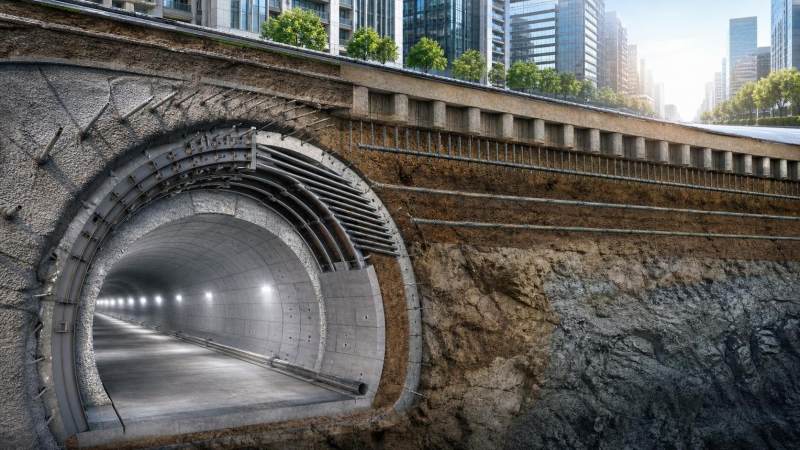
How Underground Construction Support Systems Prevent Ground Collapse in Urban Tunneling
In dense urban tunneling, ground behavior changes fast and often without much warning.
A few millimeters of settlement can affect roads, utilities, basements, and nearby foundations.
That is why underground construction support systems matter long before the tunnel face starts moving.
They control loads, stabilize weak ground, and keep excavation geometry within safe limits.
For urban projects, they also protect schedules, claims positions, and public confidence.
In practice, underground construction support systems are not just temporary works.
They are a risk-control framework linking geology, equipment choice, monitoring, and construction sequencing.
Why Ground Collapse Happens in Urban Tunneling
Ground collapse rarely comes from one mistake alone.
It usually starts with a mismatch between ground conditions and support response.
Soft clay may squeeze into the opening.
Loose sand may run when groundwater pressure drops.
Mixed-face conditions can create uneven loads across the tunnel perimeter.
Existing buildings add another layer of complexity because they amplify the cost of small movements.
More importantly, urban tunnels often pass through disturbed ground with old utilities and backfilled zones.
That makes soil behavior less predictable than a clean geotechnical model suggests.
This is where underground construction support systems become the first practical barrier against progressive failure.
- Loss of face stability during excavation
- Excessive groundwater inflow or pressure imbalance
- Delayed support installation behind the advancing face
- Underestimated loads from traffic, structures, or adjacent works
- Poor sequencing between excavation, reinforcement, and lining
What Underground Construction Support Systems Actually Do
The core job is simple.
Underground construction support systems transfer and redistribute stress before the ground loses strength.
They confine soil or rock around the opening and reduce deformation at the face, crown, and sidewalls.
That sounds technical, but the business effect is straightforward.
Better support means fewer stoppages, fewer repairs, and tighter control of settlement claims.
In urban tunneling, support systems also create time.
They slow down failure mechanisms enough for crews to monitor data and adjust operations.
Typical underground construction support systems include temporary and permanent elements working together.
- Shotcrete for immediate surface confinement
- Rock bolts, lattice girders, and steel ribs for load sharing
- Pipe umbrellas and forepoling for weak ground ahead of the face
- Grouting to reduce permeability and increase ground strength
- Segmental linings in TBM tunneling for rapid ring closure
- Struts, walers, and diaphragm walls at shafts and portals
How Support Systems Prevent Collapse at Each Stage
1. Before Excavation Starts
Pre-support often decides whether the tunnel stays stable from day one.
Ground improvement, dewatering control, and canopy tubes can reduce the chance of sudden loosening.
For shallow urban drives, this step is especially valuable under roads and existing structures.
2. At the Tunnel Face
The face is the most sensitive zone because support is incomplete while excavation is active.
Underground construction support systems maintain face pressure, limit overbreak, and control volume loss.
In EPB or slurry TBM operations, pressure balance does much of the early stabilization work.
In conventional methods, face bolts, fiberglass dowels, or staged excavation reduce instability.
3. Immediately After Advance
This is where timing becomes critical.
If support installation lags, the ground starts to relax and settlement accelerates.
Rapid shotcrete application or quick ring erection closes the structural loop before deformation grows.
4. During Ongoing Monitoring
Support design is never fully static in city tunneling.
Instrument readings show whether the installed underground construction support systems are performing as expected.
When settlement trends rise, crews can tighten excavation rounds, add grouting, or increase support density.
Choosing the Right System for Urban Conditions
No single support package fits every tunnel.
The right underground construction support systems depend on ground class, depth, water conditions, and surface sensitivity.
A dense downtown corridor requires a different strategy than a deep transport tunnel in competent rock.
From a delivery standpoint, the most effective systems are usually the ones tied to realistic construction sequences.
A strong design on paper can still fail if crews cannot install it at the required pace.
Common Mistakes That Weaken Support Performance
Recent project reviews show the same pattern again and again.
Collapse risk rises when support logic is separated from field execution.
- Installing support too late after each excavation round
- Ignoring groundwater changes during seasonal or adjacent construction shifts
- Using monitoring as reporting only, not as a trigger for action
- Selecting underground construction support systems without considering logistics and access limits
- Treating settlement thresholds as paperwork instead of operating limits
These issues are rarely dramatic at first.
They show up as small delays, inconsistent readings, or recurring overbreak.
Then the problem compounds and costs rise quickly.
A Practical Decision Framework for Better Support Strategy
A workable support plan should be simple enough to execute under pressure.
At the same time, it must be flexible enough for changing ground behavior.
- Define ground scenarios, not just one baseline condition
- Match underground construction support systems to each scenario in advance
- Set trigger levels for settlement, convergence, inflow, and face behavior
- Link each trigger to a pre-approved field response
- Review support performance weekly against production and quality data
This approach shortens decision cycles.
It also reduces the gap between design intent and site action.
For teams managing TBM and conventional tunneling programs, that gap is often where real risk sits.
Why This Matters for Long-Term Project Delivery
Effective underground construction support systems do more than stop collapse.
They improve predictability across cost, schedule, safety, and stakeholder management.
That is especially important in cities, where one tunneling issue can affect transport, utilities, and public trust at the same time.
The stronger signal in today’s market is clear.
Support strategy is becoming a front-end management decision, not just a field engineering detail.
That also aligns with the broader heavy infrastructure shift toward data-backed construction control.
For intelligence-led platforms such as TF-Strategy, the value is in connecting machine capability, ground response, and construction method selection.
When those pieces work together, underground construction support systems become a source of delivery advantage.
The practical next step is to review current tunnel packages against actual ground risk, installation speed, and monitoring triggers before problems force that conversation on site.
Related News
 Oct 23, 2026Selecting Lifting Equipment for Nuclear Component Transport: Key Safety CriteriaSelecting lifting machinery for nuclear component transport? Discover essential safety criteria, load control checks, and supplier requirements to guide confident procurement.
 Oct 22, 2026Tunnel Boring Machines in Southeast Asia: EPB vs. Slurry for Soft GroundCompare tunnel boring machines Southeast Asia projects rely on: EPB vs. slurry for soft ground. Discover how groundwater, settlement risks, and spoil handling shape the right choice.
 Oct 21, 2026Choosing Tunneling Equipment for the Middle East: Rock, Soil, and GroundwaterCompare underground tunneling equipment Middle East projects need. Explore rock, soil, groundwater, and TBM options to reduce risk and make confident procurement decisions.
 Oct 20, 2026Which Heavy Machinery Maintenance Standards Apply to Your Construction Fleet?Discover which heavy machinery maintenance standards apply to your fleet. Clarify legal duties, OEM requirements, and inspection rules to reduce risk and keep equipment ready for work.
Related News

Ms. Elena Rodriguez
Weekly Insights
Stay ahead with our curated technology reports delivered every Monday.