
Extreme Temperature Mining Solutions Cost: What Drives Total Project Spend?
Extreme Temperature Mining Solutions Cost: What Drives Total Project Spend?
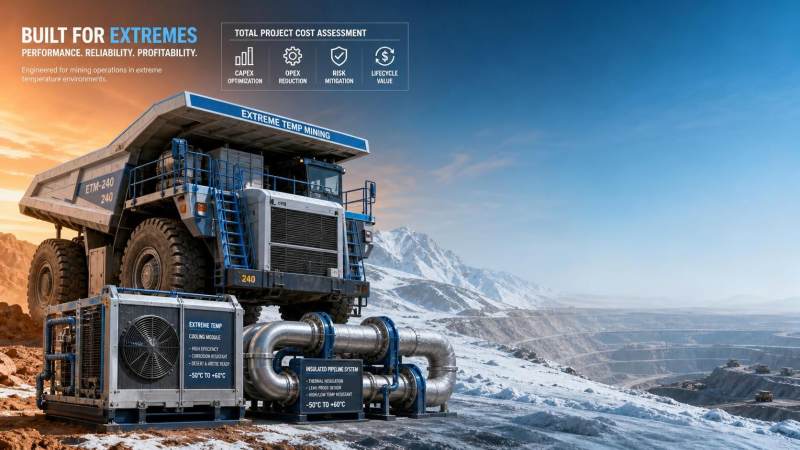
For procurement teams, understanding extreme temperature mining solutions cost goes well beyond the sticker price on a truck, shovel, heating package, or cooling system. In very hot deserts, high-altitude cold regions, and freeze-thaw sites, cost leaks out through places that do not always show up cleanly in an RFQ: thermal derating, premature hose failure, lubricant change intervals, battery performance loss, operator cabin conditioning, slower maintenance access, and logistics for parts that cannot sit exposed on site. If you are comparing suppliers for an extreme-climate mining project, the real question is not “Which unit is cheaper?” It is “Which configuration will still deliver production without forcing us into hidden support spend six months later?”
That is the frame procurement should keep. Headline capex matters, but total project spend is usually shaped by how the machine, support package, and service model behave under thermal stress. The checklist below is written from that angle.
Start with the climate envelope, not the machine brochure
A common buying mistake is to ask for a quote on a standard mining platform and add “extreme temperature package” as a line item. That is backwards. Procurement needs a verified operating envelope first: expected ambient highs and lows, duration of temperature extremes, altitude, humidity, dust loading, solar radiation, freeze-thaw frequency, and whether equipment will cold-soak overnight. Without that, vendors price assumptions, not a solution.
Ask suppliers to state clearly what performance limitations apply at the quoted temperature range. In hot environments, that may mean engine derating, hydraulic oil temperature limits, or reduced air-conditioning effectiveness. In cold environments, it may mean extended warm-up time, restrictions on starting below a certain threshold, or mandatory preheating. If the supplier cannot put those limits in writing, procurement should treat the quote as incomplete.
Check what is actually included in the thermal package
“Arctic kit,” “desert package,” and similar labels sound useful, but they hide a lot of variation. One vendor may include coolant heaters, battery warmers, insulation, low-temperature seals, and wiring protection. Another may include only a block heater and different fluids. The gap can be large, and it will show up later as retrofit cost or unplanned downtime.
- Cold-region packages: engine preheaters, hydraulic oil heating, fuel heating, low-temperature elastomers, insulated enclosures, window defrost performance, cold-start battery provisions, and material toughness for structural components.
- Hot-region packages: enlarged cooling packs, dust-resistant radiator design, fan control logic, high-temperature hoses and seals, cabin cooling performance, sun shielding for electronic enclosures, and fire risk mitigation around hot surfaces.
- Electrical systems: cable routing, connector sealing, and sensor protection are often overlooked and often expensive when they fail.
Get a component-level inclusion list. That single step usually makes bid comparisons more honest.
Watch the materials and sealing details
Extreme temperature mining solutions cost is heavily influenced by materials, and this is where low bids can become expensive. Seals, hoses, harness jackets, bearings, glazing, insulation, and hydraulic components all age differently in heat and cold. A hose compound that works well in temperate conditions may harden and crack in severe cold. In sustained heat, the issue shifts toward accelerated degradation, leakage, and pressure instability.
Procurement does not need to micromanage engineering, but it should request the material basis for critical wear items and ask whether service intervals are different under the specified climate envelope. If the supplier quotes a premium package yet keeps the same maintenance assumptions as a standard unit, that deserves scrutiny.
Fuel, power, and idle strategy can outweigh the option price
Teams often negotiate hard on package cost and then lose much more on operating energy. In cold sites, engines may idle longer to maintain temperature, auxiliary heaters add load, and cold starts can increase wear. In hot sites, cooling fans and HVAC systems draw more power, and reduced efficiency under thermal load can increase fuel burn. For diesel fleets, ask vendors for documented operating assumptions behind their consumption estimates. For electric or hybrid systems, ask how battery performance changes across temperature bands and whether thermal management cuts into usable energy or charging speed. If no site-matched duty cycle is available, mark the estimate as 【待核实】 and avoid building a business case on optimistic numbers.
This is especially important for mining dump trucks and support fleets. On paper, a cheaper unit may look attractive. In practice, a machine that burns more fuel during long thermal stabilization periods can erase that advantage fast.
Do not separate maintenance cost from climate engineering
Maintenance spend in extreme environments is rarely just “routine service.” It is access time, technician exposure limits, warm storage for parts and tools, contamination control, and the simple fact that some tasks take longer when crews are working in heavy PPE or during short weather windows.
Ask suppliers these practical questions:
- Which maintenance points were redesigned specifically for hot or cold access?
- Are filters, sensors, hoses, and seals interchangeable with the standard fleet, or are they site-specific parts?
- What is the lead time for extreme-climate spares, and where are they stocked?
- Will warranty coverage change if local fluids or substitutes are used due to supply constraints?
If the answer to the spare-parts question is vague, add contingency cost. Remote mines do not suffer from expensive parts alone; they suffer from waiting.
Site logistics deserve a line in the cost model
Extreme conditions change logistics in quiet but expensive ways. Cold-sensitive components may require protected shipping and storage. Fluids may need temperature-controlled handling. Some modules cannot be installed reliably in open weather. In very hot regions, electronics and rubber parts can degrade in staging yards before commissioning even begins.
This matters for imported equipment, especially when customs clearance, inland transport, and remote site delivery add weeks. Procurement should ask whether the quoted solution assumes enclosed storage, powered laydown areas, or temporary workshop infrastructure. If those requirements are real, they belong in total project spend, not in an afterthought budget held by operations.
Operator conditions are a cost issue, not a comfort issue
Procurement teams sometimes underrate cabin climate control, visibility management, and human-machine interface reliability in extreme weather. That is a mistake. Poor defrost performance, weak HVAC capacity, or screens that respond poorly in temperature extremes reduce usable shift time and can increase safety risk. If an operator cannot see properly, cannot stay alert, or keeps stopping to manage fogging, heat stress, or freezing conditions, productivity drops before maintenance even enters the picture.
Make suppliers explain the cabin package in operational terms: pull-down time in high heat, defrost capability in cold starts, filtration in dusty hot regions, and reliability of displays and controls under thermal cycling. Where local rules or project standards apply, procurement should verify the exact requirement rather than assume a generic package is compliant【待核实】.
Look hard at uptime guarantees and warranty exclusions
The most misleading procurement comparison is a low purchase price paired with a weak support contract. Extreme-climate failures often trigger disputes around “operating outside recommended conditions,” contaminated fluids, improper warm-up, dust ingress, or poor storage practices. Read the exclusions carefully.
If a supplier offers guaranteed availability, ask what climate assumptions, maintenance staffing levels, and spare-parts stocking rules sit behind that number. Otherwise the guarantee is more marketing than contract protection.
Regional standards and approvals should be verified early
For multinational procurement, compliance gaps can create direct cost through redesign, delay, or import hold-ups. Depending on market and application, you may need to review emission requirements, electrical conformity, safety systems, fire suppression expectations, operator protection, and mine-site specific owner standards. The exact combination varies too much by jurisdiction to generalize safely, so treat all claimed compliance items as document-check matters, not brochure claims.
A practical move is to require the supplier to submit a compliance matrix against project requirements during bid evaluation. That pushes hidden exceptions into daylight before award.
Compare suppliers on scenario cost, not unit cost
When buyers evaluate extreme temperature mining solutions cost, they should run at least three scenarios: expected operating conditions, seasonal worst case, and recovery after a failure event. The third scenario is where many budgets break. What does it cost if a critical cooling component fails during peak summer? What happens if a hydraulic system cannot start after a cold soak? How quickly can the supplier restore production, and what temporary measures are available?
This is also where suppliers with stronger intelligence support can stand out. For sectors covered by TF-Strategy, especially open-pit mining and heavy haulage, the useful vendors are usually the ones that can tie physical parameters, site method, and service planning together instead of quoting isolated hardware. Procurement should reward that depth. It usually reduces surprises later.
What to pin down before signing
- The exact ambient temperature range and altitude assumed in the offer.
- All included thermal package components, by part or subsystem.
- Any derating, warm-up time, charging limitation, or idle requirement tied to climate.
- Maintenance interval changes under extreme conditions.
- Spare-parts lead times and stocking location for climate-specific items.
- Warranty language for operation, storage, fluids, and startup procedure.
- Site infrastructure assumed by the supplier for storage, preheating, cooling, or sheltered maintenance.
If those points are still fuzzy at contract stage, the quoted number is not yet your total project spend. It is only an entry ticket.
For procurement teams, the cleanest way to control extreme temperature mining solutions cost is to force clarity early: define the climate envelope, compare thermal packages line by line, attach maintenance and logistics to the buying decision, and test every supplier promise against a realistic operating scenario. That approach does not make the project cheap. It makes the budget more real, which is usually the difference that matters.
Related News
 Oct 25, 2026Comparing Industrial Equipment Suppliers: Lead Times, Warranties, and ServiceMake a smarter industrial equipment supplier comparison. Explore lead times, warranty coverage, and service support to reduce downtime risk and choose with confidence.
 Oct 24, 2026Choosing Lifting Equipment for Middle East Petrochemical Plants in Hazardous AreasExplore petrochemical lifting equipment Middle East plants can rely on. Compare hazardous-area certification, capacity, and heat limits to make informed procurement decisions.
 Oct 23, 2026Selecting Lifting Equipment for Nuclear Component Transport: Key Safety CriteriaSelecting lifting machinery for nuclear component transport? Discover essential safety criteria, load control checks, and supplier requirements to guide confident procurement.
 Oct 22, 2026Tunnel Boring Machines in Southeast Asia: EPB vs. Slurry for Soft GroundCompare tunnel boring machines Southeast Asia projects rely on: EPB vs. slurry for soft ground. Discover how groundwater, settlement risks, and spoil handling shape the right choice.

Ms. Elena Rodriguez
Weekly Insights
Stay ahead with our curated technology reports delivered every Monday.