
Heavy Equipment Components Selection Guide: Wear Parts, Hydraulics, and Frame Basics
Heavy Equipment Components Selection Guide: Wear Parts, Hydraulics, and Frame Basics
Selecting the right heavy equipment components directly affects uptime, safety, and total operating cost.
That is especially true in mining, tunneling, road building, and heavy lifting.
A poor match rarely fails in one obvious way.
More often, the damage spreads across wear rates, hydraulic efficiency, structural fatigue, and maintenance intervals.
This is why heavy equipment components should never be evaluated as isolated parts.
A practical selection process compares application severity, machine duty cycle, material quality, and service access together.
Why component selection starts with the operating profile
Before comparing brands or part numbers, define the actual working environment.
Heavy equipment components behave differently in abrasive ore, fractured rock, wet clay, or high-altitude haul routes.
The same bucket tooth or cylinder seal can deliver very different life under different loads.
From a selection perspective, four inputs matter most:
- Duty cycle intensity and average daily operating hours
- Impact level, abrasion level, and contamination exposure
- Temperature range, altitude, and moisture conditions
- Maintenance skill level and parts replacement window
This first step keeps heavy equipment components aligned with real field conditions, not brochure performance.
It also makes later trade-offs easier when budget, lead time, and reliability start competing.
Wear parts: balancing hardness, toughness, and replacement economics
Wear parts are often the fastest-moving category among heavy equipment components.
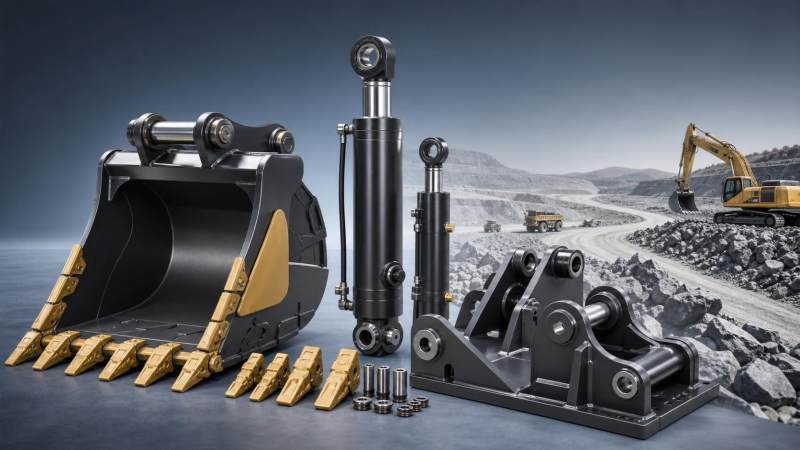
They include cutter tools, bucket teeth, lip shrouds, side cutters, liners, blades, and wear plates.
The main mistake is choosing only by initial hardness.
High hardness helps in sliding abrasion, but impact-heavy work needs toughness and crack resistance too.
In open-pit excavation, material chemistry and section thickness often matter as much as nominal hardness.
What to compare in wear part selection
- Base material type, heat treatment consistency, and hardness range
- Impact resistance under shock loading and edge retention under abrasion
- Mass distribution, penetration profile, and fuel efficiency effect
- Locking method, change-out time, and field safety during replacement
- Availability of matched systems rather than mixed, unverified parts
In tunneling, cutter consumption should be read together with geology variation and intervention frequency.
In mining, tooth profile influences breakout force, fill factor, and downstream loading rhythm.
That means the best heavy equipment components are not always the longest-lasting ones.
Sometimes the better choice is the part that reduces change-out time and protects the parent structure.
Hydraulic components: where efficiency and reliability meet
Hydraulic systems sit at the center of machine response, force delivery, and controllability.
When evaluating heavy equipment components, hydraulics deserve careful attention because small mismatches escalate quickly.
A pump, valve, hose, seal, and cylinder must work as one system.
If one part has the wrong pressure class or contamination tolerance, reliability drops across the circuit.
Core hydraulic checks
- Rated pressure, peak pressure, flow demand, and control accuracy
- Seal compatibility with oil type, temperature, and contamination levels
- Filtration rating, cleanliness targets, and maintenance access points
- Cylinder rod coating, corrosion resistance, and side-load tolerance
- Hose routing, bend radius, impulse life, and connection reliability
Recent equipment trends make this even more important.
Higher automation levels demand stable hydraulic behavior for smooth motion and accurate load control.
In crawler cranes and large excavators, hydraulic drift or overheating can become both a performance issue and a safety issue.
This is why selection should include contamination management, not only component size.
The most cost-effective heavy equipment components often come from cleaner systems and better service discipline.
Frame basics: structural integrity is a selection issue, not just a design issue
Frames, booms, car bodies, undercarriage structures, and attachment interfaces form the machine’s load path.
These heavy equipment components determine how forces move, concentrate, and dissipate over time.
That matters in repetitive digging, tunnel boring support, and heavy lift duty alike.
A frame may appear oversized on paper and still fail early if weld details or stress transitions are poor.
Structural points worth reviewing
- Material grade, plate thickness strategy, and fatigue design margin
- Weld process quality, heat-affected zones, and inspection records
- Stress concentration around pins, joints, brackets, and corners
- Compatibility with attachments, payload changes, and operating radius
- Repairability in the field and traceability of structural modifications
Frame selection also connects directly to lifecycle planning.
A slightly stronger structure may reduce cracking, alignment drift, and secondary wear in adjacent systems.
That broader value is easy to miss when heavy equipment components are compared line by line only on purchase price.
A practical comparison table for heavy equipment components
How to make better decisions across suppliers
Supplier comparison works better when the scoring model reflects operational reality.
In actual procurement reviews, heavy equipment components should be rated across at least five dimensions.
- Performance fit under the exact duty cycle
- Lifecycle cost rather than purchase cost alone
- Consistency of manufacturing and quality records
- Lead time, local support, and replacement speed
- Failure transparency and engineering feedback capability
This is also where strategic market insight becomes useful.
Supply stability, raw material shifts, and regional service capacity now influence component decisions more than before.
For critical heavy equipment components, a slightly higher unit price may be justified by predictable support.
That is especially relevant in remote mines, tunnel drives, and mega-lift projects where downtime costs escalate fast.
Final selection checklist
A solid decision on heavy equipment components usually comes down to disciplined filtering.
- Define the operating profile before reviewing any quote
- Check wear parts for both durability and parent structure protection
- Review hydraulics as an integrated cleanliness-sensitive system
- Validate frame integrity through fatigue logic and repair history
- Compare lifecycle value, support depth, and replacement risk together
When these steps are followed, component selection becomes more consistent and far less reactive.
That is the real advantage in modern infrastructure and resource projects.
Reliable heavy equipment components support safer operations, steadier output, and better capital efficiency.
Use this framework to narrow options, question assumptions, and make decisions with stronger technical confidence.
Related News
 Sep 22, 2026How to Evaluate a High-Altitude Mining Solutions Manufacturer for Remote ProjectsEvaluate a high-altitude mining solutions manufacturer with proven derating, cooling, service logistics, and lifecycle-cost support for remote projects.
 Sep 21, 2026Industrial Supplier Evaluation: A Risk-Based Scorecard for Quality, Capacity, and DeliveryIndustrial supplier evaluation made practical: use a risk-based scorecard to assess quality, capacity, and delivery reliability, reduce project risk, and select suppliers with confidence.
 Sep 20, 2026Comparing Heavy Equipment Warranty Suppliers: Coverage, Claims, and Downtime RiskSupplier comparison for heavy equipment warranty: evaluate coverage, claims speed, service networks, and downtime risk to protect uptime and project costs.
 Sep 19, 2026Mining Truck Technology Trends: What Fleet Managers Should Prioritize for 2026Mining truck technology trends for 2026: prioritize electrification, autonomy, predictive maintenance, and road intelligence to improve fleet uptime, safety, and cost control.

Ms. Elena Rodriguez
Weekly Insights
Stay ahead with our curated technology reports delivered every Monday.