
Industrial Equipment Comparison: Which Metrics Matter Most for Capex Decisions?
Industrial Equipment Comparison: Which Metrics Matter Most for Capex Decisions?
In any industrial equipment comparison, headline specs rarely tell the full financial story.
A bigger engine, longer boom, or higher throughput may look attractive at first glance.
But capital decisions in heavy industry live or die on lifecycle economics.
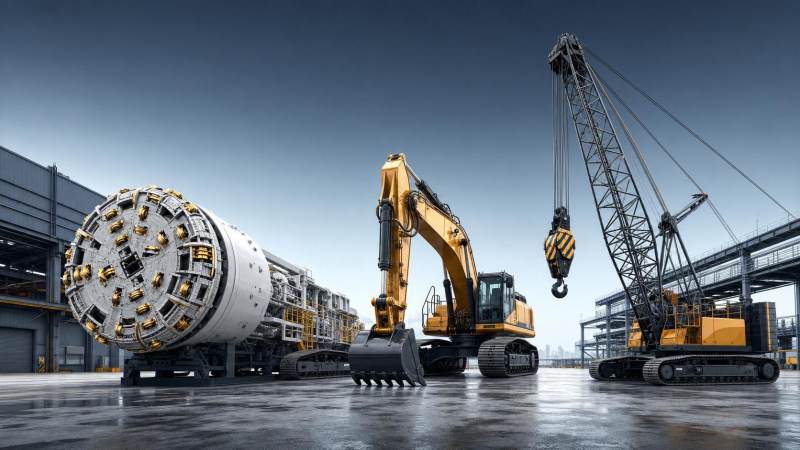
That is especially true for TBMs, mining excavators, crawler cranes, road machinery, and dump trucks.
These assets shape project timing, operating risk, maintenance load, and residual value for years.
A strong industrial equipment comparison should therefore connect technical performance with financial outcomes.
The goal is not simply to buy the most capable machine.
The goal is to buy the right capacity, at the right utilization level, with the lowest avoidable risk.
Why industrial equipment comparison must start with business context
Before reviewing metrics, define the project environment and revenue logic.
A machine that wins on one site can underperform badly on another.
For example, a crawler crane for offshore wind has different economic drivers than one serving petrochemical work.
Likewise, a mining truck in high altitude conditions faces different payload efficiency and maintenance stress.
In practice, the best industrial equipment comparison begins with five framing questions.
- What utilization rate is realistic across the asset’s full working life?
- What project delays would this equipment help prevent or possibly create?
- How sensitive is project margin to uptime, fuel, and labor efficiency?
- Will the asset retain value across multiple job types or regions?
- What technical risks become financial risks after purchase approval?
Once these answers are clear, equipment metrics become much easier to rank.
The core metrics that matter most for Capex decisions
Not every specification belongs in the final approval memo.
The most useful industrial equipment comparison focuses on a smaller set of financially meaningful indicators.
1. Total cost of ownership
TCO is often the most important metric in any industrial equipment comparison.
It combines purchase price with fuel, energy, wear parts, labor, planned service, and major component replacement.
For TBMs, cutter consumption and maintenance intervals can materially shift the economics.
For mining fleets, tire life, haul distance, and energy use may outweigh the initial discount.
A lower upfront price means little if ownership costs rise steadily after commissioning.
2. Utilization-adjusted productivity
Nameplate capacity is useful, but billable output is better.
Measure tons per hour, meters per day, lifts per shift, or paving output against expected utilization.
This is where industrial equipment comparison becomes practical.
A machine with slightly lower peak output may deliver higher annual productivity if downtime is lower.
That difference often matters more than brochure performance.
3. Uptime and mean time between failures
Reliability metrics deserve direct visibility in capital reviews.
Unplanned downtime affects schedule certainty, labor efficiency, and liquidated damage exposure.
In lifting and tunneling, even short failures can disrupt whole work fronts.
A good industrial equipment comparison should convert uptime into revenue protection and schedule resilience.
4. Maintenance intensity and parts availability
Service complexity is often underestimated during procurement.
Look closely at technician skill requirements, parts lead time, local support coverage, and rebuild cycles.
This matters even more in remote mines, cross-border projects, and politically sensitive logistics corridors.
If parts are slow or proprietary, equipment risk can quickly become financial risk.
5. Residual value and redeployment potential
Capex decisions improve when exit value is considered early.
Some machines keep strong secondary market demand because they fit many applications.
Others are highly specialized and difficult to redeploy without discounts.
A complete industrial equipment comparison should reflect both resale value and internal transfer flexibility.
How to compare metrics across heavy equipment categories
One common mistake is using the same metric weight for every asset type.
A more useful industrial equipment comparison adjusts emphasis by mission profile.
This kind of industrial equipment comparison keeps technical reviews tied to value creation.
Red flags that distort procurement decisions
Several buying habits repeatedly weaken Capex discipline.
The first is overvaluing acquisition price while underweighting operating volatility.
The second is using vendor assumptions that do not match actual site conditions.
A third is assuming full utilization for assets that will work only intermittently.
Another common issue is ignoring operator learning curves and support response times.
- Do not compare machines without a standardized duty cycle.
- Do not treat peak performance as normal performance.
- Do not separate technical approval from lifecycle cost modeling.
- Do not ignore local service infrastructure and parts access.
A disciplined industrial equipment comparison should challenge optimistic assumptions before approval, not after delivery.
A practical framework for better approval decisions
A workable review process does not need to be overly complex.
It simply needs to translate engineering detail into decision clarity.
- Define the operating scenario, utilization range, and project duration.
- Build a like-for-like industrial equipment comparison using identical duty assumptions.
- Model TCO under base, upside, and stress-case conditions.
- Score uptime, service support, and parts resilience separately.
- Estimate residual value and redeployment options before final sign-off.
- Link the final recommendation to cost per output and schedule impact.
This approach creates a more balanced industrial equipment comparison.
It also helps separate strategic assets from purchases driven by short-term pressure.
From a long-term perspective, that distinction protects both cash flow and execution quality.
Final takeaway
The best industrial equipment comparison is not the one with the most data.
It is the one that makes capital risk easier to see.
When TCO, uptime, utilization-adjusted productivity, maintenance intensity, and residual value are reviewed together, approvals improve.
That matters across every heavy industry category followed by TF-Strategy.
In mining, tunneling, lifting, and road building, the wrong metric focus can lock in years of avoidable cost.
The right metric focus turns industrial equipment comparison into a practical investment tool.
Use that framework early, test assumptions hard, and approve equipment only when performance clearly supports lifecycle value.
Related News
 Sep 22, 2026How to Evaluate a High-Altitude Mining Solutions Manufacturer for Remote ProjectsEvaluate a high-altitude mining solutions manufacturer with proven derating, cooling, service logistics, and lifecycle-cost support for remote projects.
 Sep 21, 2026Industrial Supplier Evaluation: A Risk-Based Scorecard for Quality, Capacity, and DeliveryIndustrial supplier evaluation made practical: use a risk-based scorecard to assess quality, capacity, and delivery reliability, reduce project risk, and select suppliers with confidence.
 Sep 20, 2026Comparing Heavy Equipment Warranty Suppliers: Coverage, Claims, and Downtime RiskSupplier comparison for heavy equipment warranty: evaluate coverage, claims speed, service networks, and downtime risk to protect uptime and project costs.
 Sep 19, 2026Mining Truck Technology Trends: What Fleet Managers Should Prioritize for 2026Mining truck technology trends for 2026: prioritize electrification, autonomy, predictive maintenance, and road intelligence to improve fleet uptime, safety, and cost control.


Ms. Elena Rodriguez
Weekly Insights
Stay ahead with our curated technology reports delivered every Monday.