
Heavy Equipment in North America: Buying Factors, Lead Times, and Dealer Support Compared
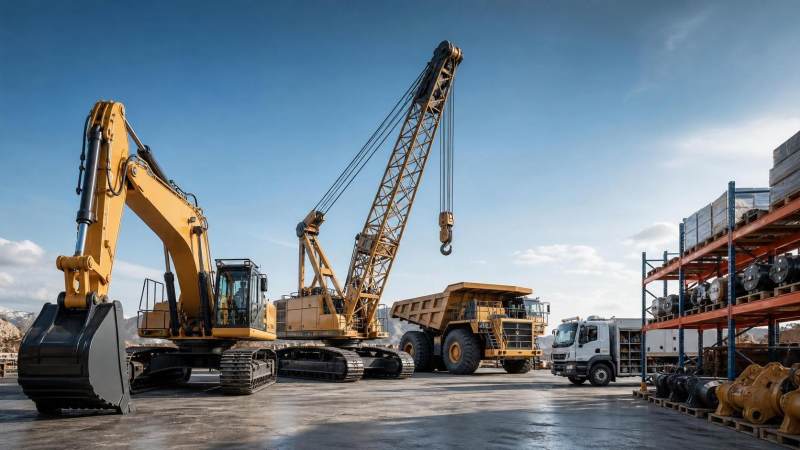
Heavy Equipment in North America: Buying Factors, Lead Times, and Dealer Support Compared
For business evaluators comparing heavy equipment North America markets, the real advantage lies beyond headline pricing.
Buying factors, delivery lead times, and dealer support often shape uptime, financing risk, and project execution more than the initial quote.
That is especially true in mining, tunneling, lifting, and road construction, where delays quickly become expensive.
In the heavy equipment North America landscape, buyers usually compare three things at once.
First is machine capability. Second is delivery certainty. Third is the dealer network standing behind the asset after commissioning.
A lower purchase price can look attractive early, but weak parts coverage or unstable lead times may erase that benefit later.
This article breaks down the key decision points and shows how regional conditions across North America affect procurement outcomes.
Why the Heavy Equipment North America Market Requires a Different Buying Lens
North America is not one uniform equipment market.
The United States, Canada, and Mexico each present different import flows, emissions rules, labor conditions, and aftersales expectations.
That changes how heavy equipment North America buyers should score suppliers.
For example, a mining fleet in Alberta values cold-weather reliability and field service reach.
A tunnel project in the eastern United States may prioritize engineering support, permitting alignment, and spare parts predictability.
A port or industrial lifting job near Mexico may focus more on import timing and technician availability.
The practical point is simple.
A machine that fits the brochure may still be the wrong commercial choice if the surrounding support model does not match the project environment.
Core Buying Factors Beyond Sticker Price
Most procurement reviews begin with price, but that should only be the opening filter.
In heavy equipment North America decisions, the more durable comparison usually includes six buying factors.
- Application fit: payload, reach, breakout force, ground pressure, fuel burn, and duty cycle suitability.
- Compliance fit: Tier 4, OSHA, transport width, axle load, and regional safety requirements.
- Operating cost: fuel, wear parts, tires or undercarriage, and technician hours.
- Parts availability: local stock, central warehouse access, and expected fill rate.
- Digital support: telematics, remote diagnostics, and data integration with fleet systems.
- Residual value: resale strength, secondary market demand, and brand acceptance.
From a cost perspective, total cost of ownership matters more than unit acquisition price.
That is especially visible for excavators, cranes, dump trucks, and road machinery running under long shifts.
A cheaper machine with higher downtime risk can become the most expensive option on the board.
Lead Times: The Hidden Driver of Project Risk
Lead time volatility has become one of the biggest issues in heavy equipment North America sourcing.
Even when supply chains have stabilized, specialized models still face long production queues and shipping uncertainty.
This is common with ultra-large excavators, crawler cranes, mining trucks, and engineered tunnel systems.
Lead time should be assessed in layers, not as one single date.
- Factory slot confirmation.
- Component readiness for engines, hydraulics, controls, and structures.
- Port handling or inland transport scheduling.
- Site assembly, testing, and operator handover.
In real procurement work, two suppliers can quote similar delivery windows while carrying very different execution risk.
One may hold secured production slots. Another may still depend on upstream allocations.
That difference matters because project liquidated damages, idle crews, and temporary rental coverage can quickly exceed the equipment discount.
For heavy equipment North America buyers, the useful question is not only “when can it ship?”
The better question is “which milestones are contractually protected, and which remain estimated?”
Dealer Support Often Decides the Real Winner
Dealer support is often underestimated during early comparison rounds.
Yet in the heavy equipment North America market, dealer performance can define uptime more than factory branding.
A strong dealer usually brings faster parts response, better field diagnostics, trained technicians, and more realistic maintenance planning.
That becomes critical for remote mines, large civil projects, and high-utilization fleets.
When comparing dealer support, focus on evidence instead of general promises.
- Branch density near operating regions.
- Emergency response time commitments.
- Critical spare parts stocking lists.
- Availability of loaner units or temporary backup.
- Technician certification on the exact platform.
- Remote monitoring and preventive alerts.
A dealer that supports standard machines well may still struggle with niche, high-capacity equipment.
This is where reference checks become valuable.
Ask how the dealer handled actual outages, not just planned maintenance visits.
Regional Differences Across North America
The heavy equipment North America market behaves differently by region, and those differences affect sourcing strategy.
United States
The United States generally offers the broadest dealer coverage and strongest used-equipment liquidity.
Buyers often gain more financing options and faster access to common models.
However, customized machines may still face long waits, especially in energy and infrastructure segments.
Canada
Canada often places more pressure on cold-weather durability, remote support, and logistics planning.
Dealer distance matters more, and freight costs can materially change lifecycle economics.
For mining and resource projects, field service depth is often decisive.
Mexico
Mexico can offer strategic manufacturing proximity and useful cross-border supply advantages.
At the same time, buyers may need closer attention to customs timing, local service readiness, and parts flow discipline.
For some categories, the value case is strong, but support mapping must be done carefully.
How to Compare Suppliers in a Practical Way
A useful heavy equipment North America evaluation model should combine commercial, technical, and operational criteria.
This kind of scorecard helps remove bias from brand familiarity.
It also makes internal approvals easier, because tradeoffs become visible and defensible.
Common Procurement Mistakes to Avoid
Several mistakes appear repeatedly in heavy equipment North America buying decisions.
- Comparing base prices without normalizing attachments, transport, training, and commissioning.
- Accepting broad delivery promises without milestone detail.
- Treating dealer support as identical across brands or regions.
- Ignoring parts lead times for high-wear components.
- Overlooking residual value when calculating lifecycle cost.
These issues are avoidable with tighter bid templates and stronger supplier questioning.
More importantly, they help separate a low quote from a low-risk solution.
Final Decision Framework
The best heavy equipment North America purchase is rarely the cheapest machine on paper.
It is usually the option that balances application fit, dependable lead times, and proven dealer support.
For high-value assets, that balance directly affects schedule protection, operating margin, and asset longevity.
A disciplined review should test three final questions.
- Can this supplier deliver on a timeline that is contractually credible?
- Can the dealer keep the machine productive in the real operating region?
- Does the full cost model still work after maintenance, downtime, and resale are included?
When those answers are clear, procurement decisions become more stable and easier to defend internally.
In a market where timing and support can outweigh list price, that clarity is where the strongest buying advantage usually begins.
Related News
 Oct 03, 2026How to Assess TBM Manufacturers for Hard-Rock Tunneling Projects?Choose the right tunnel boring machine manufacturer for hard-rock projects. Explore key criteria for design, lifecycle cost, factory quality, and service support.
 Oct 02, 2026How to Evaluate Heavy Equipment Technology Suppliers for Fleet Uptime and SupportHeavy equipment technology suppliers can make or break fleet uptime. Learn how to assess diagnostics, data access, parts, service coverage, and support terms before you buy.
 Oct 01, 2026How to Use Technical References to Benchmark Industrial Equipment PricesIndustrial equipment technical reference pricing: learn how to normalize specifications, scope, service life, and operating costs to benchmark quotes accurately and choose the best-value equipment.
 Sep 30, 2026What Does an Ultra-Large Excavator Really Cost Over Its Service Life?Ultra-large excavators cost far more than purchase price. Explore lifecycle expenses, uptime risks, energy use, maintenance, and cost-per-tonne insights.
Ms. Elena Rodriguez
Weekly Insights
Stay ahead with our curated technology reports delivered every Monday.