
How Long Does It Take to Deliver a Large TBM to a Remote Project Site?
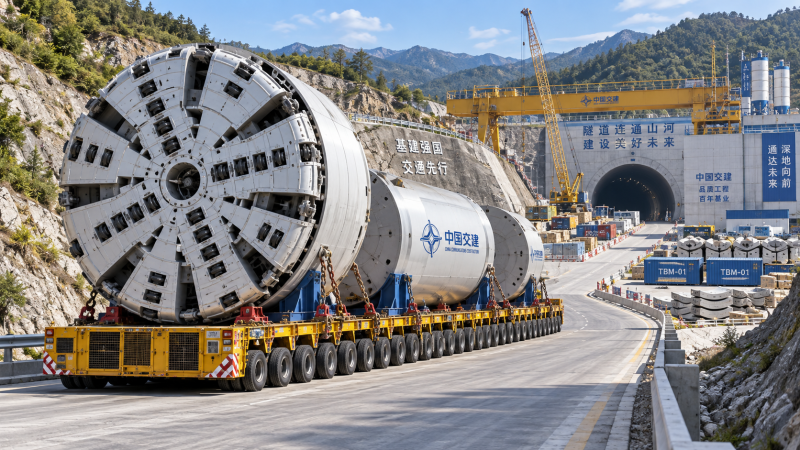
A large tunnel boring machine is rarely “delivered” in the way conventional construction equipment is delivered. For a remote project, the period from confirmed machine configuration to a complete TBM being available for assembly at the launch site can range from several months to well over a year. The transport movement itself may occupy only a portion of that period. Route engineering, dismantling strategy, port handling, permits, border formalities, road strengthening, seasonal access, and site readiness often determine the real schedule.
A practical planning assumption is that a cross-border delivery of a large TBM to an accessible site may require roughly six to nine months after the machine is ready for dispatch. A remote mountain, island, high-altitude, or poorly connected site can require nine to eighteen months or longer when enabling works must be completed before the largest loads can move. These are planning ranges rather than delivery guarantees: a machine designed for one transport concept can face a very different schedule if the final access route changes.
What does “delivery” mean for a TBM?
The first source of confusion is the delivery milestone. A TBM may be described as delivered when it leaves the manufacturer’s works, arrives at the destination port, crosses the project boundary, reaches the assembly chamber, or completes commissioning underground. Those dates can be separated by months.
For project scheduling, the more useful milestone is usually all critical TBM components available at the assembly location, inspected, and released for erection. A cutterhead at the port does not help if the main drive, shield sections, trailing gear, conveyors, transformers, and handling equipment remain in transit. Nor is physical arrival sufficient if the launch chamber cannot accept the components or the erection crane is unavailable.
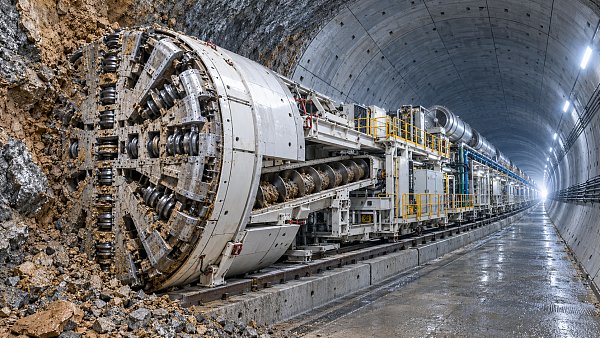
Large hard-rock and mixed-ground TBMs are normally broken down into transportable modules. The cutterhead may be separated into sectors; the shield is divided into rings or major sections; the main bearing and drive unit may travel independently; backup gantries are shipped in modules; and ancillary systems move in containers, flat racks, breakbulk cargo, or specialized heavy-lift arrangements. The machine’s total weight matters, but the dimensions and mass of the heaviest single lift often govern logistics feasibility.
How much time does each stage take?
There is no standard calendar because machine diameter, geological configuration, supplier location, country of import, and site access conditions vary substantially. Still, the sequence below shows why distance alone is a poor predictor.
The critical point is that these stages do not all run in sequence. Customs preparation can begin while cargo is being packed; route strengthening can proceed while the vessel is at sea; assembly crews can mobilize before the final shipment arrives. Good planning compresses the schedule by managing these interfaces. Poor planning creates waiting time between them.
Why remote access changes the calculation
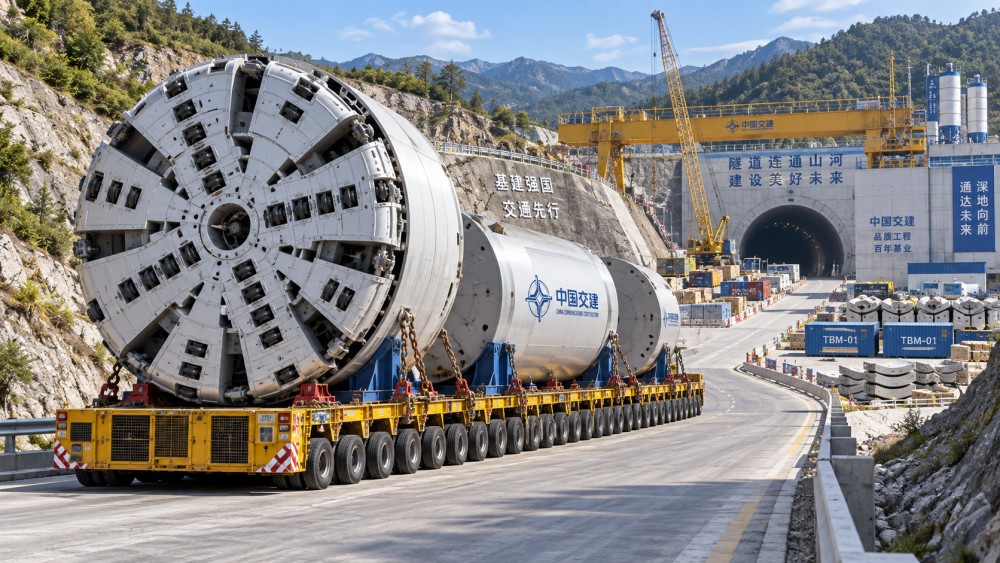
A remote site is not defined simply by its distance from a seaport. It is defined by the weakest link between the port or rail terminal and the launch area. A relatively short route can be difficult if it includes a bridge with limited load capacity, a sharp village turn, a tunnel with restricted vertical clearance, an unstable mountain road, or a ferry that cannot accept the required axle configuration.
For a large TBM, logistics engineers focus on the transport envelope of each critical component: gross weight, axle load distribution, overall width, height, length, center of gravity, lifting points, and required handling orientation. A component that is manageable on a multi-axle modular trailer may still be impossible to move through a narrow switchback or across a lightly designed bridge. Dividing that component further may solve the route issue, but it affects manufacturing, packaging, site assembly time, lifting requirements, and sometimes the design of the machine itself.
Road improvement work can therefore become part of TBM procurement planning. This may involve temporary widening, removal and reinstatement of roadside furniture, reinforcement of culverts, construction of bypasses, utility relocation, or preparation of holding areas for abnormal-load convoys. Such work requires land access, local approvals, engineering validation, and a clear reinstatement obligation. It should not be treated as a minor transport contractor issue.
Mountain and high-latitude routes add an additional constraint: the calendar. Snow, heavy rainfall, flood exposure, freeze-thaw damage, wind restrictions for lifting, and seasonal road closures can narrow the movement window. If the heaviest component misses that window, the consequence may be measured in months rather than days.
Ocean freight is important, but it is not the whole answer
Large TBM shipments frequently use a combination of breakbulk, heavy-lift, roll-on/roll-off, and containerized transport. The right method depends on cargo dimensions, port infrastructure, lifting capacity, stowage requirements, cargo sequence, and destination access. Small electrical cabinets, spares, tools, and hydraulic equipment may move in standard containers, while shield segments, cutterhead elements, or major drive assemblies require project cargo handling.
The port choice should be evaluated as a logistics system, not selected solely because it is geographically closest. A nearer port may have inadequate berth depth, limited storage, insufficient crane capacity, restrictive gate dimensions, or poor heavy-haul connections. A more distant port with proven project-cargo capability and a workable inland route can produce a lower-risk schedule.
Port congestion is only one issue. Cargo can be delayed by unavailable shore cranes, restricted lifting windows, berth allocation, incomplete cargo documentation, or a mismatch between the vessel’s discharge method and the receiving port’s operating rules. When a shipment contains abnormal loads, the destination port should confirm in advance how each item will be discharged, marshalled, secured, inspected, and released to the inland carrier.
What documents can delay a TBM shipment?
Customs delays are often caused less by the size of the machine than by incomplete or inconsistent documentation. A TBM package can include thousands of parts across multiple consignments, with components manufactured in different countries and shipped from different locations. The commercial invoice, packing list, bill of lading, certificate of origin where required, insurance documents, import declarations, and technical descriptions must align.
Tariff classification deserves early attention. A complete tunnelling machine, spare parts, tooling, temporary equipment, and consumables may not receive identical treatment. Where the TBM is imported for a defined project and later re-exported, the availability and conditions of temporary admission procedures should be examined before shipment. The applicable rules depend on the importing jurisdiction, and the contract should make clear which party bears duties, taxes, broker costs, demurrage, and the consequences of documentary errors.
Wood packaging can also create avoidable problems. Where international phytosanitary requirements apply, timber dunnage, crates, and pallets need compliant treatment and marking. This is a small detail compared with a cutterhead shipment, but an inspection hold on improperly packaged material can disrupt the release sequence for equipment needed during erection.
Can a contractor shorten the delivery period by shipping in more pieces?
Sometimes, but not automatically. More segmentation reduces the size and weight of individual loads, which can ease road transport and lower route-upgrade requirements. Yet it also increases the number of lifts, packing operations, tracking points, customs entries, potential damage points, and assembly interfaces. It may require additional welding, bolting, alignment, inspection, and testing at the project site.
The appropriate question is not whether the machine can be split into smaller pieces. It is whether the transport savings exceed the added site complexity and schedule exposure. A remote site with limited crane capacity, restricted laydown space, or harsh weather may benefit from fewer, larger modules if the route can support them. A constrained mountain route may justify a more highly modular machine even though assembly takes longer.
Transport design also affects the startup sequence. The components needed to establish the erection area, lifting system, temporary power, and first stages of assembly should arrive in a controlled order. A shipment plan based only on freight efficiency can leave expensive equipment waiting because a small but essential auxiliary package is still at a transshipment port.
When should logistics planning begin?
For a remote TBM project, logistics planning should begin during machine specification, not after manufacture is complete. The transport route can influence maximum module dimensions, cutterhead configuration, backup train segmentation, lifting points, packaging design, and the type of site crane required. Once heavy structural components are fabricated, redesign becomes slower and more expensive.
A disciplined early review normally establishes the preliminary transport corridor, candidate ports, route constraints, critical component list, likely permits, border procedures, temporary storage needs, lifting capacity, and site-readiness milestones. It should also identify which assumptions must be verified by physical survey rather than desktop mapping. Satellite images and road data can be useful screening tools, but they do not confirm bridge condition, pavement bearing capacity, local turning geometry, utility clearances, or practical convoy management.
Which risks most often turn a reasonable schedule into a delay?
The most damaging risk is usually an untested assumption at an interface. A port operator may accept the vessel but not have a suitable discharge arrangement. A road authority may approve a route in principle but require structural checks before issuing a movement permit. The site may have a crane on the mobilization plan but lack the completed working platform needed to erect it. Customs papers may be prepared for the main machine while omitted ancillary equipment holds up commissioning.
Another recurring weakness is treating storage as neutral. TBM components can spend weeks in a port, bonded yard, or remote laydown area if site works slip. Long storage requires preservation measures suited to electrical systems, hydraulic equipment, bearings, machined surfaces, seals, and corrosion-sensitive components. Storage conditions, security, lifting access, inspection responsibility, and insurance transfer points should be defined before cargo lands.
Schedule contingency should be assigned to identifiable risks rather than added as an unexplained buffer. A route that depends on one seasonal mountain crossing needs a different contingency logic from a delivery through a major industrial port with multiple inland alternatives. The schedule should also distinguish between delays that can be recovered through parallel work and delays that block the first critical assembly operation.
How can project teams judge whether a delivery promise is credible?
A credible delivery plan identifies the largest transport units, names the proposed ports and inland corridors, states the required permits and their approval owners, and links cargo arrival dates to specific site-readiness conditions. It also provides a shipment sequence rather than one generic “delivery date.”
Warning signs include a plan that quotes only sailing time, assumes standard trucking for abnormal loads, leaves customs responsibility undefined, or treats the launch chamber and heavy-lift platform as details to resolve after cargo arrival. Another warning sign is a transport proposal that has not reconciled the TBM manufacturer’s module weights with the actual lifting and road constraints at the site.
For the question, “How long does it take to deliver a large TBM to a remote site?”, the most defensible answer is therefore not a single number. It is a schedule built around the heaviest modules, the weakest transport link, the import pathway, and the readiness of the assembly location. A machine can cross an ocean quickly and still be months away from productive tunnelling. Conversely, a longer physical route can be manageable when the transport concept, permits, ports, and site works have been engineered as one integrated delivery system.
Related News
 Oct 08, 2026How to Evaluate a Heavy Machinery Information Platform for Project Equipment SourcingHeavy machinery information platform guide: compare equipment fit, source reliability, lifecycle costs, supplier capability, and compliance to make smarter sourcing decisions.
 Oct 07, 2026How to Evaluate a Hydraulic System Component Supplier for Heavy Equipment UptimeChoose a hydraulic system component supplier with proven quality, technical fit, and reliable delivery to reduce heavy equipment downtime and lifecycle costs.
 Oct 06, 2026Selecting Petrochemical Overhead Cranes for Hazardous Areas and Heavy Process LoadsPetrochemical overhead cranes for hazardous areas: learn how to match capacity, duty, controls, corrosion protection, and maintenance access for safer, reliable lifts.
 Oct 05, 2026Tunneling Equipment Specification Planning: Key Criteria for Ground and Project RisksEquipment specification planning tunneling: learn how to match TBM systems to ground risks, geometry, safety, logistics, and lifecycle cost for more reliable project delivery.
Ms. Elena Rodriguez
Weekly Insights
Stay ahead with our curated technology reports delivered every Monday.