
How infrastructure construction delays raise costs
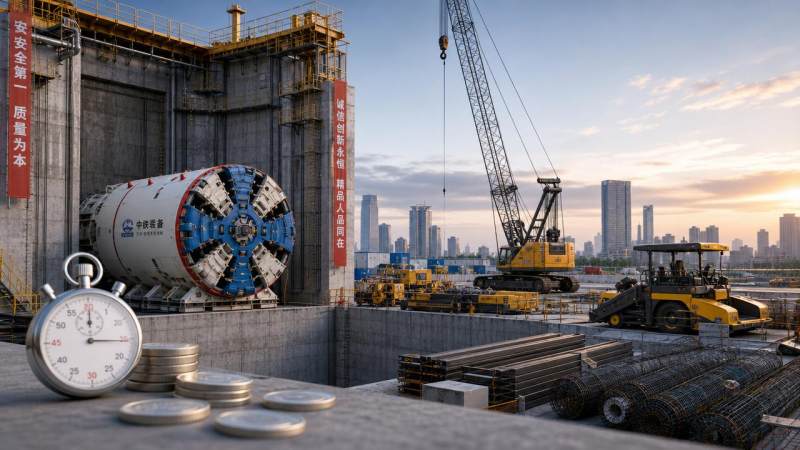
In infrastructure construction, delays rarely stay confined to the schedule—they rapidly escalate into higher equipment standby costs, labor inefficiencies, financing pressure, and contractual risks. For project managers overseeing TBM tunneling, open-pit development, heavy lifting, or roadworks, every postponed milestone can disrupt supply chains and weaken overall delivery performance. Understanding why delays occur and how they multiply costs is essential for protecting budgets, improving resource allocation, and keeping complex engineering programs commercially viable.
For engineering leaders, the issue is not only whether a project finishes 30, 60, or 120 days late. The deeper concern is how one delayed activity changes the economics of machines, crews, subcontractors, working capital, and risk allocation across the full delivery chain.
Why Delays in Infrastructure Construction Become Cost Multipliers
Infrastructure construction involves high-value assets, long procurement cycles, and tightly sequenced work fronts. When one segment slips, idle cost appears first, but secondary losses often become larger within 2–4 weeks.
The hidden economics behind a postponed milestone
A tunnel boring machine cannot simply be parked without consequence. Cutterhead inspection, slurry systems, ventilation, power supply, and standby crews continue to generate cost even when advance rate drops to zero.
The same logic applies to crawler cranes waiting for foundation readiness, ultra-large excavators delayed by blasting permits, or paving fleets held back by drainage works. Heavy equipment is priced around utilization, not patience.
- Daily equipment standby can include operators, fuel readiness, lubricants, inspection teams, and insurance exposure.
- A 10-day delay can trigger rescheduling penalties across 3–5 subcontract packages.
- Long-lead components, such as TBM cutter tools or crane rigging systems, may require 6–12 weeks for replacement procurement.
Project managers should treat time variance as a commercial variable. In infrastructure construction, lost float is often the first sign of future claims, acceleration costs, and supplier repricing.
Common cost channels created by construction delays
The following table shows how different delay sources translate into financial pressure. It is useful for monthly control meetings, contractor reviews, and early-warning dashboards.
The key conclusion is that delays rarely affect only one cost account. They move through equipment utilization, labor productivity, contract administration, and financing at the same time.
Equipment Standby and Utilization Losses in Heavy Engineering
Heavy machinery is one of the largest cost centers in infrastructure construction. A fleet plan that assumes 70%–85% utilization can become uneconomic when access, permits, or interfaces reduce productive hours.
TBM tunneling: when advance rate becomes cash flow
In tunnel projects, a TBM delay can affect segment logistics, muck haulage, grout supply, power infrastructure, and shaft operations. Even a 5-meter daily shortfall becomes significant over a 90-day drive.
If planned progress is 12 meters per day and actual progress falls to 8 meters, the project loses roughly 120 meters over 30 days. That gap can delay follow-on lining, track, MEP, or station interface works.
Open-pit and earthmoving operations: productivity depends on rhythm
Open-pit development depends on shovel-truck balance. When haul roads are not ready, drainage fails, or blasting approvals slip, ultra-large excavators and mining dump trucks lose cycle efficiency.
A haulage cycle extended from 18 minutes to 24 minutes may look manageable, but it can reduce daily moved volume by more than 20% if truck count and shift duration remain unchanged.
Practical utilization checks for project managers
- Review actual productive hours against planned hours every 7 days.
- Separate mechanical downtime from waiting time caused by site constraints.
- Track fuel burn per productive hour, not only total fuel consumption.
- Compare planned equipment allocation with actual work-front availability.
These checks help identify whether the project has a machinery problem, a sequencing problem, or a commercial problem hidden inside the daily progress report.
Labor, Subcontractor, and Supply Chain Inefficiencies
In infrastructure construction, labor cost escalates when crews cannot work in stable production zones. Workers may remain on payroll while waiting for designs, permits, materials, or predecessor activities.
The productivity penalty of fragmented work
A crew moved between 3 separate work fronts in one shift loses time in travel, toolbox meetings, equipment repositioning, and quality setup. The measured loss can exceed visible waiting time.
Subcontractors price their resources around predictable access. If civil works, mechanical installation, and commissioning overlap in a compressed area, overtime and rework may replace planned productivity.
Supply chain exposure in long-cycle equipment projects
TBM cutterhead components, specialized hydraulic assemblies, crawler crane attachments, and heavy-duty tires often involve long procurement cycles. A missed approval date can create a 4–10 week availability issue.
Project managers should map critical spares and imported components with the same discipline used for structural concrete or steel. Procurement float is a schedule asset, not an administrative detail.
The table below summarizes practical control points for labor and supply chain risk in large engineering programs.
These controls turn delay management from reaction into prevention. They also improve commercial evidence when extension-of-time claims or variation requests must be substantiated.
Financing, Contractual Exposure, and Claims Pressure
Delayed infrastructure construction affects finance because capital is tied to unfinished assets. Interest during construction, bond charges, insurance, and management overhead continue while revenue or public benefit is deferred.
Why time extensions do not always protect the budget
An approved time extension may protect against liquidated damages, but it does not automatically recover standby cost, escalation, or lost productivity. Contracts often separate entitlement from valuation.
For this reason, project teams need contemporaneous records. Daily logs, machine utilization reports, weather records, interface notices, and procurement correspondence should be aligned within 24–48 hours.
Typical commercial risks caused by delay
- Liquidated damages triggered after the contractual completion date, often calculated per day or per milestone.
- Price escalation on steel, fuel, power, explosives, cement, or specialty wear parts.
- Extended site overhead, including temporary facilities, supervision, testing, and safety teams.
- Disputes over concurrent delays when owner, contractor, and third-party causes overlap.
A 60-day delay on a billion-dollar transport, mining, or energy project can create multiple parallel claims. The strongest position belongs to the team that records cause, effect, and cost with discipline.
Documentation habits that reduce dispute risk
Good documentation is not paperwork for its own sake. It is the commercial memory of the project, especially when leadership changes or disputes are reviewed months later.
- Record delay events with date, location, responsible interface, and affected work package.
- Link each event to productivity data, such as meters bored, cubic meters moved, or lifts completed.
- Maintain separate cost codes for standby, acceleration, rework, and extended overhead.
- Issue notices within the contractual window, commonly 7, 14, or 28 days depending on agreement terms.
These steps do not eliminate delay, but they improve recovery options and support better negotiation with employers, partners, lenders, and insurers.
How Project Managers Can Reduce Delay-Driven Costs
Cost control in infrastructure construction starts before execution. The best results come from combining realistic planning, equipment intelligence, procurement visibility, and disciplined field feedback.
Build a delay-resilient baseline
A resilient baseline identifies critical path activities, near-critical paths, and resource constraints. For heavy engineering projects, it should include machinery mobilization, maintenance intervals, and spare-part availability.
A practical baseline should include at least 4 layers: civil sequence, equipment utilization, procurement lead time, and contractual notice requirements. Missing one layer weakens the whole control system.
Use intelligence to improve decisions before costs escalate
TF-Strategy focuses on the intelligence connection between heavy machinery parameters, construction methodology, and global infrastructure demand. This helps decision-makers compare risks before commitments become irreversible.
For example, a project team selecting between TBM configurations should examine geology, cutterhead wear behavior, segment logistics, and local support capability. The cheapest machine is not always the lowest-cost machine.
A 5-step control framework
- Identify the top 10 delay drivers during tender review and update them after site investigation.
- Assign cost ownership for equipment standby, subcontractor waiting time, and material expediting.
- Create weekly variance reports using physical quantities, not only percentage completion.
- Set trigger thresholds, such as 15% productivity loss or 5 days of critical float consumption.
- Review mitigation options every 2 weeks, including resequencing, additional shifts, or alternative suppliers.
This framework gives project managers a repeatable method for turning delay signals into operational decisions. It also supports transparent communication with owners and board-level stakeholders.
Procurement and Planning Criteria for High-Risk Projects
Procurement choices strongly influence delay exposure. In infrastructure construction, equipment selection should consider technical fit, delivery lead time, service access, energy demand, and lifecycle cost.
Selection standards beyond purchase price
A crawler crane with longer mobilization time may still be preferable if it reduces lift count by 20%. A mining truck fleet with better thermal performance may protect productivity at high altitude.
Similarly, large road machinery should be evaluated by paving continuity, compaction consistency, and maintenance support. A 2-day breakdown during asphalt works can waste material and disrupt traffic closure windows.
Procurement questions before contract award
- Can the supplier confirm lead times for the first unit, critical spares, and technical personnel?
- Is the equipment compatible with site power, climate, geology, haul gradients, or lift radius requirements?
- What maintenance tasks are required every 250, 500, or 1,000 operating hours?
- How quickly can field support respond during a critical stoppage: 24 hours, 48 hours, or longer?
These questions help project leaders compare total delivery risk rather than only initial procurement cost. That distinction is essential for complex machinery-intensive projects.
Common Mistakes That Increase Delay Costs
Many delay costs are preventable. They grow when teams underestimate interfaces, overtrust optimistic schedules, or treat machinery as a fixed resource instead of a dynamic cost driver.
Mistake 1: measuring progress without measuring productivity
A report showing 45% completion may hide declining daily output. Project managers should track quantities per shift, machine hours per unit, and crew output against planned norms.
Mistake 2: responding after the critical path has already moved
If intervention starts only after a milestone is missed, recovery usually costs more. Earlier triggers, such as 3 consecutive low-output days, allow cheaper corrective action.
Mistake 3: separating technical risk from commercial risk
Ground instability, equipment mismatch, lift restrictions, and haul road failure are technical issues, but each has commercial consequences. Integrated reviews reduce blind spots between engineering and contracts teams.
A practical review rhythm
For major infrastructure construction programs, a weekly technical-commercial review is usually more effective than separate monthly reports. It links production reality with cost exposure while decisions are still actionable.
- Review the top 5 schedule variances and their cost consequences.
- Confirm whether mitigation requires design, procurement, labor, or equipment changes.
- Update claim notices and supporting records within the same reporting cycle.
This rhythm creates discipline without slowing execution. It also gives senior stakeholders a clearer view of which delays are controllable and which require strategic intervention.
Turning Delay Awareness into Better Delivery Decisions
Infrastructure construction delays raise costs because they disturb a connected system: machines, labor, finance, contracts, materials, and stakeholder commitments. Treating delay as only a schedule issue understates its impact.
Project managers and engineering leaders need earlier signals, better equipment intelligence, and clearer commercial records. This is especially important for TBM tunneling, open-pit mining, heavy lifting, roadworks, and heavy haulage operations.
TF-Strategy supports decision-makers by connecting global heavy equipment intelligence with infrastructure execution realities. From TBM performance trends to electric mining truck economics and crawler crane applications, the goal is practical risk reduction.
If your team is planning, procuring, or recovering a complex infrastructure construction project, use data-driven intelligence before delay costs become unavoidable. Contact TF-Strategy to explore tailored insights, compare machinery options, and learn more solutions for resilient project delivery.
Related News
 Oct 17, 2026Tunnel Boring Machine Supplier List: Compare TBM Types and Service CoverageExplore our tunnel boring machinery supplier list to compare EPB, slurry and hard rock TBMs, assess service coverage and lifecycle costs, and build a smarter procurement shortlist.
 Oct 16, 2026Heavy-Duty Petrochemical Lifting: Selecting Cranes by Load, Radius, and Site AccessExplore heavy-duty petrochemical lifting solutions. Compare cranes by load, radius, site access, and ground support to reduce project risk and optimize lifting costs.
 Oct 15, 2026Crane Selection for Petrochemical Turnarounds: Capacity, Radius, and Site AccessExplore petrochemical lifting solutions cranes can deliver, with expert guidance on capacity, working radius, and site access to help you plan a safer, more efficient turnaround.
 Oct 14, 2026High-Capacity Heavy Lifting Solutions: Matching Load, Radius, and Ground ConditionsDiscover heavy lifting solutions high capacity projects demand—compare load charts, working radius, and ground conditions to select a feasible, cost-effective system.

Ms. Elena Rodriguez
Weekly Insights
Stay ahead with our curated technology reports delivered every Monday.