
How pre-tender intelligence reduces equipment uncertainty at bid stage
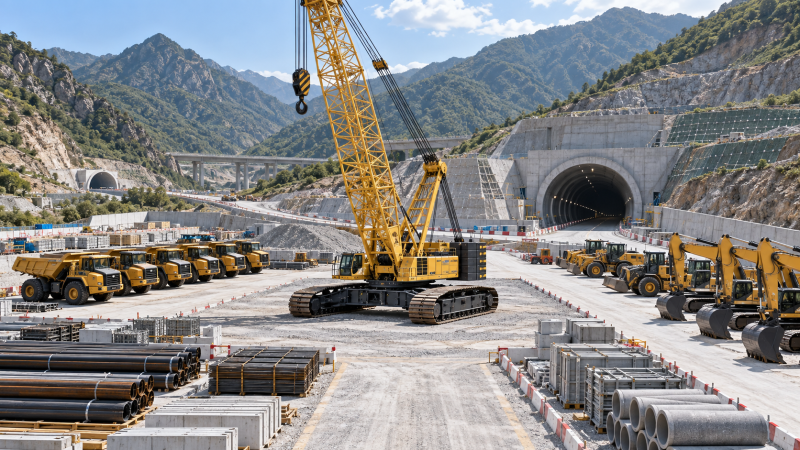
At bid stage, equipment uncertainty can undermine cost estimates, schedules, and delivery commitments before a project even begins.
Pre-tender intelligence gives commercial evaluation teams clearer evidence on machine availability, technical fit, lifecycle cost, geological demands, and supply-chain exposure.
For major infrastructure, mining, and lifting projects, the objective is not simply to select impressive machinery. It is to submit a bid that remains credible after award.
The central commercial question is straightforward: can the proposed equipment strategy deliver the promised output, within the stated period, at an acceptable risk-adjusted cost?
What Commercial Teams Need to Know Before Pricing a Bid
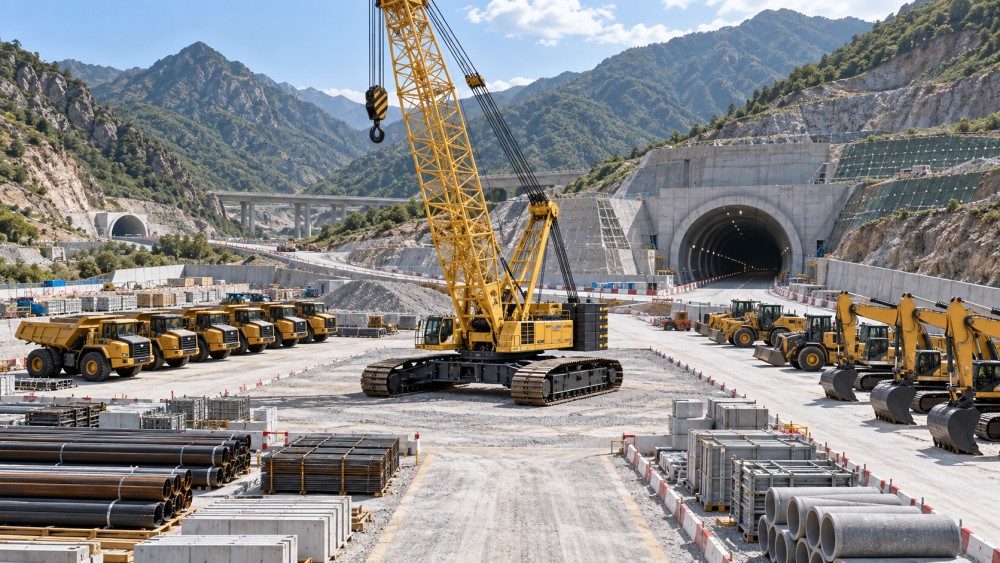
Pre-tender intelligence converts uncertain equipment assumptions into testable bid inputs. It combines project data, market visibility, technical performance evidence, and supplier intelligence.
Its value is greatest where equipment drives the critical path, including TBM tunnelling, open-pit mining, heavy lifting, road construction, and long-distance material haulage.
Commercial evaluators should begin by separating known requirements from assumptions. Tender documents often describe outcomes, while leaving decisive operating conditions only partially defined.
A stated tunnel diameter does not confirm cutterhead suitability. A crane lift chart does not confirm site access, assembly constraints, ground bearing pressure, or weather restrictions.
Likewise, a mining production target does not establish whether haul trucks can sustain payload, cycle time, tyre life, fuel consumption, and maintenance availability.
These gaps matter because early equipment assumptions rapidly become embedded in rates, schedules, subcontract terms, contingency allowances, and executive approval decisions.
Once a bid is submitted, changing the equipment basis can trigger margin erosion, qualification disputes, programme revisions, or an uncompetitive commercial position.
The purpose of intelligence is therefore not perfect prediction. It is identifying the assumptions with the highest financial consequence and reducing uncertainty before commitments harden.
Strong pre-tender intelligence also distinguishes a manageable risk from an unpriced unknown. That distinction supports disciplined decisions about pricing, partnering, qualifications, and bid-no-bid choices.
Start With the Equipment Decisions That Can Change Bid Economics
Not every equipment detail requires the same research effort. Evaluation teams should focus first on assets capable of changing programme duration, capital cost, productivity, or liability.
For a TBM project, those assets may include the machine type, cutterhead configuration, backup system, segment logistics, slurry treatment plant, and rescue capability.
For heavy lifting work, attention should center on crane capacity, boom configuration, transportability, erection duration, auxiliary cranes, rigging, and lift-window constraints.
In open-pit mining, the high-impact equipment set includes excavators, loading tools, haul trucks, crushers, drilling rigs, tyre supply, workshops, and fleet dispatch systems.
A useful method is to rank each assumption by cost impact, schedule impact, likelihood of change, and time required to correct it after award.
Items with high combined scores deserve validation before final pricing. Lower-value uncertainties can remain in controlled contingency or later technical clarification registers.
This prioritisation prevents teams from collecting large volumes of market information without resolving the issues that actually threaten the bid.
It also creates a common language between estimators, planners, engineers, procurement teams, operations leaders, and senior commercial approvers.
Instead of debating equipment preferences, the team can evaluate evidence: required output, comparable performance, access constraints, ownership cost, and available mitigation options.
Validate Technical Fit Against the Real Operating Environment
Equipment capacity is not the same as equipment suitability. Published specifications are useful starting points, but project conditions determine whether theoretical performance can be achieved.
Commercial teams need intelligence that links machine parameters to geology, site geometry, climate, logistics, energy supply, regulatory restrictions, and construction methodology.
For tunnelling, geotechnical interpretation should test more than rock strength. Abrasivity, water pressure, mixed-face conditions, fault zones, gas risk, and settlement limits can alter the machine strategy.
Comparable project records help identify whether an earth pressure balance, slurry, hard-rock, or multi-mode TBM is more defensible for the anticipated ground profile.
For crawler cranes, actual lift radius and hook height must be assessed alongside wind limits, foundation conditions, component delivery routes, and available laydown space.
A technically possible lift can still be commercially impractical when the crane cannot be mobilised efficiently or assembled without prolonged supporting works.
Mining bids require a similar operating view. Altitude, gradients, haul-road condition, dust, ambient temperature, fuel quality, and maintenance capability materially affect fleet productivity.
Pre-tender intelligence should identify where technical uncertainty needs a qualification, alternative method, provisional allowance, or targeted clarification from the client.
That early discipline reduces the risk of winning work on a machine selection that appears compliant on paper but performs poorly in field conditions.
Assess Availability Before Building a Programme Around a Machine
Equipment availability is often treated as a procurement issue after award. For constrained specialist assets, that approach can invalidate an otherwise competitive programme.
A bidder may know that a particular TBM, crane, excavator, or truck model exists, yet lack evidence that it can mobilise within the required window.
Availability analysis should cover owned fleets, rental fleets, manufacturer production slots, refurbishment status, competing project demand, transport routes, and commissioning lead times.
It should also identify the difference between nominal availability and operational readiness. A stored machine may require inspection, overhaul, recertification, tooling, or specialist personnel.
For TBMs, a new-build option may provide technical alignment but create design, manufacturing, factory testing, shipping, assembly, and acceptance schedule exposure.
A refurbished machine may mobilise faster, but only if its diameter, drive power, shield design, cutterhead, backup configuration, and remaining life suit the project.
For ultra-large cranes, regional demand from wind, petrochemical, nuclear, and port projects can tighten supply long before public tenders reach final submission.
Commercial evaluators should request supplier capacity evidence early, while recognising that non-binding indications are not equivalent to reserved delivery slots.
When access to a critical asset remains uncertain, the bid should model alternatives, include clear conditions, or avoid committing to an unsupported completion date.
Translate Equipment Choices Into Whole-Life Bid Costs
Purchase price or rental rate alone rarely represents the true commercial cost of heavy equipment. Pre-tender intelligence must build a whole-life operating perspective.
The relevant cost base includes mobilisation, transport, assembly, energy, consumables, labour, planned maintenance, breakdown response, insurance, demobilisation, and residual-value exposure.
For TBM operations, cutter consumption, intervention requirements, segment handling, slurry treatment, spoil management, and power demand can outweigh initial machine cost differences.
For mining fleets, fuel or electricity consumption, tyre performance, component life, maintenance labour, spares inventory, and downtime assumptions require particular scrutiny.
Heavy-lift estimates should include crane erection, dismantling, transport permits, foundations, rigging, standby exposure, weather downtime, and support-crane requirements.
Teams should convert technical assumptions into transparent cost drivers rather than relying on single productivity rates copied from an unrelated project.
Sensitivity analysis is especially valuable. Test how margin changes if utilisation falls, cutter wear rises, equipment arrival slips, fuel prices increase, or maintenance availability deteriorates.
This does not mean loading every theoretical risk into the tender. It means understanding which variables require contingency, transfer, clarification, or management attention.
A defensible bid explains its economics internally. Decision-makers should be able to see which equipment assumptions create upside, downside, and non-negotiable exposure.
Use Comparable Projects Carefully, Not Superficially
Comparable project intelligence is one of the strongest tools available to commercial teams, but only when similarities and differences are documented rigorously.
A past TBM advance rate has little value without context about geology, diameter, ground treatment, crew structure, maintenance regime, logistics, and downtime classification.
Similarly, a crane’s prior lift history must be adjusted for configuration, lift radius, wind environment, site preparation, component weight, and local permitting conditions.
Mining productivity benchmarks need reconciliation with bench height, haul distance, road gradient, payload policy, operator practices, and equipment age.
The question is not whether a project looks comparable. The question is whether the performance mechanism is sufficiently similar to support a pricing assumption.
TF-Strategy-style intelligence is valuable here because it connects equipment parameters with project methodology, regional market conditions, and technical evolution across heavy-industry sectors.
Evaluation teams should record the source, date, operating context, adjustment rationale, and confidence level for every benchmark used in the estimate.
This evidence trail improves governance and allows reviewers to challenge assumptions constructively before submission, rather than discovering them during project mobilisation.
It also protects organisational learning. Future bids can distinguish verified performance data from optimistic estimates that were never validated against actual results.
Turn Supply-Chain Intelligence Into a Practical Risk Response
Equipment uncertainty extends beyond the principal machine. Critical supply chains can affect production just as severely as the asset itself.
Examples include TBM cutters, bearings, hydraulic components, electrical drives, crane wire rope, rigging hardware, truck tyres, batteries, filters, and specialist lubricants.
Lead times should be assessed against expected consumption, project location, customs procedures, local storage capacity, supplier service coverage, and alternative approved sources.
Raw-material volatility may affect replacement parts, fabrication costs, and manufacturer delivery commitments. This is particularly relevant for steel-intensive and electrically driven equipment.
Commercial teams should identify single-source dependencies before award, especially where certification, warranty terms, or proprietary interfaces limit substitution options.
A practical response may involve strategic spares, framework agreements, local repair capability, dual sourcing, escalation clauses, or a revised construction sequence.
The right response depends on cost and urgency. Holding excessive inventory can consume working capital, while insufficient protection can create costly production stoppages.
Pre-tender intelligence helps quantify this trade-off by estimating the probability, duration, and consequence of supply disruption under the proposed operating plan.
That approach moves supply-chain risk from a generic narrative into a specific commercial decision with an owner, budget, and mitigation timetable.
Build an Evidence-Based Equipment Review Into Bid Governance
The strongest results come when equipment intelligence is embedded in the bid process, rather than requested informally during the final days before submission.
Establish an equipment review gate early enough to influence methodology, programme, supplier engagement, risk pricing, and executive bid approval.
The review should define the proposed equipment fleet, required performance, availability status, technical assumptions, cost basis, supply dependencies, and unresolved decision points.
Each major assumption should have an accountable owner and an evidence grade. Verified supplier information deserves more confidence than an untested market estimate.
Commercial leaders should also ask what would invalidate the equipment plan. This prompts teams to identify trigger events and viable alternatives in advance.
For example, a delayed crane mobilisation may require resequencing, a secondary crane arrangement, or a contractual qualification tied to access and delivery conditions.
A geotechnical uncertainty may require a TBM option analysis, additional investigation, ground-treatment allowance, or client acceptance of revised performance obligations.
Documenting these choices improves internal approvals and makes tender clarifications more precise, commercially meaningful, and easier for the client to evaluate.
It also gives project delivery teams a usable starting position after award, reducing the information loss that commonly occurs between estimating and operations.
Make a Clear Bid Decision, Not Just a Better Equipment List
Pre-tender intelligence reduces equipment uncertainty by improving the quality of commercial choices, not by eliminating every unknown from complex projects.
For business evaluation teams, the desired outcome is a bid whose programme, cost, and technical commitments are aligned with realistic equipment conditions.
That means validating technical fit, confirming credible availability, calculating whole-life costs, testing comparable evidence, and addressing supply-chain dependencies before submission.
Where evidence is strong, teams can price confidently and position capability clearly. Where evidence is incomplete, they can qualify, mitigate, partner, or reconsider exposure.
In capital-intensive earth engineering, an unsupported machine assumption can consume margin long before field productivity reveals the problem.
Well-structured pre-tender intelligence gives decision-makers a disciplined basis for deciding whether the proposed equipment strategy is achievable, competitive, and worth the risk.
Related News
 Oct 01, 2026How to Use Technical References to Benchmark Industrial Equipment PricesIndustrial equipment technical reference pricing: learn how to normalize specifications, scope, service life, and operating costs to benchmark quotes accurately and choose the best-value equipment.
 Sep 30, 2026What Does an Ultra-Large Excavator Really Cost Over Its Service Life?Ultra-large excavators cost far more than purchase price. Explore lifecycle expenses, uptime risks, energy use, maintenance, and cost-per-tonne insights.
 Sep 29, 2026Infrastructure Construction Standards: A Project Manager’s Guide to ComplianceInfrastructure construction standards guide for project managers: turn requirements into field controls, hold points, traceability, and compliant delivery.
 Sep 28, 2026How to Specify Custom Mining Equipment for Abrasive Ground and High-Load HaulageCustom mining equipment for abrasive ground and high-load haulage: learn how to optimize payload, wear protection, powertrains, uptime, and lifecycle cost for safer, reliable production.


Ms. Elena Rodriguez
Weekly Insights
Stay ahead with our curated technology reports delivered every Monday.