
How to Choose Heavy Machinery Maintenance Providers for Reliable Fleet Uptime
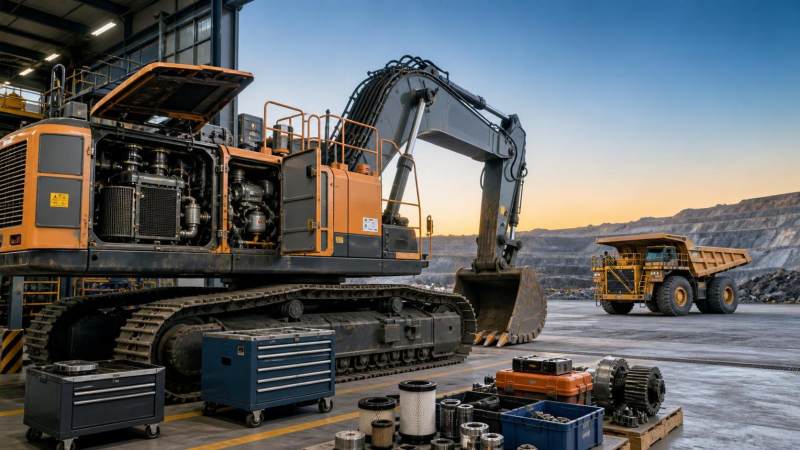
Fleet uptime is not secured by choosing the maintenance provider with the lowest call-out rate or the largest service footprint. It depends on whether that provider can prevent foreseeable failures, diagnose abnormal conditions accurately, mobilize the right people and parts within the operational window, and take clear responsibility when work affects availability.
That distinction matters most for high-value, low-tolerance assets: tunnel boring machines working under geological uncertainty, ultra-class excavators on continuous mining cycles, crawler cranes committed to critical lifts, road equipment tied to paving windows, and haul trucks operating across long shifts. In these environments, a maintenance contract is not simply an outsourced workshop function. It is a risk-allocation arrangement that influences production continuity, safety exposure, asset life, and the credibility of project schedules.
Start with the equipment’s failure consequences, not the provider’s brochure
“Heavy machinery maintenance providers” is a broad category. A general mobile-service business may be perfectly suitable for a mixed fleet of standard excavators, loaders, and support equipment, yet be structurally unprepared for a TBM main-drive issue, a crane boom hoist fault, or an intermittent failure in an electronically controlled mining truck. The relevant question is not whether a provider services heavy equipment, but whether it can support the specific equipment architecture and operating consequence involved.
Before comparing providers, separate fleet assets into service-criticality groups. This should reflect more than acquisition value. A relatively inexpensive machine can be operationally critical if it is the only unit capable of feeding a crusher, supporting a concrete segment logistics route, or preparing a narrow paving window. Conversely, a high-value machine may have adequate redundancy and therefore justify a different service model.
A useful criticality assessment considers:
- the production or project impact of an unplanned stoppage;
- the time needed to isolate, access, repair, test, and recommission the machine;
- availability of backup equipment or alternative work sequences;
- the safety implications of degraded performance or delayed maintenance;
- the lead time for major components and specialist labour; and
- whether the fault can be monitored, planned, or only addressed after failure.
This exercise often exposes a procurement mistake: assigning one uniform service requirement to the whole fleet. Critical machines may need resident technical coverage, agreed component-exchange arrangements, remote diagnostics, and tightly defined escalation paths. Lower-criticality equipment may be better served through scheduled inspections and a local call-out agreement. Paying premium coverage for every asset wastes budget; under-specifying support for bottleneck equipment transfers a much larger cost into downtime.
Technical capability must be demonstrated at system level
Maintenance quality is often judged by visible tasks—oil changes, filters, greasing, undercarriage inspection, or replacement of worn parts. Those tasks matter, but they do not establish whether a provider can manage the systems that cause prolonged outages: hydraulics, powertrain, electrical networks, automation controls, telematics, structural interfaces, and machine-specific safety circuits.
For complex equipment, ask for evidence that goes beyond a generic list of OEM brands supported. The provider should be able to describe its diagnostic process for the relevant machine families: how fault codes are interpreted; how wiring, sensors, valves, pumps, and control logic are distinguished as root causes; what test instruments are available; and who has authority to make repair decisions when a fault affects safety or production.
Capability also needs to match the equipment’s configuration. A provider familiar with a base model may not be qualified to support a machine altered by site-specific attachments, autonomous or remote-control functions, high-altitude cooling packages, fire-suppression interfaces, or third-party condition-monitoring systems. For TBMs, support requirements can extend well beyond conventional mobile equipment skills, involving cutterhead systems, segment erector interfaces, slurry or earth-pressure-balance subsystems, conveyor arrangements, and project-specific electrical distribution. For crawler cranes, inspection competence must align with the actual boom configuration, hoist systems, load-moment protection arrangements, and local lifting requirements.
Training certificates are useful, but they are not sufficient on their own. Certificates can confirm course completion; they do not reveal whether the provider has access to current service literature, diagnostic software, technical bulletins, or escalation support for unusual failures. Require a practical technical submission that identifies named roles, the equipment families each role can cover, the diagnostic tools held or accessible, and the boundary between work performed independently and work requiring OEM approval.
Response time is only meaningful when the service clock is defined
Many proposals promise “rapid response.” That phrase has little contractual value unless it specifies what response means. Is it acknowledgement of an email, a technician departing a depot, arrival at the gate, arrival at the machine, initial diagnosis, or restoration of safe operation? These are different milestones, and confusing them can make service performance appear better than it is.
A workable service-level agreement should define separate clocks for notification acknowledgement, remote technical triage, site attendance, fault diagnosis, parts quotation or release, and repair completion where completion is within the provider’s control. It should also distinguish between normal-hours work, night shifts, weekends, public holidays, and restricted-access sites. A remote mine, a tunnel workface, and an urban infrastructure project have different access constraints; a nominal travel-time commitment may be irrelevant if induction, escort, ventilation clearance, or lifting support has not been planned.
Service commitments should be tied to the likely failure modes of each critical asset. A provider may be able to send a field technician quickly but lack a hydraulic test kit, approved lifting gear, electrical schematics, or authority to access software parameters. In that case, the first visit may only confirm that another mobilization is needed. The right question is: what resources will be dispatched for defined incident types, and what can be resolved during the first intervention?
Do not turn every metric into an automatic financial penalty. A provider cannot control weather shutdowns, client access delays, undisclosed machine modifications, or parts held at customs. However, exclusions should be explicit rather than becoming a general excuse for poor service delivery.
Parts access is a supply-chain question, not a catalogue question
Parts availability is frequently the weak point in otherwise capable service arrangements. A provider may have strong technicians and still be unable to protect uptime if it cannot source genuine components, approved alternatives, exchange units, seals, hoses, electronic modules, or wear parts at the required speed.
The first issue is traceability. For safety-related, load-bearing, high-pressure, emissions-control, or electronically integrated components, the source and approval status of parts must be clear. “Equivalent” parts should not be accepted solely because they fit mechanically. A non-approved sensor, hydraulic hose assembly, bearing, or electronic controller can create compatibility problems, undermine warranties, complicate failure analysis, or introduce safety risk.
The second issue is inventory design. A good provider does not need to stock every possible item locally. It should, however, propose a critical-spares strategy based on consumption patterns, known lead times, component condition, and the cost of downtime. This may include site-held consumables, consignment stock, regional emergency stock, repairable exchange components, and agreed reorder points. The arrangement must specify ownership, insurance, shelf-life management, obsolete-stock treatment, and the process for releasing parts during an emergency.
Third, ask how the provider manages imported parts. Cross-border fleets and international projects can be exposed to customs delays, export-control restrictions, product certification requirements, and inconsistent local availability. The provider should be able to state where parts are stocked, whether it imports directly or through an authorized channel, how it handles serial-number-controlled components, and what alternatives exist if a normal supply route fails. Broad assurances about global networks do not replace a documented route for the parts that can stop the machine.
Compare maintenance models by control, not just price
Several commercial models can appear similar in an annual budget while creating very different operational outcomes. Time-and-materials support provides flexibility and can suit non-critical or sporadically used assets, but it leaves spend and response exposure largely with the fleet owner. Planned-maintenance agreements improve scheduling discipline but may exclude corrective work, component rebuilds, and consequential damage. Full-maintenance or availability-oriented contracts transfer more responsibility, yet require much more precise definitions of operating conditions, exclusions, inspection rights, and performance measurement.
The appropriate model depends on the predictability of usage and condition. A fleet operating fixed shifts with stable operating data can support a more structured planning arrangement. Equipment exposed to highly variable geology, overload risk, extreme temperatures, or changing operators may require a contract that allows inspection findings to reset maintenance assumptions without creating disputes over every intervention.
When comparing bids, normalize the scope before comparing totals. Confirm whether quoted rates include travel, mobilization, accommodation, site induction, overtime, diagnostic software access, consumables, fluids, waste handling, cranes or lifting equipment, hoses fabricated on site, calibration, and reporting. A low hourly labour rate can be offset by minimum charges, travel multipliers, parts mark-ups, or exclusions that only become visible during a major event.
Lifecycle evaluation should also examine the provider’s maintenance philosophy. A contract that rewards only short-term restoration may encourage repeated replacement of symptoms rather than root-cause investigation. One that requires extensive approval before every repair can protect budget authority but delay recovery. Better arrangements balance authorization thresholds with pre-agreed emergency powers, clear root-cause reporting for recurring failures, and an approval workflow that remains usable during off-hours incidents.
Data access and reporting determine whether maintenance becomes more predictable
Condition monitoring and telematics can improve planning, but only if the information is usable and contractually accessible. It is not enough for a provider to state that it offers digital reporting. Determine who owns raw machine data, who can export it, what alerts are monitored, how alarms are triaged, and whether the fleet owner receives machine-level records rather than only monthly summaries.
Reports should support decisions, not merely record completed jobs. Useful records link work orders to machine hours, fault symptoms, root cause where established, labour and parts used, downtime classification, deferred defects, inspection findings, and recommended actions. For critical equipment, trend reporting on repeat faults, fluid contamination, abnormal temperatures, pressure deviations, brake wear, undercarriage condition, or component life can help schedule intervention before a failure becomes disruptive. The relevance of each indicator depends on the machine and duty cycle; a generic dashboard is not a maintenance strategy.
Cybersecurity and access control also deserve attention where machines use remote diagnostics or connected control systems. Contract terms should define authorized access, software update approval, retention of diagnostic records, and the procedure for ending access when the agreement expires. This is particularly important when machine data informs warranty decisions, safety investigations, or disputes over operating conditions.
Audit the provider’s operating system before award
A proposal review cannot reveal everything. Where fleet criticality justifies it, a pre-award audit should examine the operating system behind the offer: workshop capability, field-service vehicles, tooling calibration records, parts storage controls, technician competence records, safety procedures, subcontractor management, and work-order governance. The goal is not to demand a large facility for every contract; it is to verify that the promised delivery model actually exists.
Subcontracting deserves particular scrutiny. Specialist subcontractors can be appropriate for machining, non-destructive testing, controls engineering, welding, or major transport. The risk arises when the lead provider presents outsourced capacity as its own and cannot control its response, quality, insurance, or documentation. Contracts should identify material subcontracted activities, require approval for changes affecting critical services, and make the lead provider accountable for the subcontractor’s performance.
Quality and safety documentation should be proportionate to the work. Maintenance on lifting equipment, pressure systems, high-voltage equipment, braking systems, or safety-critical controls requires disciplined inspection, test records, and release-to-service procedures. Applicable statutory inspection obligations and manufacturer requirements cannot be replaced by a provider’s internal checklist. Where equipment operates across jurisdictions, confirm which party monitors local obligations and how changes to requirements are communicated.
Build an exit path into the agreement
The weakest time to discover a maintenance dependency is during a dispute or a project transition. Contracts should protect continuity by requiring orderly handover of service histories, inspection records, defect lists, configuration information, calibration certificates, parts inventory records, and open work orders. If the provider manages telematics or diagnostic platforms, access and data export after termination need to be addressed before the contract begins.
It is equally important to avoid locking the fleet into a provider through undocumented settings, proprietary reporting formats, or unreturned special tooling. For major equipment, identify which software permissions, passwords, service interfaces, and technical documents are necessary for lawful continued support. OEM restrictions may limit what can be transferred, but the contractual position should be understood rather than assumed.
The most reliable choice is rarely the provider that makes the broadest promise. It is the one whose technical scope, parts route, response model, data practices, and contractual responsibilities align with the fleet’s real failure consequences. When those elements are tested before award, maintenance procurement becomes a practical control over uptime rather than a reactive expense after the machine stops.
Related News
 Oct 17, 2026Tunnel Boring Machine Supplier List: Compare TBM Types and Service CoverageExplore our tunnel boring machinery supplier list to compare EPB, slurry and hard rock TBMs, assess service coverage and lifecycle costs, and build a smarter procurement shortlist.
 Oct 16, 2026Heavy-Duty Petrochemical Lifting: Selecting Cranes by Load, Radius, and Site AccessExplore heavy-duty petrochemical lifting solutions. Compare cranes by load, radius, site access, and ground support to reduce project risk and optimize lifting costs.
 Oct 15, 2026Crane Selection for Petrochemical Turnarounds: Capacity, Radius, and Site AccessExplore petrochemical lifting solutions cranes can deliver, with expert guidance on capacity, working radius, and site access to help you plan a safer, more efficient turnaround.
 Oct 14, 2026High-Capacity Heavy Lifting Solutions: Matching Load, Radius, and Ground ConditionsDiscover heavy lifting solutions high capacity projects demand—compare load charts, working radius, and ground conditions to select a feasible, cost-effective system.



Ms. Elena Rodriguez
Weekly Insights
Stay ahead with our curated technology reports delivered every Monday.