
How to Evaluate Geotechnical Engineering Consulting Before Tender and Design
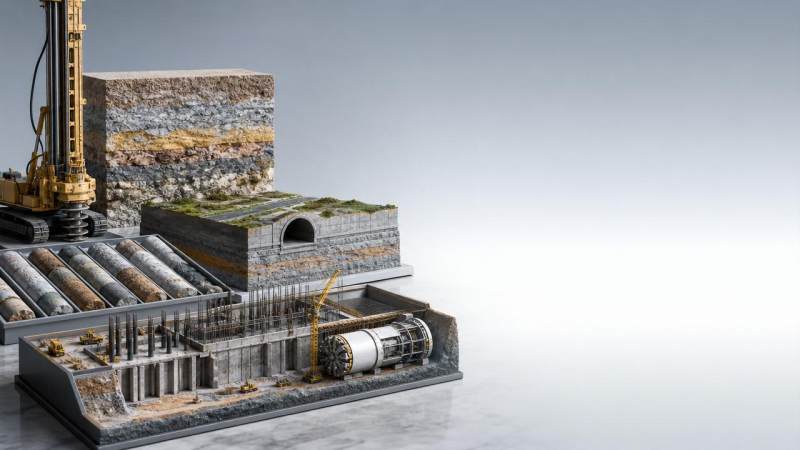
Why does geotechnical engineering consulting matter before tender and design?
Subsurface risk is expensive because it stays hidden until work begins.
That is why geotechnical engineering consulting should start before tender documents are fixed.
A strong consultant does more than issue borehole logs or lab summaries.
The real value lies in turning uncertain ground conditions into usable design and procurement decisions.
In tunneling, mining access works, crane platforms, haul roads, and heavy foundations, that translation is critical.
For projects tracked by TF-Strategy, ground conditions often shape equipment choice, construction sequencing, and total risk exposure.
A weak scope can produce cheap reports and costly surprises.
A better geotechnical engineering consulting team helps define investigation density, interpret variability, and connect findings to constructability.
That early clarity supports fairer tenders, fewer claims, and more realistic pricing.
What should be reviewed first when comparing geotechnical engineering consulting firms?
Start with relevance, not brochure size.
The best comparison usually begins with project similarity, geological complexity, and construction method alignment.
For example, tunnel portals, deep cuts, open-pit ramps, and heavy crane pads do not share the same risk profile.
A consultant experienced in building foundations may still be a weak fit for TBM launch zones.
More useful review points include the following:
- Track record in comparable geology, not just comparable contract value.
- Ability to link investigation results with excavation, support, drainage, and staging methods.
- Depth of field supervision during drilling, sampling, and in situ testing.
- Quality control for laboratory testing and data interpretation.
- Clarity in reporting assumptions, limitations, and residual risks.
One practical sign of quality is whether the consultant asks difficult questions early.
If they immediately price a standard scope without discussing alignment, loads, groundwater, or construction access, caution is reasonable.
A quick comparison table helps separate surface confidence from technical depth
How can you tell whether the proposed scope is actually enough?
This is where many decisions go wrong.
A scope may look detailed because it lists drilling meters, test counts, and report sections.
That still does not prove it answers the project’s critical questions.
A useful scope should explain why each investigation element is needed.
It should also show how findings will affect tender quantities, design assumptions, or construction controls.
In practical terms, geotechnical engineering consulting is adequate when it can support decisions such as:
- Whether a tunnel alignment needs treatment for faulted or water-bearing zones.
- Whether a crane working platform requires reinforcement or staged loading restrictions.
- Whether haul roads or ramps need drainage redesign under weak subgrade conditions.
- Whether excavation support classes should vary by chainage or depth.
More often, the gap is not too little drilling alone.
The bigger issue is poor targeting.
Groundwater regime, transition zones, fill interfaces, and weathered rock horizons can dominate risk.
If the scope misses those zones, the report may look complete while leaving decisions exposed.
Is technical capability enough, or should procurement look at delivery behavior too?
Technical capability is essential, but delivery behavior often decides project value.
Geotechnical engineering consulting affects schedules because site access, drilling permits, testing windows, and reporting cycles are all time-sensitive.
A capable team that communicates poorly can still delay tender release or misalign with design packages.
This matters even more on large infrastructure programs where heavy equipment selection depends on ground information.
TF-Strategy regularly follows projects where machine productivity, support systems, and logistics planning shift after new subsurface data emerges.
That pattern shows why reporting speed and interpretation discipline matter as much as raw technical credentials.
Useful questions to test delivery behavior include:
- Who reviews field logs before crews leave the site?
- How are unexpected conditions escalated and documented?
- Can preliminary risk notes be issued before the full report?
- How will the consultant coordinate with designers and temporary works teams?
The strongest responses usually sound operational, not promotional.
They describe workflows, decision gates, and named responsibilities.
Where do cost and schedule assessments usually become misleading?
Low fees are not always efficient.
Sometimes they simply shift uncertainty into later redesign, claims, or contingency growth.
The better question is not how much geotechnical engineering consulting costs in isolation.
It is whether the scope meaningfully reduces downstream cost exposure.
That evaluation becomes sharper when the consultant quantifies decision impact.
For instance, improved rock mass characterization may refine TBM cutter expectations.
Groundwater interpretation may alter dewatering strategy, shaft support, or haul route maintenance needs.
Those are not academic details.
They influence tender risk pricing and equipment utilization.
A practical review should separate three cost layers:
- Direct consulting fee for investigation, testing, interpretation, and reporting.
- Program effect on tender timing, design freeze dates, and package release.
- Risk reduction value in claims avoidance, redesign prevention, and construction efficiency.
When these layers are reviewed together, a seemingly higher fee may be commercially stronger.
Common evaluation mistakes are easier to spot in a short checklist
What final checks help confirm the right consulting choice?
By the final review stage, the key issue is confidence in decision support.
The chosen team should be able to explain what is known, what remains uncertain, and how that uncertainty should be managed.
That balance is far more useful than overconfident language.
A strong closing review often includes these checks:
- Confirm that the deliverables support tender notes, design inputs, and construction planning.
- Check whether assumptions are traceable to field data and test methods.
- Verify how the consultant will update interpretations if new ground conditions appear.
- Make sure commercial exclusions do not remove critical advisory tasks.
In major earth engineering programs, geotechnical engineering consulting is not a paperwork step.
It is part of strategic project intelligence.
That idea aligns with the way TF-Strategy interprets heavy industry decisions.
Physical parameters, construction methodology, and commercial consequences have to be read together.
When evaluating geotechnical engineering consulting, the most reliable next step is simple.
Define the project decisions the ground investigation must unlock.
Then compare firms against those decisions, not against generic credentials alone.
That approach creates clearer tenders, sharper design inputs, and fewer surprises once work moves from paper to ground.
Related News
 Oct 26, 2026How TBM Electrical Systems Distribute Power and Protect Against FaultsExplore how TBM equipment electrical systems distribute power, coordinate fault protection, and maintain essential services. Learn what to check for safer, more reliable tunneling.
 Oct 25, 2026Comparing Industrial Equipment Suppliers: Lead Times, Warranties, and ServiceMake a smarter industrial equipment supplier comparison. Explore lead times, warranty coverage, and service support to reduce downtime risk and choose with confidence.
 Oct 24, 2026Choosing Lifting Equipment for Middle East Petrochemical Plants in Hazardous AreasExplore petrochemical lifting equipment Middle East plants can rely on. Compare hazardous-area certification, capacity, and heat limits to make informed procurement decisions.
 Oct 23, 2026Selecting Lifting Equipment for Nuclear Component Transport: Key Safety CriteriaSelecting lifting machinery for nuclear component transport? Discover essential safety criteria, load control checks, and supplier requirements to guide confident procurement.



Related News

Ms. Elena Rodriguez
Weekly Insights
Stay ahead with our curated technology reports delivered every Monday.