
What Are Petrochemical Components? Key Types, Materials, and Where They Are Used
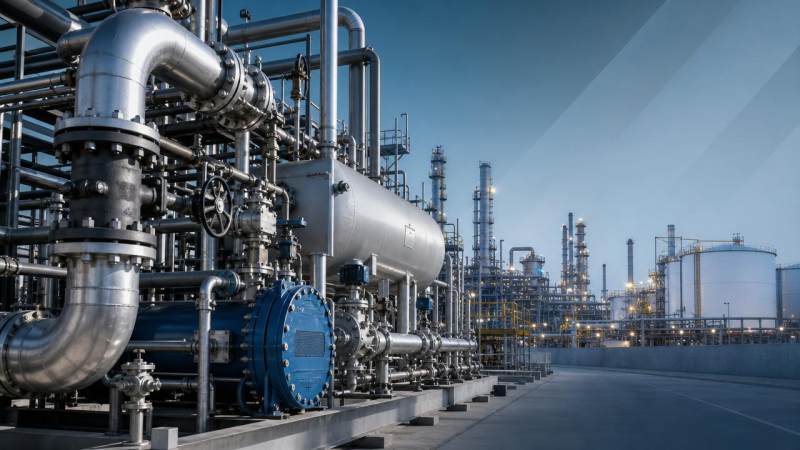
Why do petrochemical components matter beyond the refinery gate?
Petrochemical components sit behind many systems people notice only when they fail.
They support flow control, storage integrity, heat transfer, lifting preparation, and plant safety across energy and construction-linked industries.
In practical terms, petrochemical components include pipes, valves, flanges, fittings, tanks, pressure vessels, pumps, seals, supports, and instrumentation hardware.
These parts are not isolated items. They work as an interdependent system where material choice, pressure rating, corrosion resistance, and maintenance access all affect performance.
That is why the topic matters to infrastructure intelligence platforms such as TF-Strategy.
When crawler cranes lift large modules, or mining and road projects connect with fuel, chemical, and logistics chains, petrochemical components become part of a larger heavy-industry picture.
A useful way to read this subject is simple: understand the component, match it to the operating condition, then judge how it affects cost, risk, and project delivery.
What counts as a petrochemical component, and how are the main types grouped?
Searches for petrochemical components often start with one basic confusion.
Are people talking about process equipment, piping parts, or structural assemblies?
Usually, the answer is all three, but each group serves a different purpose.
Process path components
These handle movement, isolation, and control of liquids, gases, steam, or chemical feedstock.
- Pipes and tubes for transport under defined pressure and temperature.
- Valves for shutoff, throttling, check protection, and emergency isolation.
- Fittings, elbows, tees, and reducers for routing and size transitions.
- Flanges and gaskets for serviceable connections between sections.
Core equipment components
These do the heavy process work inside plants and terminals.
- Pressure vessels for reaction, separation, and containment.
- Heat exchangers for thermal efficiency and process stability.
- Pumps and compressors for fluid movement and pressure management.
- Storage tanks for feedstock, intermediates, and finished chemicals.
Support and protection components
These are easier to overlook, yet they often decide operational reliability.
- Pipe supports, clamps, hangers, and anchors.
- Insulation jackets and fireproofing systems.
- Seals, packing, fasteners, and expansion joints.
- Sensors, gauges, and connection hardware for monitoring.
A common mistake is to define petrochemical components too narrowly.
In actual projects, the performance of one valve may depend on the gasket, flange finish, pipe schedule, and support spacing around it.
Which materials are most common, and why does material choice change so much?
Material selection is where many comparisons become meaningful.
Petrochemical components rarely fail because a nameplate looked wrong.
They fail when the material does not match corrosion, pressure, temperature, or media composition.
Carbon steel remains common because it balances strength, availability, and cost for general service.
Low-alloy steel is preferred when higher temperature and pressure resistance are needed.
Stainless steel is widely used where corrosion resistance, hygiene, or longer service life justify the higher price.
Duplex and super duplex grades appear in chloride-rich or offshore-related environments where stress corrosion is a major concern.
Nickel alloys and special metals enter the picture when media are highly aggressive, acidic, or exposed to extreme temperatures.
Non-metallic materials also matter. PTFE linings, composite parts, and engineered plastics can improve chemical resistance in selected applications.
A better question than “Which material is best?” is “Best for what duty cycle?”
That shift usually leads to more reliable judgments.
Where are petrochemical components most widely used in real projects?
The obvious answer is refineries and petrochemical plants, but usage extends further.
Petrochemical components also appear in LNG terminals, fertilizer plants, tank farms, offshore platforms, power stations, and industrial utility networks.
They are also deeply linked to heavy lifting and infrastructure execution.
Large pressure vessels, reactors, and modular skids often require crawler cranes, specialized transport, and strict route planning before installation.
That connection is one reason TF-Strategy tracks both heavy equipment and strategic industrial demand.
A petrochemical component is not only a plant item. It can also be a logistics and assembly challenge.
Typical usage by setting
- Refineries: reactors, exchangers, piping networks, flare lines, and storage systems.
- Chemical plants: corrosion-sensitive valves, lined piping, dosing systems, and tanks.
- Energy terminals: loading arms, transfer piping, cryogenic-compatible assemblies, and safety valves.
- Heavy industrial construction: prefabricated modules, steel structures, supports, and lifted process packages.
In field conditions, the same component may perform differently depending on climate, altitude, dust load, marine exposure, and maintenance access.
So application context matters as much as design data.
How do you compare petrochemical components without getting lost in specifications?
This is where many readers need a practical filter.
The most useful comparison method is to group decisions into operating fit, lifecycle fit, and project fit.
Operating fit
Check pressure, temperature, fluid chemistry, abrasion level, and required sealing performance.
A cheaper part that cannot hold process stability is not truly economical.
Lifecycle fit
Review inspection intervals, expected corrosion rate, spare availability, coating life, and repair complexity.
For remote or high-risk sites, maintenance burden can outweigh purchase price.
Project fit
Consider lead time, transport dimensions, welding requirements, certification needs, and lifting constraints.
This becomes especially important for large modules integrated into billion-dollar infrastructure schedules.
This kind of comparison keeps the discussion practical rather than purely technical.
What risks or misconceptions show up most often?
Several misconceptions repeat across projects.
One is assuming all petrochemical components are standardized enough to be interchangeable.
Standards help, but service conditions, fabrication quality, and certification details still create major differences.
Another is focusing only on initial cost.
In corrosive or high-pressure service, poor selection can trigger leaks, shutdowns, and expensive retrofits.
A third issue is underestimating installation realities.
Even well-designed petrochemical components can suffer from bad alignment, weak support design, uncontrolled welding, or improper storage before commissioning.
- Do not judge a valve only by size and pressure class.
- Do not treat corrosion allowance as a substitute for proper material choice.
- Do not ignore transport, lifting, and module integration limits.
- Do not separate procurement decisions from maintenance reality.
In heavy-industry analysis, risk is usually cumulative, not isolated.
Small errors across multiple petrochemical components can compound into major reliability problems.
If you are building a baseline understanding, what should you review next?
A solid starting point is to map petrochemical components by function, material, and operating environment.
That creates a more useful framework than memorizing part names alone.
Then compare how each component affects installation, maintenance access, and project sequencing.
This matters especially where heavy lifting, modular construction, or large-scale logistics are involved.
For broader industry tracking, it also helps to watch how energy transition projects change material demand, inspection standards, and lifecycle expectations.
That is where strategic intelligence becomes useful.
Platforms following equipment, infrastructure methods, and component demand together can reveal how technical choices influence cost and execution quality.
If the goal is better judgment, the next step is straightforward.
List the operating conditions, identify the most critical petrochemical components, compare material options, and check the related transport, lifting, and maintenance constraints before drawing conclusions.
Related News
 Sep 12, 2026Open-Pit Mining in North America: Key Project Risks and Planning PrioritiesOpen-pit mining North America: uncover key risks and planning priorities for geology, permitting, water, fleet strategy, and resilient project delivery.
 Sep 11, 2026TBM Systems in Southeast Asia: Key Selection Factors for Variable Ground ConditionsTBM systems Southeast Asia: discover key selection factors for variable ground, pressure control, monsoon resilience, and safer tunnel delivery.
 Sep 10, 2026How to Select Bridge Lifting Machinery for Span, Load, and Site ConstraintsLifting machinery for bridges: learn how to match capacity, span, radius, ground conditions, and access constraints for safer, cost-effective bridge erection.
 Sep 12, 2026Is heavy haulage more cost-effective by rail or truck in remote infrastructure projects?Is heavy haulage more cost-effective by rail or truck in remote areas? Discover the real TCO drivers—beyond fuel and distance—for infrastructure projects.


Ms. Elena Rodriguez
Weekly Insights
Stay ahead with our curated technology reports delivered every Monday.