
How to Evaluate a Heavy Equipment Supplier for Large Infrastructure Projects
How to Evaluate a Heavy Equipment Supplier for Large Infrastructure Projects
Choosing the right heavy equipment supplier can shape the outcome of an entire infrastructure project.
A weak supplier creates delays, claims, and rising ownership costs.
A strong heavy equipment supplier supports schedule control, technical fit, safety, and predictable lifecycle value.
For large infrastructure works, price alone is never enough.
You need a supplier that can deliver machines, parts, service, and accountability under pressure.
This guide explains how to evaluate a heavy equipment supplier with a practical, risk-aware approach.
Start with project reality, not catalog claims
Before comparing suppliers, define the operating reality of the project.
That means geology, haul distance, lift profile, climate, altitude, site access, and daily utilization targets.
A heavy equipment supplier may look strong on paper yet fail in your actual conditions.
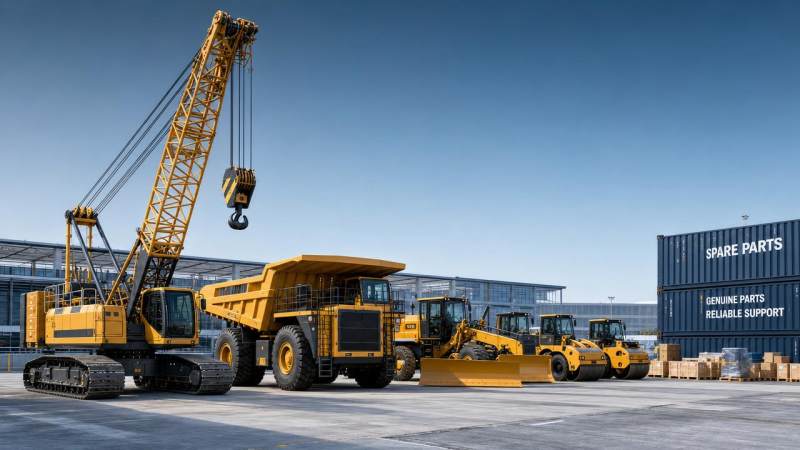
This is especially true for TBM operations, open-pit fleets, crawler cranes, and large road machinery.
In practice, supplier evaluation starts with a technical requirement matrix.
- Required output, cycle time, and operating hours
- Site environment, terrain limits, and transport constraints
- Safety, emissions, and local compliance rules
- Maintenance windows and spare parts expectations
- Project duration and likely extension scenarios
Once this baseline is clear, every heavy equipment supplier can be assessed against the same business case.
Check technical capability beyond the brochure
Technical fit is the first serious filter.
A qualified heavy equipment supplier should explain why a machine matches your workload, not just quote rated capacity.
Ask for application-specific data, duty cycle assumptions, and performance under similar ground or load conditions.
For complex assets, model configuration matters as much as the brand.
A TBM cutterhead setup, crane boom combination, or dump truck powertrain choice can change operating economics dramatically.
Ask technical questions that reveal depth
- What assumptions support the productivity estimate?
- What components are most exposed to wear?
- How does performance change at high altitude or extreme temperatures?
- Which options improve uptime and which only raise capex?
- What field modifications are common after commissioning?
A capable heavy equipment supplier answers with evidence, operating logic, and trade-off clarity.
Measure delivery reliability and supply chain resilience
For large projects, late delivery can be more expensive than a higher equipment price.
That is why delivery reliability should be a core evaluation factor for every heavy equipment supplier.
Look closely at manufacturing lead times, export experience, transport planning, and customs support.
Recent market shifts also make component sourcing more important.
Engines, hydraulics, electronics, and tire supply can all become project bottlenecks.
A dependable heavy equipment supplier should show where critical components come from and how shortages are managed.
Review these delivery risk indicators
- On-time delivery record for similar project sizes
- Regional parts warehouse coverage
- Backup sources for critical subsystems
- Installation and commissioning manpower availability
- Clear escalation path for schedule recovery
If the answers are vague, the supplier risk is probably higher than the quotation suggests.
Evaluate service support as part of total cost
Many teams focus on purchase cost, then lose money through downtime.
A strong heavy equipment supplier helps reduce total cost of ownership, not just acquisition cost.
Service response time, technician skill, and spare parts availability directly affect project margins.
This matters even more on remote sites, cross-border projects, and high-utilization fleets.
Ask for documented service levels instead of general promises.
In real procurement work, service weakness often becomes visible only after the machines arrive. That is already too late.
Test financial stability and commercial transparency
A heavy equipment supplier may offer attractive pricing while carrying hidden commercial risk.
If the supplier is financially weak, warranty support and parts continuity may suffer later.
This also affects long projects where payment milestones extend across many months.
Review audited financials when possible, banking support, insurance coverage, and contract discipline.
Commercial transparency matters just as much.
A trustworthy heavy equipment supplier should break down price drivers, exclusions, warranty conditions, and service assumptions clearly.
Watch for these red flags
- Large pricing gaps without technical explanation
- Unclear warranty scope or many exclusions
- Weak penalties for delivery failure
- No clarity on commissioning responsibilities
- Parts pricing left undefined after award
A lower upfront quote can become the highest-cost option once delays, claims, and downtime are included.
Use references, site visits, and performance proof
Reference checks remain one of the best ways to evaluate a heavy equipment supplier.
But generic reference letters are not enough.
Focus on projects with similar scale, geology, utilization, climate, and compliance demands.
If possible, visit an operating site and speak with the users directly.
Ask what failed, what took time to fix, and whether promised productivity was achieved.
The most valuable insight usually comes from problems, not presentations.
- Request three recent comparable references.
- Interview both project and maintenance teams.
- Validate uptime, fuel use, wear rates, and parts lead times.
- Compare field reality with proposal claims.
That process gives a far clearer picture of the supplier’s real operating value.
Build a weighted scorecard for fair comparison
Once the evidence is collected, use a weighted scorecard.
This keeps heavy equipment supplier selection consistent and easier to defend internally.
The exact weighting depends on project risk, but the structure should stay disciplined.
A good scorecard balances cost pressure with project risk.
It also helps prevent a decision from being driven by a single impressive sales point.
Make the final decision with lifecycle thinking
The best heavy equipment supplier is not always the one with the lowest bid.
It is the one most likely to perform across the full project lifecycle.
That includes mobilization, daily operation, maintenance, compliance, and end-of-project asset value.
From a procurement and cost perspective, this wider view usually leads to better outcomes.
In today’s infrastructure market, resilience matters as much as price.
The right heavy equipment supplier brings engineering understanding, transparent commitments, and support that holds up in the field.
That is also where strategic market intelligence becomes useful.
For projects involving TBM systems, mining fleets, crawler cranes, road machinery, or haulage equipment, current sector insight sharpens supplier evaluation.
Use this framework to compare options carefully, challenge assumptions early, and choose a heavy equipment supplier with confidence.
Related News
 Oct 25, 2026Comparing Industrial Equipment Suppliers: Lead Times, Warranties, and ServiceMake a smarter industrial equipment supplier comparison. Explore lead times, warranty coverage, and service support to reduce downtime risk and choose with confidence.
 Oct 24, 2026Choosing Lifting Equipment for Middle East Petrochemical Plants in Hazardous AreasExplore petrochemical lifting equipment Middle East plants can rely on. Compare hazardous-area certification, capacity, and heat limits to make informed procurement decisions.
 Oct 23, 2026Selecting Lifting Equipment for Nuclear Component Transport: Key Safety CriteriaSelecting lifting machinery for nuclear component transport? Discover essential safety criteria, load control checks, and supplier requirements to guide confident procurement.
 Oct 22, 2026Tunnel Boring Machines in Southeast Asia: EPB vs. Slurry for Soft GroundCompare tunnel boring machines Southeast Asia projects rely on: EPB vs. slurry for soft ground. Discover how groundwater, settlement risks, and spoil handling shape the right choice.

Ms. Elena Rodriguez
Weekly Insights
Stay ahead with our curated technology reports delivered every Monday.