
Infrastructure Construction Equipment Planning: What to Choose for Each Project Stage
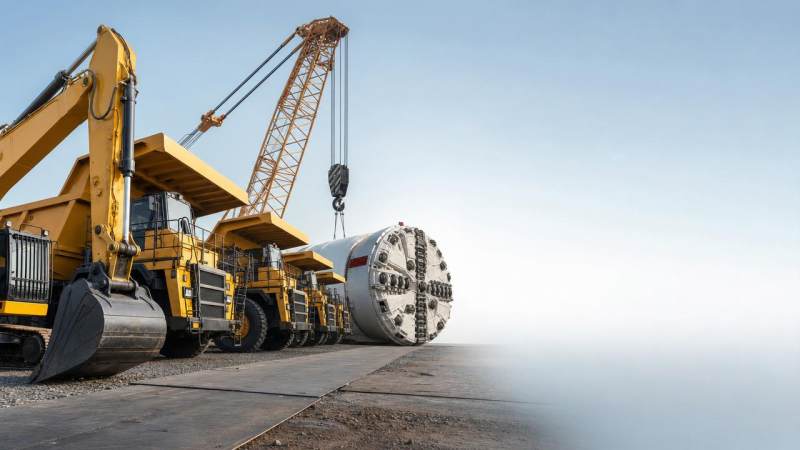
Infrastructure Construction Equipment Planning: What to Choose for Each Project Stage
Successful infrastructure construction starts with choosing the right equipment at the right stage.
That sounds obvious, but many delays and cost overruns begin here.
A machine that performs well in one phase can become a burden in the next.
Good infrastructure construction planning is not about buying the biggest fleet.
It is about matching machine capability with site conditions, delivery targets, and lifecycle cost.
In practice, the best equipment strategy also protects schedule certainty and safety performance.
This matters even more on complex jobs involving tunnels, heavy lifting, road networks, and bulk haulage.
From TF-Strategy’s view, strong decisions come from connecting machinery data with real construction methodology.
Start With the Project Logic, Not the Equipment List
Before selecting equipment, define what the project must achieve at each stage.
That includes output volume, access constraints, geotechnical conditions, lifting needs, and weather exposure.
Infrastructure construction often fails when planners treat all sites as standard production environments.
They are not.
Urban rail tunneling, mountain highways, mine access roads, and offshore wind logistics require different machinery logic.
A useful first screen is to review five planning variables.
- Ground condition: soft soil, rock, mixed face, unstable slope, or compacted base.
- Production target: peak daily output, cycle time, and buffer capacity.
- Site geometry: tunnel diameter, turning radius, lifting envelope, and haul distance.
- Risk profile: vibration limits, safety exposure, weather, and maintenance access.
- Commercial logic: CAPEX, fuel use, operator availability, and total cost of ownership.
Once these variables are clear, infrastructure construction equipment planning becomes far more precise.
Stage 1: Site Preparation and Early Earthworks
Early-stage infrastructure construction sets the tempo for everything that follows.
This phase usually requires clearing, grading, drainage shaping, temporary roads, and basic cut-and-fill operations.
The core fleet often includes excavators, bulldozers, wheel loaders, compactors, and motor graders.
What to prioritize
- Choose excavator size based on loading cycle, trench depth, and haul truck match.
- Use bulldozers for rough shaping where traction and pushing power matter more than finesse.
- Bring in compactors early if subgrade stability affects temporary traffic flow.
- Select graders when haul access and future paving quality depend on tighter surface control.
A common mistake is oversizing earthmoving equipment to chase short-term speed.
That can increase idle time, fuel burn, and rework if downstream haulage cannot keep pace.
For infrastructure construction, balance is usually more valuable than raw machine power.
Stage 2: Bulk Excavation, Haulage, and Material Flow
Once access is established, the focus shifts to sustained production.
This is where ultra-large excavators and mining dump trucks can change project economics.
On major corridors, quarry-linked road works, and large mining-related infrastructure construction, material flow becomes the main battleground.
How to choose wisely
Start with haul distance, gradient, payload requirement, and road condition.
Then match truck capacity to loading unit pass count.
If an excavator needs too many passes per truck, cycle efficiency drops fast.
If trucks are too large for road geometry, tire wear and safety risk rise.
This is where TF-Strategy often sees planning value in data-led fleet matching.
In heavy infrastructure construction, moving material smoothly is often more important than moving it faster for one shift.
Stage 3: Tunneling and Underground Works
Tunneling changes the planning model completely.
Here, equipment selection is driven by geology, diameter, lining method, groundwater, and settlement control.
For large underground infrastructure construction, TBM choice is the strategic decision.
When a TBM is the right answer
A TBM works best when alignment length, ground consistency, and schedule certainty support mechanized advance.
It becomes even more valuable where urban disturbance must be minimized.
But the machine alone does not define success.
Support systems matter just as much.
- Muck removal systems must match expected penetration rate.
- Segment handling and lifting plans must protect cycle time.
- Cutterhead material strategy must reflect abrasive or mixed ground conditions.
- Power and hydraulic reliability must support long continuous shifts.
From recent project patterns, smarter TBM planning now includes remote monitoring and predictive maintenance.
That helps infrastructure construction teams reduce stoppages that are expensive and hard to recover.
Stage 4: Heavy Lifting and Structural Installation
As projects move into structural assembly, crawler cranes become critical.
This is especially true in wind power, bridge segments, petrochemical modules, and major utility installations.
In infrastructure construction, lifting risk is rarely just about rated capacity.
It is about ground bearing pressure, lift radius, setup space, wind window, and transport logistics.
Key crane selection questions
- Does the site allow full crawler crane assembly and movement?
- Will repeated lifts justify a larger crane with better cycle efficiency?
- Are transport routes strong enough for counterweights and boom sections?
- Can lifting plans absorb weather delays without affecting critical path work?
This phase rewards planning discipline.
The right crane for infrastructure construction is the one that completes lifts safely and predictably, not just dramatically.
Stage 5: Roadworks, Surfacing, and Final Delivery
In the final visible phase, large road machinery defines finish quality.
Pavers, rollers, milling machines, and stabilizers must work as a coordinated system.
This is where poor upstream equipment planning often becomes obvious.
Weak subgrade, uneven haul timing, and moisture variation quickly damage surface results.
Best practice for this phase
Choose paving width and rolling pattern based on throughput and temperature window.
Avoid isolated machine decisions.
For infrastructure construction, the paver, plant, truck fleet, and compaction plan must stay synchronized.
More projects now also evaluate telematics and intelligent compaction.
That creates better quality records and stronger handover confidence.
How to Control Cost Without Hurting Delivery
The cheapest equipment option is rarely the lowest-cost infrastructure construction strategy.
A better approach is to track total cost of ownership across project stages.
- Measure idle hours, not just fuel hours.
- Price maintenance support into remote or difficult sites.
- Factor operator skill requirements into commissioning schedules.
- Review resale value or redeployment potential after phase completion.
- Assess electrification or hybrid options where regulations and energy supply support them.
This is also where market intelligence helps.
TF-Strategy follows tender movements, component trends, and heavy equipment evolution so infrastructure construction decisions stay grounded in reality.
A Practical Planning Framework
If equipment planning feels too broad, simplify it into a repeatable sequence.
- Map the project into clear construction stages.
- Define output targets and site constraints for each stage.
- Match primary equipment to production logic, not supplier preference.
- Check support systems, transport, maintenance, and operator readiness.
- Stress-test the plan against delay, weather, and geology risk.
- Revisit the fleet plan as project conditions change.
That last point matters more than most teams expect.
Infrastructure construction is dynamic.
Ground conditions shift, haul routes change, and delivery pressure increases near milestones.
The strongest plans leave room for adjustment without losing control.
Choose equipment stage by stage, test it against real operating conditions, and infrastructure construction outcomes become more predictable, efficient, and commercially sound.
Related News
 Oct 25, 2026Comparing Industrial Equipment Suppliers: Lead Times, Warranties, and ServiceMake a smarter industrial equipment supplier comparison. Explore lead times, warranty coverage, and service support to reduce downtime risk and choose with confidence.
 Oct 24, 2026Choosing Lifting Equipment for Middle East Petrochemical Plants in Hazardous AreasExplore petrochemical lifting equipment Middle East plants can rely on. Compare hazardous-area certification, capacity, and heat limits to make informed procurement decisions.
 Oct 23, 2026Selecting Lifting Equipment for Nuclear Component Transport: Key Safety CriteriaSelecting lifting machinery for nuclear component transport? Discover essential safety criteria, load control checks, and supplier requirements to guide confident procurement.
 Oct 22, 2026Tunnel Boring Machines in Southeast Asia: EPB vs. Slurry for Soft GroundCompare tunnel boring machines Southeast Asia projects rely on: EPB vs. slurry for soft ground. Discover how groundwater, settlement risks, and spoil handling shape the right choice.


Ms. Elena Rodriguez
Weekly Insights
Stay ahead with our curated technology reports delivered every Monday.