
Industrial Excavation Techniques Explained: Which Methods Fit Rock, Clay, and Urban Utility Corridors?
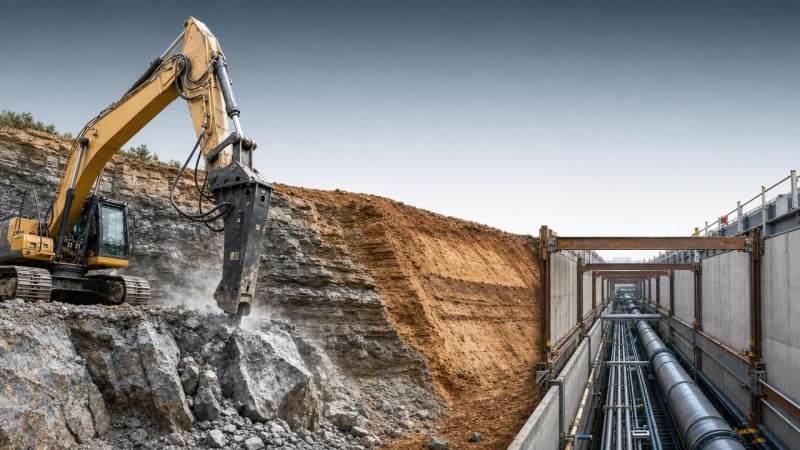
Selecting industrial excavation techniques is rarely a simple equipment choice. In rock cuts, saturated clay, and utility-dense city corridors, the method determines not only production rate, but also vibration risk, support needs, spoil handling, and downstream construction reliability.
That is why the topic matters across mining, transport, energy, and urban infrastructure. For platforms such as TF-Strategy, where machinery data and construction strategy are read together, excavation is best understood as a match between ground behavior, machine capability, and project constraints.
Why method selection has become more critical
Industrial excavation techniques are under closer scrutiny because projects now face tighter schedules, denser infrastructure interfaces, and stronger safety expectations. The wrong method can trigger slope instability, settlement, utility strikes, or avoidable wear on high-value equipment.
There is also a cost logic behind the discussion. A technique that looks fast at the face may create expensive hauling, dewatering, support, or environmental control requirements later.
In heavy industry, this link between field conditions and total project performance is increasingly visible. TF-Strategy’s broader view of excavators, TBM systems, haulage fleets, and lifting support reflects the same reality: excavation decisions shape the whole construction chain.
Understanding the main families of industrial excavation techniques
Most industrial excavation techniques fall into several practical groups. Each group responds differently to strength, abrasiveness, groundwater, access limitations, and proximity to existing assets.
- Mechanical digging, usually with hydraulic excavators, backhoes, trenchers, or wheel loaders, suits softer to medium soils and offers flexible maneuvering.
- Ripping uses a dozer or excavator-mounted ripper to fracture weathered rock or stiff material before loading.
- Rock breaking with hydraulic hammers handles localized hard zones where blasting is restricted.
- Drill-and-blast remains effective in competent rock where production demands are high and vibration can be controlled.
- Continuous cutting, including roadheaders, surface miners, and trenching systems, can improve profile control and reduce blast impacts.
- Specialized corridor methods, such as vacuum excavation or microtrenching support tools, prioritize precision around buried services.
In practice, projects often combine methods. A corridor may start with vacuum verification, move to saw cutting, then shift to compact excavators and hammer attachments in isolated obstructions.
What usually fits rock conditions
Rock is not one category. Excavation strategy changes between weathered shale, fractured basalt, massive granite, and mixed ground with soil seams. Strength alone never tells the full story.
Ripping and mechanical breaking in fractured or weathered rock
Where jointing is favorable, ripping can outperform blasting on control, permitting simplicity, and sequencing. It works best when the rock mass breaks along natural discontinuities rather than resisting as a uniform block.
Hydraulic breakers then handle isolated hard lenses. This combination is common where nearby structures, pipelines, or traffic make explosive use impractical.
Drill-and-blast in competent formations
For strong, massive rock and large cut volumes, drill-and-blast often remains the benchmark. It can deliver high output, but only when blast design, burden, timing, and overbreak control are tightly managed.
The evaluation should include fragmentation targets, flyrock protection, allowable vibration, and how the blast profile affects later support or pavement layers. Poor fragmentation can erase apparent savings through slower loading and crusher inefficiency.
Continuous cutting where precision matters
Roadheaders and surface miners deserve attention when the rock is cuttable and the project values profile accuracy, lower disturbance, or selective excavation. They are not universal solutions, but in suitable geology they reduce rehandling and improve wall quality.
This is especially relevant in tunnel approaches, controlled benches, and sites linked to downstream lifting or transport operations, where geometry matters as much as raw volume.
How clay changes the excavation decision
Clay appears easier than rock, yet it can create more instability and production loss than expected. The issue is not cutting resistance alone. Moisture sensitivity, stickiness, strength loss, and sidewall behavior shape the real method choice.
Stable clay versus sensitive clay
In firm, relatively dry clay, conventional mechanical excavation works well. Standard buckets, trenchers, and grade-control systems can maintain productivity with limited pretreatment.
Sensitive or wet clay is different. It may slump after exposure, trap equipment, and contaminate haul roads. Here, industrial excavation techniques must be judged with dewatering, temporary support, and spoil traffic in mind.
Equipment selection in sticky soils
Bucket geometry, track pressure, and machine mobility become decisive. Wide tracks, proper bucket coatings, and shorter haul cycles may matter more than nominal digging force.
Where trench shape must remain tight, trench boxes, sheeting, or staged excavation may be necessary. The best method is often the one that limits remobilization after wall collapse or base softening.
Watch the material after it leaves the cut
Clay can reduce cycle efficiency after excavation. It sticks in truck beds, overloads cleaning operations, and affects disposal or reuse plans. Evaluations that ignore off-face handling usually underestimate total cost.
Urban utility corridors demand a different mindset
In urban corridors, the excavation challenge is less about maximum output and more about controlled risk. Congested underground networks, narrow work zones, traffic management, noise restrictions, and settlement tolerance dominate the decision.
This is where industrial excavation techniques shift toward precision. Existing services may include fiber, gas, district energy, water, drainage, and legacy cables with incomplete records.
Low-impact methods around buried assets
Vacuum excavation is widely used for exposure and verification because it reduces mechanical contact risk. It is rarely the fastest bulk method, but it is often the most economical first step in high-uncertainty corridors.
Compact excavators, saw cutting, and selective hammering then follow once actual utility positions are confirmed. The sequence matters as much as the machine list.
Settlement, vibration, and reinstatement
A method that disturbs the subgrade or shakes adjacent assets can create problems beyond the trench. Pavement reinstatement quality, surface drainage recovery, and nearby building response should be part of method evaluation from the start.
That is why many urban projects favor controlled excavation rates over aggressive production. Predictability wins when corridor access is short and penalties for service interruption are high.
A practical comparison framework
When comparing industrial excavation techniques, a simple table helps keep the review grounded in field performance rather than assumptions.
What technical evaluation should focus on
The most useful evaluations connect geotechnical facts with operational consequences. Laboratory data and borehole logs matter, but they should lead to clear construction implications.
- Check rock mass structure, not only unconfined compressive strength.
- Review groundwater behavior and how it changes face stability.
- Measure the impact of spoil characteristics on haulage and disposal.
- Compare attachment wear, fuel demand, and downtime exposure.
- Include vibration, noise, and permitting constraints in urban or energy sites.
- Look at interface effects on cranes, roads, shoring, and downstream installation work.
This broader view aligns with the intelligence-led approach seen across TF-Strategy’s coverage. Excavation should not be isolated from haulage logic, machine lifecycle cost, or project delivery risk.
Where the industry is moving next
Method selection is becoming more data-driven. Digital terrain models, machine telemetry, remote-controlled excavation, and material tracking are improving how industrial excavation techniques are planned and adjusted in real time.
This matters in large mines, tunnel portals, and urban infrastructure alike. Better data makes it easier to predict wear, compare productivity by geology band, and decide when to shift from one method to another.
The strongest decisions usually come from combining three lenses: the ground, the machine, and the corridor around the work. If one lens is missing, the chosen method may look efficient on paper yet perform poorly on site.
A useful next step is to build a comparison matrix for each project section, then score industrial excavation techniques against geology, utility exposure, support needs, production targets, and life-cycle cost. That creates a clearer basis for method selection before field conditions force expensive changes.
Related News
 Oct 21, 2026Choosing Tunneling Equipment for the Middle East: Rock, Soil, and GroundwaterCompare underground tunneling equipment Middle East projects need. Explore rock, soil, groundwater, and TBM options to reduce risk and make confident procurement decisions.
 Oct 20, 2026Which Heavy Machinery Maintenance Standards Apply to Your Construction Fleet?Discover which heavy machinery maintenance standards apply to your fleet. Clarify legal duties, OEM requirements, and inspection rules to reduce risk and keep equipment ready for work.
 Oct 19, 2026Sizing Industrial Hydraulic Power Packs: Pressure, Flow, and Duty CycleSize industrial hydraulic power packs with confidence. Learn how pressure, flow, and duty cycle affect performance, energy costs, and heat control—and avoid costly sizing mistakes.
 Oct 18, 2026How Equipment Specifications Affect Purchase, Installation, and Operating CostsExplore equipment specification planning cost factors that shape purchase, installation, and operating budgets. Compare lifecycle costs, avoid oversizing, and buy with confidence.

Ms. Elena Rodriguez
Weekly Insights
Stay ahead with our curated technology reports delivered every Monday.