
Infrastructure Construction Delays: 7 Common Causes and How Project Teams Can Prevent Them
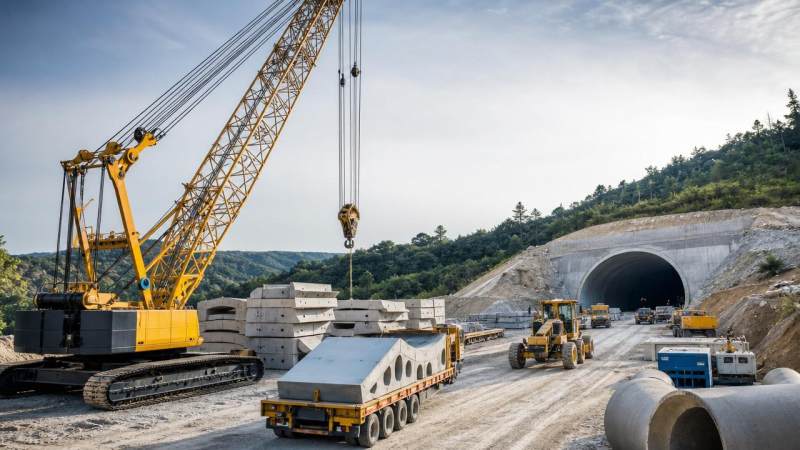
Why infrastructure construction delays rarely come from one issue
Infrastructure construction delays usually begin as small coordination gaps, then grow into schedule shocks across design, procurement, equipment deployment, and site execution.
That pattern appears in tunnel drives, open-pit access roads, wind component lifts, and highway expansion packages alike.
Budgets tighten fast when standby labor, idle machinery, and resequenced subcontract work pile up at the same time.
Stakeholder confidence also drops when milestones move without a clear explanation tied to physical site constraints.
In practice, infrastructure construction depends on the fit between ground conditions, heavy equipment capability, logistics timing, and decision speed.
This is why TF-Strategy often frames delay analysis through both machinery parameters and construction method choices, not schedule charts alone.
Different jobsite conditions create different delay risks
A mountain tunnel and a petrochemical lifting zone can both face delays, but the trigger points are rarely identical.
Underground works are more sensitive to geology shifts, cutter wear, ventilation limits, and muck handling continuity.
Surface mining support works depend more on haul-road readiness, fleet balance, fuel strategy, and weather exposure.
Large lifting operations add another layer, because crane selection, ground bearing pressure, and component delivery windows must align precisely.
Road infrastructure often looks simpler on paper, yet paving quality, material temperature, traffic diversion, and utility conflicts can still derail progress.
A useful delay review starts by asking which physical bottleneck governs the sequence, not which team is easiest to blame.
Where judgment changes by scenario
Seven common causes appear repeatedly in infrastructure construction
1. Incomplete site investigation
Many infrastructure construction delays start before mobilization, when surveys look complete but fail to capture operational reality.
For tunneling, that may mean underestimated abrasive zones or water ingress. For crane work, it may mean weak subgrade under outrigger paths.
Prevention depends on targeted verification, not just more documents. Recheck uncertain zones that directly affect sequence-critical activities.
2. Design changes arriving after field commitment
Late revisions hit hardest once specialized equipment is already assigned or prefabricated components are in transit.
In heavy infrastructure construction, design flexibility shrinks as machine setup, access preparation, and safety plans become fixed.
A stronger change gate helps. Any revision should be tested against equipment reach, lifting path, excavation method, and downtime impact.
3. Procurement and logistics misalignment
A schedule can look healthy while a critical bearing, cutter head component, hydraulic hose set, or imported steel section is already late.
This is common when teams track purchase orders but not transport risk, customs exposure, storage constraints, or site release readiness.
Better infrastructure construction planning uses milestone-linked procurement dashboards, with clear alerts for long-lead and single-source items.
4. Equipment underperformance in real conditions
A machine can meet nominal specifications and still fail the job when altitude, heat, slope, rock hardness, or duty cycle changes.
This matters across TBM systems, excavators, dump trucks, and large road machinery. Rated output is not the same as sustained field output.
Prevention means matching equipment to the actual operating envelope, then protecting uptime through parts planning and maintenance windows.
5. Weak interface management between contractors
Infrastructure construction often slows at handoff points rather than within a single work package.
A tunnel breakthrough can wait on spoil disposal changes. A crane lift can wait on civil tolerances. Paving can wait on utilities not relocated.
Interface maps should list dependency owners, acceptance criteria, and the latest date each handoff can slip without damaging the master sequence.
6. Poor risk response to weather and environment
Weather is not just a force majeure note. In many regions, it is a predictable production variable.
Extreme temperatures affect asphalt behavior, hydraulic efficiency, battery performance, and worker rotation planning.
Rainfall changes hauling efficiency, access stability, and lift safety margins. Cold conditions slow curing, fueling, and maintenance cycles.
The more practical response is to build seasonal methods into the baseline instead of treating them as exceptions.
7. Slow decision loops after early warning signs
Most infrastructure construction delays give warning before they become visible on the milestone chart.
Penetration rate drops, haul cycles lengthen, lift preparations repeat, and material variance grows. The signal is there, but action lags.
Teams that recover faster usually have threshold-based triggers, not vague review routines. That is where digital monitoring starts to pay back.
What teams often misread before delays become expensive
A frequent mistake is assuming similar infrastructure construction packages share the same control points.
For example, two tunnel sections may use the same TBM class, yet one faces fractured rock and the other faces abrasive wear.
Another misread is focusing on purchase price while ignoring downtime cost, replacement lead time, and support accessibility.
Some teams also overtrust static schedules. On complex sites, the real question is how quickly the plan can absorb disruption without losing flow.
- Do not judge equipment only by brochure output. Check sustained performance under local loads and climate.
- Do not separate engineering data from logistics data. Delays often sit between those systems.
- Do not treat access roads, drainage, power supply, and lifting pads as secondary works.
- Do not assume reporting speed equals decision speed. Escalation authority still matters.
How prevention looks in day-to-day infrastructure construction
The strongest prevention plans are usually plain, measurable, and tied to field reality.
In actual projects, that means linking schedule control to machinery health, material availability, and physical readiness checks.
It also means using intelligence well. TF-Strategy’s focus on tenders, raw material supply, equipment evolution, and operating logic reflects this need.
When project teams understand both market signals and machine constraints, they can spot delay patterns earlier and respond with better options.
A practical prevention checklist
- Validate the most schedule-sensitive ground, access, and load assumptions before full mobilization.
- Track long-lead items by arrival risk, not by order status alone.
- Match heavy equipment selection to real duty cycles, not ideal operating windows.
- Create interface registers for each dependency that can stop critical path work.
- Set trigger points for intervention when production indicators move outside normal bands.
- Review total cost of delay, including standby fleets, resequencing, and quality rework exposure.
Keeping infrastructure construction on track starts with sharper scenario judgment
Infrastructure construction delays are rarely solved by pushing one supplier or extending one shift.
The more reliable approach is to identify which scenario-specific constraint is most likely to break continuity, then plan around it early.
That may involve rechecking geology, revising logistics buffers, comparing equipment options, or tightening interface ownership before the next milestone.
A useful next step is to map current infrastructure construction packages by ground condition, machinery dependency, supply risk, and weather exposure.
From there, build a simple adaptation standard: critical assumptions, warning signals, fallback actions, and the decision window for each major activity.
Related News
 Sep 12, 2026Open-Pit Mining in North America: Key Project Risks and Planning PrioritiesOpen-pit mining North America: uncover key risks and planning priorities for geology, permitting, water, fleet strategy, and resilient project delivery.
 Sep 11, 2026TBM Systems in Southeast Asia: Key Selection Factors for Variable Ground ConditionsTBM systems Southeast Asia: discover key selection factors for variable ground, pressure control, monsoon resilience, and safer tunnel delivery.
 Sep 10, 2026How to Select Bridge Lifting Machinery for Span, Load, and Site ConstraintsLifting machinery for bridges: learn how to match capacity, span, radius, ground conditions, and access constraints for safer, cost-effective bridge erection.
 Sep 12, 2026Is heavy haulage more cost-effective by rail or truck in remote infrastructure projects?Is heavy haulage more cost-effective by rail or truck in remote areas? Discover the real TCO drivers—beyond fuel and distance—for infrastructure projects.


Ms. Elena Rodriguez
Weekly Insights
Stay ahead with our curated technology reports delivered every Monday.