
Infrastructure Construction Delays: How Geotechnical Risks Affect Cost and Schedule
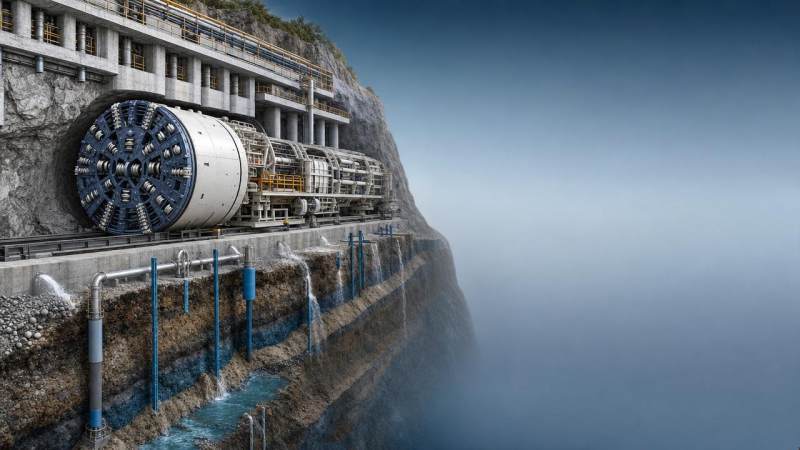
Why do geotechnical risks trigger infrastructure construction delays so often?
In infrastructure construction, the visible delay is rarely the real starting point. The deeper cause is often below grade, where soil, rock, and groundwater do not match early assumptions.
That mismatch quickly spreads across design, procurement, equipment selection, and field sequencing. A tunnel drive may slow, a crane foundation may need redesign, or a road platform may require unexpected stabilization.
For schedule reviews, geotechnical uncertainty matters because it changes more than excavation rates. It affects access roads, temporary works, dewatering, spoil handling, and the safe use of heavy machinery.
This is why infrastructure construction delays often look operational on the surface but are geological in origin. When ground behavior changes, cost and schedule assumptions lose reliability at the same time.
In sectors tracked by TF-Strategy, this pattern appears repeatedly. TBM drives face mixed ground and water ingress, open-pit operations encounter unstable benches, and large lifting plans depend on subgrade capacity that must be proven, not assumed.
Which subsurface conditions create the biggest cost and schedule shocks?
Not every ground issue causes major disruption. The most damaging ones are those that force redesign, slow production, or create safety controls that were not built into the baseline program.
In practical terms, four conditions appear again and again in delayed infrastructure construction projects.
- Unstable or variable soil layers that reduce bearing capacity and complicate excavation support.
- Groundwater pressure that increases dewatering demand, inflow risk, and lining or shoring complexity.
- Unexpected rock strength or mixed-face conditions that reduce TBM performance and accelerate cutter wear.
- Contaminated or collapsible material that changes spoil treatment, haulage logistics, and environmental controls.
A key point is that these conditions rarely stay isolated. Weak ground can increase groundwater problems. Water ingress can slow excavation, then disrupt concrete works, then delay mechanical installation.
That chain reaction is where budget pressure grows. Direct costs rise, but indirect costs often rise faster through standby equipment, contract claims, supervision extensions, and lost productivity.
A quick judgment table for common geotechnical delay signals
A simple review table can help separate manageable uncertainty from conditions likely to disrupt infrastructure construction at scale.
How do ground risks affect equipment productivity, not just civil works?
This is where many reviews become too narrow. Ground risk does not only damage excavation plans. It also reshapes the performance envelope of heavy equipment across the job.
For TBM operations, unexpected ground changes can alter thrust demand, slurry balance, cutter replacement cycles, and segment installation rhythm. A machine designed for one range of conditions may still operate, but with lower efficiency and higher intervention frequency.
For crawler cranes, the issue is often hidden in plain sight. Lift planning may be technically sound, yet poor ground bearing capacity can force mat redesign, reduced lifting windows, or restricted movement on site.
Road machinery also feels the impact. If subgrade moisture or density remains unstable, paving sequences stretch, rework increases, and downstream quality assurance becomes more expensive.
The same logic applies in mining-linked infrastructure construction. Haul roads, dump platforms, and pit-edge works depend on geotechnical stability. When that stability weakens, truck cycle times and excavation continuity suffer together.
TF-Strategy’s value in this context is not promotional but analytical. Its intelligence model connects physical machine behavior with construction methodology, making it easier to judge whether a delay risk is geological, mechanical, or a combination of both.
What are the early warning signs before a delay becomes expensive?
The most useful warning signs are usually operational, not dramatic. Projects seldom fail because of one shocking discovery. More often, they drift into trouble through repeated small indicators.
- Advance rates trend below plan without a clear mechanical fault.
- Water management shifts from routine pumping to continuous emergency response.
- Temporary support quantities exceed design allowances early in the work.
- Spoil characteristics vary sharply from the geotechnical baseline report.
- Work pads, access tracks, or crane positions require repeated strengthening.
When two or three of these signals appear together, the schedule risk usually moves beyond normal field variance. At that point, the question is no longer whether infrastructure construction will slow, but how far the delay will spread.
A useful discipline is to compare field data against assumptions made during tendering. If the geotechnical baseline, equipment utilization model, and actual consumption rates are moving apart, the risk profile has changed materially.
How should schedule and cost exposure be evaluated before committing?
A strong review does not ask whether geotechnical risk exists. It asks whether the project has priced, sequenced, and contractually allocated that risk in a realistic way.
One practical approach is to test the project through linked questions rather than a single contingency percentage.
Questions that usually reveal hidden exposure
- How dense is the site investigation, and does it match the complexity of the alignment or footprint?
- Are groundwater assumptions supported by seasonal data or only one survey window?
- Does the baseline program include downtime for probe drilling, treatment, or support changes?
- Are major equipment choices aligned with the most difficult ground, not only average ground?
- Who carries the cost if actual conditions differ from interpreted conditions?
In real infrastructure construction deals, the contract structure matters as much as the soil report. A low initial price may simply mean that unresolved ground risk has been pushed forward into claims, change orders, or future delay notices.
This is also where intelligence from heavy industry sources becomes useful. Benchmarks on TBM cutter wear, crane ground-pressure limits, or haulage performance in weak formation can sharpen assumptions that generic reports often miss.
Can infrastructure construction delays from geotechnical risk be reduced in practice?
Yes, but not through one control measure. The better results usually come from combining investigation quality, adaptive planning, and equipment-aware execution.
In practical terms, the most effective actions tend to be the following.
- Expand early subsurface verification in zones where consequences of failure are highest.
- Build schedule buffers around known geological transition areas, not uniformly across the whole project.
- Match heavy equipment configuration to adverse conditions, including spare parts and intervention access.
- Define trigger points for redesign, dewatering escalation, or production resequencing before work starts.
- Use field monitoring data as a management tool, not just a compliance record.
The common mistake is waiting for certainty. In infrastructure construction, full certainty underground is rare. Better performance comes from preparing disciplined responses to uncertainty that is already expected.
That mindset is especially important on projects involving TBM systems, heavy lifting platforms, large roadworks, or mining-linked logistics. These are equipment-intensive environments where geotechnical surprises multiply through every dependent activity.
What should be reviewed next when a project already looks vulnerable?
Start with the points where geology, equipment, and contract exposure intersect. Those are usually the fastest paths to understanding whether an apparent delay is temporary or structural.
Recheck the geotechnical baseline against current field records. Compare predicted production with actual machine behavior. Then test whether mitigation measures are funded, scheduled, and contractually supported.
If the project depends on high-value machinery, review the physical parameters that matter most: ground pressure tolerance, wear rate, water control capacity, lifting platform performance, and haulage continuity.
Reliable infrastructure construction decisions come from linking those technical signals to commercial exposure. That is where specialized intelligence, including the cross-sector perspective associated with TF-Strategy, can improve judgment without turning analysis into sales language.
The next step is straightforward: build a short review list for ground assumptions, schedule sensitivity, and equipment fit. Once those three lines are tested together, delay risk becomes easier to price, compare, and manage.
Related News
 Oct 26, 2026How TBM Electrical Systems Distribute Power and Protect Against FaultsExplore how TBM equipment electrical systems distribute power, coordinate fault protection, and maintain essential services. Learn what to check for safer, more reliable tunneling.
 Oct 25, 2026Comparing Industrial Equipment Suppliers: Lead Times, Warranties, and ServiceMake a smarter industrial equipment supplier comparison. Explore lead times, warranty coverage, and service support to reduce downtime risk and choose with confidence.
 Oct 24, 2026Choosing Lifting Equipment for Middle East Petrochemical Plants in Hazardous AreasExplore petrochemical lifting equipment Middle East plants can rely on. Compare hazardous-area certification, capacity, and heat limits to make informed procurement decisions.
 Oct 23, 2026Selecting Lifting Equipment for Nuclear Component Transport: Key Safety CriteriaSelecting lifting machinery for nuclear component transport? Discover essential safety criteria, load control checks, and supplier requirements to guide confident procurement.
Related News

Ms. Elena Rodriguez
Weekly Insights
Stay ahead with our curated technology reports delivered every Monday.