
Infrastructure Construction Project Planning: What Drives Cost, Delays, and Risk?
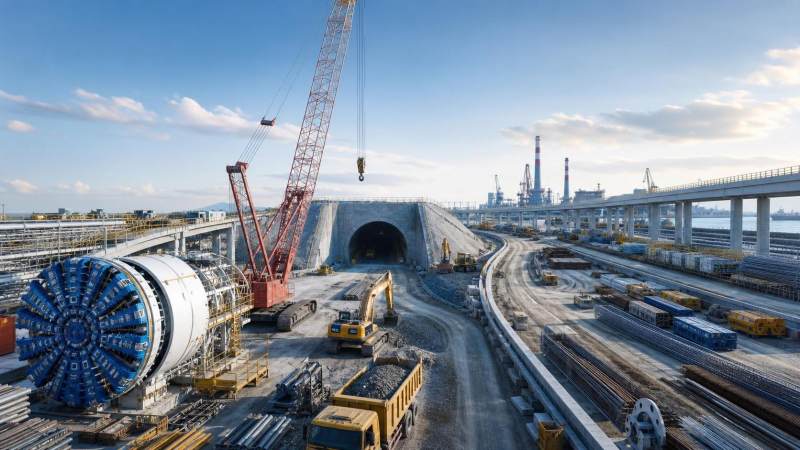
Infrastructure Construction Project Planning: What Drives Cost, Delays, and Risk?
Infrastructure construction projects rarely fail for one reason alone.
More often, cost, schedule, and risk start drifting when several small planning gaps overlap.
A weak ground model affects equipment choice.
Equipment choice affects productivity, logistics, maintenance, and crew planning.
That chain reaction is where many infrastructure construction problems begin.
Good planning does not remove uncertainty.
It makes uncertainty visible early enough to manage.
Why Infrastructure Construction Costs Rise Faster Than Expected
The first cost driver is incomplete scope definition.
If interfaces, utility conflicts, haul routes, or access windows stay vague, budgets look cleaner than reality.
That may help a business case.
It usually hurts delivery later.
The second driver is ground uncertainty.
In tunneling, poor geological prediction changes cutter wear, advance rates, spoil handling, and support requirements.
In open-pit or road works, it changes blasting, drainage, slope stability, and pavement preparation.
The third driver is equipment mismatch.
A machine can be technically capable and still be wrong for the project.
For example, a TBM with the wrong cutterhead setup can destroy productivity.
An oversized crane can increase mobilization cost without improving lift efficiency.
Labor productivity is another silent cost issue.
Many budgets assume ideal crew output.
Real output depends on training, shift design, safety controls, weather, maintenance access, and supervision quality.
In practical infrastructure construction planning, the biggest cost mistake is treating estimates as fixed facts instead of managed assumptions.
Common Cost Escalation Triggers
- Late design changes after procurement starts
- Underestimated spare parts and consumables
- Weak assumptions for fuel, power, and haul distance
- Temporary works excluded from early budgets
- Rework caused by poor interface management
- Claims exposure from unclear contract boundaries
What Causes Infrastructure Construction Delays
Delays usually appear in schedules long after they begin in planning.
That is why schedule recovery often feels expensive and slow.
One major cause is unrealistic sequencing.
Some plans look efficient on paper but ignore access restrictions, permit timing, or actual installation windows.
The result is a schedule with no breathing room.
Another cause is procurement lag.
Critical items in infrastructure construction often include long-lead steel, electrical systems, cutters, bearings, hydraulic components, or transport permits.
If procurement is not tied to the critical path, the schedule becomes fragile.
Logistics is also more important than many plans admit.
Heavy equipment delivery depends on ports, roads, escorts, customs clearance, and lifting availability.
A delay in one route can idle an entire workfront.
More noticeably now, digital reporting does not automatically improve schedule control.
If progress data arrives late or lacks field validation, dashboards simply display delay more clearly.
Delay Patterns Seen Repeatedly
- Permits are assumed, not tracked as critical deliverables.
- Design packages are released unevenly, causing stop-start execution.
- Maintenance downtime is ignored in production forecasts.
- Weather risks are listed but not built into work logic.
- Contractors optimize their package, not the full infrastructure construction sequence.
How Hidden Risk Builds Inside Complex Projects
Risk in infrastructure construction is rarely hidden because nobody looked.
It is hidden because teams look in isolated ways.
Engineering teams may focus on technical soundness.
Procurement teams focus on price and lead time.
Site teams focus on daily output.
Commercial teams focus on claims and change control.
Each view is valid, but incomplete.
This is where strategic intelligence matters.
TF-Strategy follows the links between machine capability, geology, methods, and delivery strategy.
That perspective is useful because risk usually travels across those same links.
For example, cutter wear is not only a maintenance issue.
It can become a schedule issue, a logistics issue, and then a cost issue.
The same is true for haul road quality, crane ground bearing pressure, or dump truck performance in altitude and heat.
In other words, hidden risk grows when teams fail to translate technical detail into project consequences.
A Better Way to Read Risk Early
- Test production assumptions against maintenance cycles
- Map every critical machine to spare parts exposure
- Compare ground data with chosen construction methodology
- Review logistics routes before equipment finalization
- Link contract clauses to realistic field events
Planning Decisions That Improve Infrastructure Construction Outcomes
Better outcomes start before mobilization.
They come from sharper planning decisions, not just stronger site effort.
First, plan around constraints, not ideal flow.
The best infrastructure construction schedules are built from real bottlenecks backward.
That includes permits, shafts, launch windows, transport corridors, grid access, and lifting capacity.
Second, choose equipment as part of a system.
A TBM, excavator, crane, paver, or dump truck should never be evaluated in isolation.
Its value depends on support equipment, operator capability, maintenance support, and site conditions.
Third, manage cost through scenario ranges.
Single-point estimates create false confidence.
A stronger approach uses base, stress, and disruption cases for productivity, wear, weather, and supply timing.
Fourth, create one version of operational truth.
Field reporting, maintenance data, and commercial records should describe the same reality.
Without that, infrastructure construction decisions become reactive and political.
A Practical Planning Checklist
How Better Intelligence Supports Better Delivery
Today, infrastructure construction is shaped by tighter margins and more technical complexity.
At the same time, owners expect better safety, lower emissions, and more predictable delivery.
That raises the value of high-quality intelligence.
Not just market news, but usable insight on methods, machine performance, material trends, and project execution logic.
TF-Strategy focuses on exactly that intersection.
Its coverage of TBM systems, open-pit equipment, crawler cranes, road machinery, and mining trucks helps connect technical choices with project outcomes.
That matters because infrastructure construction success depends on those links being visible early.
The clearer the link between machine behavior and delivery strategy, the easier it becomes to control total project cost.
It also becomes easier to defend schedules and reduce avoidable risk.
Final Takeaway
Most infrastructure construction problems start as planning assumptions that go untested.
Costs rise when scope, ground data, and equipment reality do not align.
Delays grow when procurement, logistics, and sequencing are separated.
Risk expands when technical signals are not translated into commercial and operational action.
The practical response is straightforward.
Challenge assumptions early, plan around real constraints, and connect equipment decisions to field conditions.
That approach makes infrastructure construction more predictable, more efficient, and far easier to steer under pressure.
When planning becomes more integrated, delivery becomes more reliable.
Related News
 Sep 16, 2026Infrastructure Equipment Market Reference: Demand, Pricing, and Supplier BenchmarksInfrastructure equipment market reference for buyers: assess demand signals, total cost, pricing risks, and supplier benchmarks for tunnels, mining, cranes, and road projects.
 Sep 15, 2026How to Evaluate Infrastructure Equipment Suppliers for Complex Project RequirementsInfrastructure equipment solutions supplier evaluation guide for complex projects: assess technical fit, lifecycle cost, reliability, local support, and contract risk.
 Sep 14, 2026What Drives Surface Mining Equipment Cost Across a Mine’s Operating Life?Surface mining equipment cost depends on fleet matching, fuel, wear, maintenance, availability, and rebuild timing. Explore lifecycle strategies that protect output and margins.
 Sep 13, 2026Crawler Crane Application Analysis for Wind Farms, Bridges, and Confined SitesCrawler crane application analysis for wind farms, bridges, and confined sites—optimize lift paths, ground conditions, access, and schedules for safer project delivery.
Ms. Elena Rodriguez
Weekly Insights
Stay ahead with our curated technology reports delivered every Monday.