
Wind Power Components Explained: Key Parts, Functions, and Failure Points
Why do wind power components matter so much?
Understanding wind power components starts with one practical question: what actually keeps a turbine producing power reliably for years?
A wind turbine looks simple from a distance. In reality, it is a tightly linked system of structural, electrical, and control parts.
If one component underperforms, the effect spreads fast. Output drops, maintenance costs rise, and downtime can become expensive surprisingly quickly.
That is why wind power components are not only an engineering topic. They also influence project finance, crane planning, transport strategy, and long-term asset value.
This matters even more in heavy industry contexts. Platforms such as TF-Strategy often track how lifting capacity, site logistics, and equipment reliability connect across infrastructure projects.
In wind energy, that same logic applies. The physical parameters of components shape installation methods, maintenance windows, and total cost of ownership.
So when people search for wind power components, they usually want more than a parts list. They want to know what each part does and where failures usually begin.
Which wind power components are considered the core of a turbine?
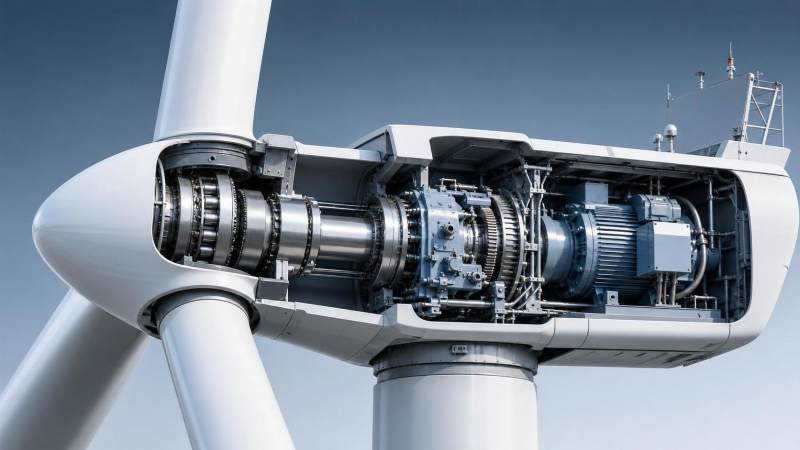
The core wind power components can be grouped into aerodynamic, mechanical, electrical, and control sections.
At the front, the blades capture wind energy. Their shape determines how efficiently airflow turns rotational force into usable motion.
The hub connects the blades and transfers loads into the main shaft. It also carries pitch systems on many turbine designs.
Behind that sits the nacelle, which houses many of the most critical wind power components, including the gearbox, generator, brake, bearings, and control hardware.
The tower supports the nacelle and rotor at height, where wind is stronger and more stable. The foundation then transfers all dynamic loads into the ground.
Electrical systems complete the chain. These include the converter, transformer, cables, sensors, and control units that regulate output and grid compatibility.
- Blades: capture wind and create lift.
- Hub and pitch system: control blade angle and load response.
- Main shaft and bearings: transfer rotating loads.
- Gearbox or direct-drive unit: manage speed conversion.
- Generator and converter: turn motion into controlled electricity.
- Tower and foundation: hold structural integrity under cyclic stress.
In practical reviews, these parts should never be judged separately. Wind power components work as a load-sharing system, not as isolated products.
How does each component affect performance, maintenance, and cost?
Not all wind power components influence project results in the same way. Some drive energy capture, while others drive maintenance intensity.
Blades affect annual energy production directly. Even small surface damage can reduce aerodynamic efficiency and increase noise or imbalance.
The gearbox is often the most watched mechanical component. It handles heavy torque variation and can become a major maintenance cost center.
Bearings deserve similar attention. Main bearings and pitch bearings can degrade slowly, but once wear accelerates, replacement becomes costly and logistically demanding.
Electrical wind power components shape power quality and grid compliance. Converter faults may not look dramatic, but they can stop generation immediately.
The table below gives a more useful view than a simple parts glossary.
A useful takeaway is this: the most expensive wind power components are not always the ones that fail most often. They are often the hardest to access or replace.
Where do wind turbine failures usually begin?
Failure points usually begin where stress, motion, and environment meet. That is why blades, bearings, gearboxes, and electrical systems are closely monitored.
Blade leading-edge erosion is one of the most common issues. Rain, dust, and airborne particles slowly damage the surface and reduce aerodynamic performance.
Pitch systems also create recurring concern. If pitch motors or hydraulic units respond poorly, the turbine may struggle to control loads during strong wind events.
Inside the nacelle, lubrication problems can trigger a chain reaction. A minor issue in oil quality or contamination may later appear as bearing wear or gearbox distress.
Electrical failures often begin less visibly. Heat buildup, moisture ingress, insulation aging, or converter stress can gradually undermine reliability.
Foundation and tower issues are less frequent, but they are high consequence. Bolt preload loss, corrosion, or fatigue cracking should never be treated as cosmetic.
- Watch vibration trends rather than one-off alarm events.
- Compare oil debris data with temperature behavior.
- Check blade condition before output loss becomes obvious.
- Review crane access needs for major component replacement.
In real asset reviews, failure analysis is most useful when paired with logistics thinking. Replacing large wind power components is a heavy-lift decision, not only a maintenance decision.
How should you judge different wind power components when comparing turbine designs?
A common mistake is to compare wind power components only by rated capacity. That tells part of the story, but not enough.
A more grounded comparison looks at load path, service access, supply chain maturity, and replacement complexity.
For example, direct-drive turbines remove the gearbox, which can reduce one failure category. However, generator size, weight, and material demands may increase elsewhere.
Blade design also needs context. Longer blades can improve energy capture, but transport limits, crane selection, and site constraints may reshape the business case.
That perspective aligns with broader infrastructure analysis. TF-Strategy often examines how machinery parameters affect execution strategy, and wind projects follow the same rule.
When comparing options, these questions usually produce better answers than headline efficiency claims:
- Which wind power components are hardest to inspect on site?
- How available are replacement parts in the target region?
- What heavy-lift equipment is needed for major repairs?
- How does the design behave in dust, salt, cold, or heat?
- Which failures create long outages instead of short resets?
What are the most common misunderstandings about wind power components?
One misunderstanding is that all critical wind power components sit inside the nacelle. In fact, blade condition often has a direct and early effect on revenue.
Another is that higher-tech control systems automatically remove mechanical risk. Smarter controls help, but they cannot erase fatigue, contamination, or installation errors.
Some also assume that rare failures matter less than frequent ones. That is not always true. Low-frequency structural failures can carry the highest consequence.
It is also easy to underestimate installation quality. Misalignment, torque errors, cable routing mistakes, or poor sealing may create later failures that look like design defects.
A final misunderstanding concerns cost. Cheap replacement parts do not guarantee low lifecycle cost if access requires large cranes, vessel support, or long weather delays.
If you are reviewing a turbine, what should you check first?
Start with the relationship between energy capture, failure history, and service difficulty. That combination tells more than a standalone component list.
Then map the major wind power components against three filters: consequence of failure, time to replace, and sensitivity to local operating conditions.
If the goal is a quick technical screen, focus first on blades, gearbox or direct-drive architecture, main bearings, converter reliability, and tower-foundation integrity.
If the goal is lifecycle judgment, add spare parts access, heavy-lift requirements, monitoring quality, and regional service support.
That is usually where a smarter review begins. Wind power components should be read as part of an operating system, not as disconnected hardware entries.
The next sensible step is to build a simple comparison sheet. List key parts, likely failure points, inspection intervals, and recovery complexity for each design under review.
Done well, that approach supports clearer decisions on reliability, maintenance exposure, and long-term infrastructure value.
Related News
 Sep 19, 2026Mining Truck Technology Trends: What Fleet Managers Should Prioritize for 2026Mining truck technology trends for 2026: prioritize electrification, autonomy, predictive maintenance, and road intelligence to improve fleet uptime, safety, and cost control.
 Sep 17, 2026How TBM Guidance Technology Maintains Alignment Through Curves and Variable GroundTunnel boring machine guidance technology helps teams maintain precise alignment through curves and variable ground, reducing risk, improving lining accuracy, and protecting schedules.
 Sep 16, 2026Infrastructure Equipment Market Reference: Demand, Pricing, and Supplier BenchmarksInfrastructure equipment market reference for buyers: assess demand signals, total cost, pricing risks, and supplier benchmarks for tunnels, mining, cranes, and road projects.
 Sep 15, 2026How to Evaluate Infrastructure Equipment Suppliers for Complex Project RequirementsInfrastructure equipment solutions supplier evaluation guide for complex projects: assess technical fit, lifecycle cost, reliability, local support, and contract risk.
Ms. Elena Rodriguez
Weekly Insights
Stay ahead with our curated technology reports delivered every Monday.