
Nuclear Components and Quality Standards: What Buyers Should Verify Before Approval
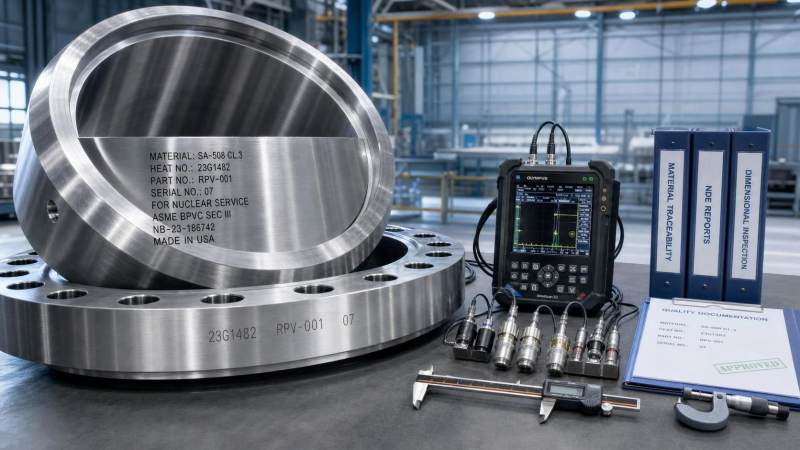
Why do nuclear components need deeper verification before approval?
In heavy industry, approval is rarely a paperwork exercise. That is especially true for nuclear components used in lifting, containment, heat transfer, and safety-related systems.
A certificate may confirm compliance on paper. It does not automatically prove that the component matches the approved material heat, weld procedure, inspection scope, or final dimensions.
This matters because nuclear components often move through complex supply chains. Forgings, machining, welding, coating, testing, packing, and site handling may all involve different parties.
In projects linked to crawler cranes, nuclear island installation, or other critical infrastructure, one missing record can delay release, trigger rework, or raise regulatory questions later.
That is why experienced reviewers look beyond the headline certificate. They check whether the full evidence trail supports safe service, code acceptance, and long-term reliability.
From a broader TF-Strategy perspective, this is part of the same “Power and Precision” logic seen across TBM cutterheads, mine equipment structures, and ultra-large lifting assemblies.
When components carry high loads, harsh temperatures, or consequence-sensitive duties, small documentation gaps become major project risks.
What should be verified first: certificates, traceability, or actual manufacturing records?
The practical answer is to start with traceability, then connect it to certificates and manufacturing records.
If traceability is weak, every later document becomes harder to trust. A material test certificate is only useful when it clearly ties to the exact part, heat number, and revision status.
For nuclear components, the first review usually covers these checkpoints:
- Base material identification matches drawing, purchase specification, and code requirement.
- Heat numbers remain traceable after cutting, machining, and welding.
- Certificate values align with chemistry, mechanical properties, and heat treatment condition.
- Manufacturing route records show each critical step without unexplained gaps.
- Document revisions are controlled, signed, and consistent with the final component configuration.
In real projects, more problems come from broken continuity than from missing top-level certificates. A forged ring may have the right chemistry, yet the marking transfer after rough machining may be unclear.
That single weakness can affect approval confidence. It also complicates root-cause analysis if a later NDT indication appears near a weld preparation area.
A useful rule is simple: if the part history cannot be followed step by step, approval should pause until the record chain is restored.
A quick screening table for early approval decisions
Before a deep technical review, a short screening table helps identify whether the nuclear components package is ready for serious approval.
How closely should welding, NDT, and heat treatment records be checked?
Very closely. For many nuclear components, this is where acceptance confidence is either confirmed or lost.
Welding records should not be reviewed as isolated forms. They need to be read together with joint design, filler material control, preheat limits, interpass control, and repair history.
A weld may pass radiography and still raise concerns if the wrong procedure revision was used or if post-weld heat treatment was not applied within the approved window.
The same principle applies to NDT. Reports should answer more than “pass” or “fail.” They should show method, operator qualification, calibrated equipment, inspection coverage, and the correct acceptance standard.
In practice, the most useful review questions are often very direct:
- Was ultrasonic testing performed before or after final machining?
- Did liquid penetrant testing cover repair areas and attachment removal zones?
- Did heat treatment charts show actual holding time, ramp rate, and thermocouple locations?
- Were any concessions accepted, and if so, who approved them?
These details matter because nuclear components often operate where stress concentration, thermal cycling, and access limitations amplify small manufacturing deviations.
A good review also compares NDT results with fabrication history. If several indications cluster in one area, that pattern deserves attention even when each report is technically acceptable.
Are dimensional checks and code references really as important as material quality?
Yes, because approval risk is often created at the intersection of geometry and code, not material alone.
A component can be made from the correct alloy and still fail in service or at installation if flatness, bore alignment, wall thickness, or weld preparation geometry falls outside tolerance.
This is especially relevant where nuclear components interface with large equipment, support frames, anchor systems, or heavy-lift rigging plans. Small dimensional shifts can change load distribution.
Code references deserve the same attention. Different projects may call for ASME Section III, RCC-M, or project-specific supplements. Similar wording does not mean identical acceptance criteria.
A disciplined check should confirm:
- The drawing revision used for inspection is the final released version.
- Critical dimensions are measured with traceable instruments.
- Acceptance criteria are taken from the correct code edition and addenda.
- Any deviation permits are linked to exact dimensions and locations.
More than one project delay has started with a compliant test report attached to a component inspected against an outdated drawing. That kind of mismatch is preventable.
Where do approval teams usually misjudge nuclear components?
The common mistake is assuming that complete documentation means reliable documentation.
A thick dossier can still hide weak links. Repeated copy-paste values, unsigned hold-point releases, or missing repair maps are warning signs, even when the file looks impressive.
Another frequent error is treating deviations as purely commercial issues. For nuclear components, even a minor concession can affect future maintenance logic, replacement compatibility, or regulator confidence.
It is also easy to underestimate packaging and preservation records. Corrosion, impact damage, or contamination during storage can undo careful manufacturing control.
A more grounded review asks whether the component can be defended through its whole lifecycle, not just released from the shop.
That lifecycle view fits the intelligence-led approach often used in major infrastructure sectors. Whether reviewing TBM systems, open-pit machinery structures, or nuclear lifting interfaces, the strongest decisions combine data integrity with field reality.
Signals that deserve a second look
- Material certificates mention equivalent grades without formal approval.
- NDT coverage percentages are stated, but scanned areas are not mapped.
- Weld repair count is missing or inconsistent between reports.
- Dimensional reports show pass results without raw measured values.
- Final dossier arrives quickly after a long manufacturing delay.
What is the most practical approval workflow before final release?
The most effective workflow is staged, evidence-based, and difficult to bypass.
Start with specification alignment. Confirm code, drawing revision, material class, inspection level, and hold points before reading the full dossier.
Then review traceability and manufacturing flow. If the identity chain is weak, deeper checks may waste time because the package is not yet approval-ready.
After that, focus on the risk-heavy records: welding, NDT, heat treatment, and dimensions. These usually determine whether the nuclear components package is technically defensible.
Only then should concessions, punch items, preservation status, and shipment release be closed out.
A simple workflow often works best:
- Define critical attributes before document review begins.
- Use a single approval checklist tied to code clauses and drawing notes.
- Escalate any traceability break before discussing minor paperwork gaps.
- Record technical reservations clearly, with location and evidence.
- Release only when dossier, marking, and physical condition match.
That approach reduces approval risk without turning the process into a document chase. It also supports better coordination across fabrication, transport, lifting, and installation interfaces.
Final check: what should be in place before approval is signed?
Before signing off, the evidence should tell one consistent story. The component identity, material origin, process history, inspection results, and final condition should all match.
For nuclear components, that consistency is often more valuable than a large volume of documents. Clear, connected evidence is easier to defend during audits, installation reviews, and later service investigations.
A sound final check usually confirms code compliance, verifies unresolved deviations, reviews preservation status, and ensures the release package reflects the actual shipped item.
If any uncertainty remains, the best next step is not speed. It is targeted clarification.
Build the approval around traceability, weld integrity, NDT quality, dimensions, and code alignment. Then compare those findings against the installation and service context.
That is how approval decisions stay practical, defensible, and aligned with the high-consequence reality of modern infrastructure.
Related News
 Sep 19, 2026Mining Truck Technology Trends: What Fleet Managers Should Prioritize for 2026Mining truck technology trends for 2026: prioritize electrification, autonomy, predictive maintenance, and road intelligence to improve fleet uptime, safety, and cost control.
 Sep 17, 2026How TBM Guidance Technology Maintains Alignment Through Curves and Variable GroundTunnel boring machine guidance technology helps teams maintain precise alignment through curves and variable ground, reducing risk, improving lining accuracy, and protecting schedules.
 Sep 16, 2026Infrastructure Equipment Market Reference: Demand, Pricing, and Supplier BenchmarksInfrastructure equipment market reference for buyers: assess demand signals, total cost, pricing risks, and supplier benchmarks for tunnels, mining, cranes, and road projects.
 Sep 15, 2026How to Evaluate Infrastructure Equipment Suppliers for Complex Project RequirementsInfrastructure equipment solutions supplier evaluation guide for complex projects: assess technical fit, lifecycle cost, reliability, local support, and contract risk.




Ms. Elena Rodriguez
Weekly Insights
Stay ahead with our curated technology reports delivered every Monday.