
Rear Dump Semi-Trailer Stability: Site Conditions to Check Before Tipping

A rear dump semi-trailer can become unstable before the load has moved visibly. As the body rises, the combined center of gravity changes, and uneven ground, a leaning chassis or material stuck to one side can increase the overturning risk. A clear approach road does not establish that the tipping position itself is suitable: the ground beneath every wheel, the discharge edge and the space above the raised body all need checking.
For safety managers and quality-control personnel, the practical question is whether the vehicle, load and unloading location are compatible at that moment. Conditions can change between deliveries, particularly after rain, excavation or repeated passes by loaded vehicles. A useful inspection therefore combines a site check with a vehicle and load check, rather than treating tipping as a routine action that requires no reassessment.
Begin with the ground under the whole vehicle
The preferred tipping position is firm, level and able to support the loaded combination throughout unloading. Inspect the area where both the tractor and trailer wheels will stand, not just the patch beneath the trailer. Look for ruts, soft shoulders, recently disturbed fill, drainage channels, buried services and edges that could deform under wheel loads. A surface that appears dry on top may conceal saturated or poorly compacted material.
Pay particular attention to differences from one side to the other. If wheels on one side settle more than those on the opposite side, the chassis can lean while the body is raised. Repeated tipping at the same point can also create depressions that are less obvious to drivers approaching along the same route each time. After heavy rain or changes to the haul route, the site supervisor should reassess the position rather than relying on an earlier approval.
Where ground capacity is uncertain, do not use an arbitrary distance from an edge or assume that a visible hard surface is sufficient. Have a competent person assess the ground and any nearby excavation, retaining structure or underground void. Relocating the tipping point or preparing a suitable pad may be necessary. The UK Health and Safety Executive’s guidance on tipper stability identifies uneven or soft ground, unstable loads and overhead obstructions among the hazards to consider during tipping. Source: HSE, Workplace transport safety, “Tipper vehicles.”
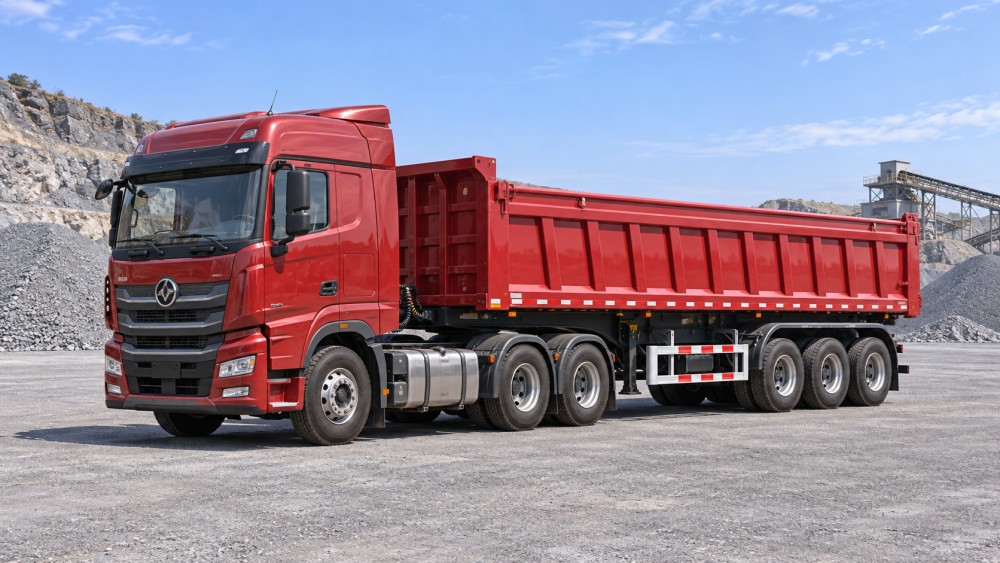
Check alignment, gradients and the discharge edge
A driver may enter a location that looks level while the tractor and trailer remain at an angle to each other. Where the vehicle manufacturer’s instructions call for a straight combination during tipping, allow enough room for the driver to align it before raising the body. Sharp turns immediately before the tipping point can also leave tires on uneven ground or place part of the combination near a weak shoulder.
Assess the tipping surface in both directions. A route can have an acceptable-looking approach while the unloading spot slopes sideways. Small changes in ground level across a long vehicle deserve attention because a raised body magnifies the consequences of a lean. Do not rely on a visual impression from the cab alone; a site inspection should consider the full wheel path and the position where the vehicle will stop.
At a stockpile, hopper or excavation, the edge is a separate hazard. The driver needs a defined stopping point and a discharge arrangement that does not require the vehicle to approach unsupported ground. A wheel stop or barrier may assist traffic control, but its suitability depends on its design, installation and the forces it may encounter. It is not a substitute for assessing ground stability or following the site’s tipping procedure.
If the intended position cannot be made suitable, the safer decision may be to tip elsewhere and move the material with another machine. That adds a handling step, but avoids forcing a trailer to unload on ground whose capacity or geometry is uncertain.
Allow for material behavior, not just payload weight
Before tipping, establish what is in the body and whether it is likely to discharge evenly. Wet soil, clay, frozen material or product that has compacted in transit may adhere to the floor or sidewalls. A load can begin to move at one end or along one side while the rest remains in place. If the body rises further while material remains stuck, the distribution of weight may become less favorable.
Load placement matters before arrival as well. Uneven loading, oversized pieces that catch on the body, or material concentrated to one side can complicate discharge. Quality personnel can reduce avoidable variation by checking loading instructions, body cleanliness and the condition of liners or other discharge aids where fitted. They should not assume that a liner eliminates sticking under all moisture and temperature conditions.
If material fails to flow as expected, the driver should stop the tipping operation and follow the manufacturer’s and site’s procedures. Shaking the vehicle, repeatedly jolting it or driving with the body raised to force a release can introduce additional hazards. No one should enter the danger area or work beneath an unsupported raised body to clear a blockage. The HSE addresses safe tipping and the risks associated with raised bodies in its workplace transport guidance. Source: HSE, Workplace transport safety, “Tipper vehicles” and “Vehicle maintenance.”
Inspect the trailer and tipping equipment
Site preparation cannot compensate for a defect in the tipping system. Before use, the operator should complete the checks required by the manufacturer and the fleet’s inspection procedure. Depending on the design, these may include visible damage or leaks around hydraulic components, the condition of the body and chassis, tire condition, and the operation of the tailgate and its locking or release mechanism.
A body that does not rise or lower normally, a new hydraulic leak, damaged structural members or an unexplained lean should trigger a stop and defect report. The appropriate response is inspection and repair by authorized personnel, not an improvised adjustment at the tipping point. For maintenance under a raised body, use the manufacturer’s specified support and isolation arrangements; hydraulic pressure alone should not be treated as a maintenance support. Source: HSE, Workplace transport safety, “Vehicle maintenance.”
When comparing dump special trailers for a fleet, assess the proposed vehicle against the actual unloading environment as well as payload requirements. A four-axle rear dump semi-trailer, for example, needs a suitable operating area, adequate ground support and sufficient clearance for its raised body. Procurement documents should request the manufacturer’s operating limits, inspection requirements, body-support arrangements and guidance for the intended materials. The axle count or apparent size of a vehicle alone does not establish that a particular tipping site is safe.
Control overhead, pedestrian and traffic exposure
Clearance must be assessed for the body in its raised position, not just for the vehicle at normal travel height. Overhead power lines, fixed structures, loading equipment, trees and temporary installations can all restrict a tipping location. Establish clearance requirements with the relevant site authority and, where power lines are involved, the electricity network operator. Do not guess a safe separation distance: it depends on the line, the equipment and applicable local requirements. Source: HSE, Guidance Note GS6, “Avoiding danger from overhead power lines.”
The discharge area should also be clear of people and other vehicles. Material can spill, roll or rebound beyond the immediate rear of the trailer, and the driver may have limited visibility around the body. Use the site’s traffic-management plan to separate pedestrians, control approaching vehicles and identify who is authorized to direct the maneuver.
If a banksman or spotter is needed, agree on a position and communication method before the vehicle reverses. The spotter should remain visible to the driver and outside the vehicle’s path and potential discharge area. If communication is lost or the driver cannot see the spotter, stop until the situation is resolved. A spotter helps manage visibility; the role does not replace a suitable tipping surface or exclusion zone. Source: HSE, Workplace transport safety, “Reversing vehicles.”
Turn the inspection into a repeatable decision
A checklist is most useful when it identifies who can approve the location, who carries out each check and what happens when a condition fails. The following sequence can be adapted to the site’s risk assessment and the trailer manufacturer’s instructions:
- Confirm the location: Check the planned stopping point, ground condition, cross-slope, nearby edges and route for entry and exit.
- Confirm the space: Assess raised-body clearance, the discharge area, traffic movements and pedestrian exclusion arrangements.
- Confirm the combination: Check alignment, visible vehicle defects, tire condition and the condition of the tipping and tailgate mechanisms.
- Confirm the load: Identify the material, its distribution and any reason it may stick, bridge or discharge unevenly.
- Agree on a stop condition: Stop if the ground settles, the vehicle leans, the load does not discharge normally, clearance is uncertain or communication breaks down.
Record exceptions in a way that can be acted on: the location, the observed condition, the person notified and whether tipping was suspended or moved. A note that a surface was “checked” provides less value than a record of a rut, a soft shoulder or a damaged tailgate lock and the action taken. For recurring deliveries, review defects and near misses alongside changes in weather, material and unloading position.
The decision to resume after a stop belongs to the responsible site and fleet personnel, using the applicable operating instructions and risk assessment. A location approved in the morning may need to be rejected later if the ground has deteriorated; equally, a sound pad does not make a defective trailer or a stuck load safe to tip.
Have questions about this sector analysis, or seeking best practices specific to your niche? Drop us a line below and let the senior consultants at TF-Strategy assist you.
Related News
 Nov 11, 2026Choosing Equipment Capacity for Different Workloads and ApplicationsExplore equipment application by capacity to match machines to real workloads, reduce bottlenecks and choose cost-effective solutions with confidence.
 Nov 10, 2026Crane Performance Comparison: Load Capacity, Reach and Lifting SpeedCrane performance comparison made practical: evaluate load capacity, reach and lifting speed to choose the right crane for your site and work sequence.
 Nov 09, 2026Heavy Equipment Technology Systems: Telematics, GPS and Machine ControlExplore heavy equipment technology systems, from telematics and GPS to machine control, and learn how to choose the right tools for your fleet and site.
 Nov 10, 2026Selecting a Four-Axle Rear Dump Semi-Trailer for Aggregate HaulingExplore dump special trailers for aggregate hauling. Learn how to compare legal payload, body durability and tipping safety before choosing a four-axle rear dump semi-trailer.

Ms. Elena Rodriguez
Weekly Insights
Stay ahead with our curated technology reports delivered every Monday.