
Underground construction risks that are easy to underestimate
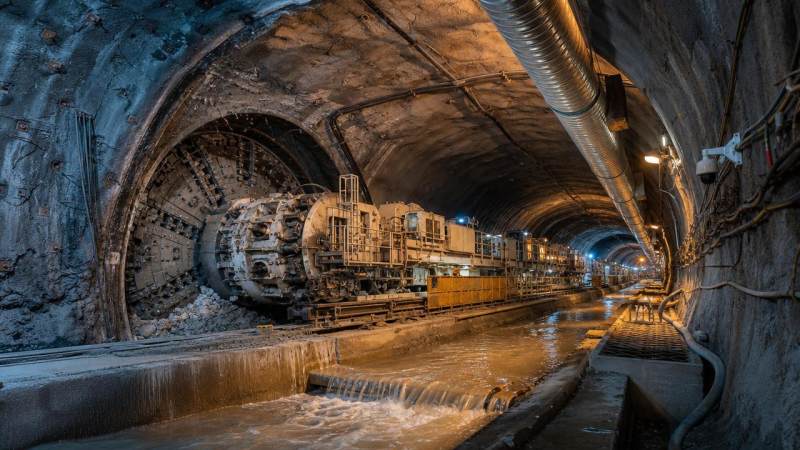
Underground construction risks are often underestimated until hidden ground conditions, water ingress, equipment failure, or ventilation issues turn into costly delays and safety incidents. For quality control and safety management teams, understanding these overlooked threats is essential to protecting workers, maintaining compliance, and preserving project schedules in complex tunneling and subsurface operations.
In practice, the biggest problem is not that risks are unknown, but that they are treated as isolated technical issues instead of system-wide control points. A tunnel heading can appear stable for 3 to 5 shifts, then deteriorate within hours when groundwater, weak strata, and delayed support installation interact.
For quality control personnel and safety managers, underground construction is a discipline of verification, response time, and disciplined documentation. Whether the project uses drill-and-blast methods, NATM sequences, or TBM excavation, small deviations in face mapping, equipment condition, or air quality monitoring can produce major downstream consequences.
This article examines the underground construction risks that are easiest to underestimate, explains why they are repeatedly missed during execution, and outlines practical control measures that support safer production, more reliable inspection routines, and fewer schedule disruptions.
Why underground construction risks are often missed in real projects
Underground construction compresses multiple risk variables into a confined space: geology, water pressure, lining quality, power supply, logistics, people movement, and machine performance. The challenge is that 4 or 5 moderate risks can combine into one severe incident even when no single indicator looks critical on its own.
Many projects still rely too heavily on pre-construction investigation data gathered weeks or months earlier. Borehole spacing of 30 m to 100 m may be acceptable at planning stage, but it does not eliminate the possibility of local faults, boulders, cavities, mixed-face conditions, or pressurized water pockets appearing between sampled points.
The false confidence created by routine progress
One reason underground construction risks are underestimated is that repetitive work creates a sense of control. When production advances 1.5 m, 3 m, or even 12 m per day without incident, teams may reduce the intensity of inspections, shorten toolbox talks, or delay non-urgent maintenance. That is when latent risk grows.
Quality and safety teams should treat every change in rock class, cutter consumption rate, water inflow pattern, or dust reading as a trigger for reassessment. In underground works, trend deviation matters as much as threshold exceedance.
Typical blind spots for QC and safety teams
The following table highlights common blind spots in underground construction and their operational consequences. These are not rare failures; they are recurring control gaps seen across tunnels, shafts, utility galleries, and subsurface transport corridors.
The key lesson is that underground construction risks often begin as quality signals rather than safety alarms. A change in muck composition, segment alignment tolerance, or grout take volume may indicate a larger hazard developing behind the visible work front.
Three questions teams should ask daily
- What changed in the last 24 hours: geology, water, vibration, dust, temperature, or machine load?
- Which inspection point was completed, but not independently verified by a second role?
- If one support, pump, fan, or power circuit failed today, how long would safe recovery take: 10 minutes, 1 hour, or one full shift?
Organizations such as TF-Strategy often frame these issues through the connection between machine parameters, geological response, and execution logic. Even a neutral reference point like 无 can remind teams that information flow matters as much as machine capacity in high-risk underground construction environments.
High-impact underground construction risks that deserve tighter control
Not all underground construction risks carry the same operational weight. For quality control and safety management functions, the most dangerous risks are those that escalate quickly, affect several systems at once, and remain partially hidden until damage is already visible.
1. Hidden ground variability and mixed-face conditions
A tunnel drive can transition from competent rock to fractured ground within 2 m to 5 m. In soft ground, the face may include clay, sand, cobbles, and fill in one section. In TBM works, mixed-face conditions increase torque fluctuation, uneven cutter wear, and settlement risk. In conventional excavation, they raise the probability of wedge failure and uncontrolled overbreak.
QC teams should compare design assumptions against actual face mapping at every round or ring. If the discrepancy persists for 2 consecutive cycles, support class, advance length, and pre-support measures should be reviewed immediately rather than at weekly meetings.
2. Water ingress that starts small and turns disruptive
Water inflow is frequently underestimated because early seepage looks manageable. However, a localized inflow of 10 L/min can rise significantly if excavation opens a connected fracture network. Water affects not only safety but also shotcrete adhesion, invert cleanliness, cable reliability, pump performance, and worker mobility.
For underground construction, teams should define trigger levels before excavation. For example, rising inflow over a 2-hour period, sudden turbidity, or pressure increase after blasting should automatically require reassessment of drainage, support sequence, and exclusion zones.
3. Ventilation failure, dust, gas, and heat load
Ventilation risk is often reduced to a fan capacity check, but underground construction requires air to reach the right location at the right velocity. Dead zones form behind equipment, at cross-passages, and near headings with cluttered duct arrangements. Diesel fleets, blasting fumes, and high rock temperature can quickly turn a nominally compliant system into an unsafe one.
Daily inspection should verify at least 4 items: duct integrity, actual airflow at the face, visibility conditions, and gas or dust monitoring status. In deeper tunnels or long drives, 2 readings per shift may be inadequate if activity patterns change significantly.
4. Equipment failure with secondary safety consequences
A failed pump, scaling rig, locomotive, conveyor, or backup generator is not only a maintenance event. In underground construction, equipment reliability supports dewatering, access, emergency response, muck removal, and escape readiness. One breakdown can lock several work fronts into unsafe waiting conditions.
This is especially true in mechanized tunneling, where cutterhead intervention, hydraulic anomalies, or segment erector malfunction can force work under constrained conditions. Monitoring intervals should be linked to machine stress, not just calendar days. A component under peak load for 60 hours deserves different attention than one operating lightly for 200 hours.
5. Delayed or inconsistent support installation
Support timing is one of the most decisive controls in underground construction. Even well-designed bolts, ribs, mesh, shotcrete, or lining segments lose effectiveness when installed too late or with poor workmanship. A 30-minute delay can matter in squeezing ground, and thickness deviation of shotcrete can change structural behavior materially.
Safety managers should not only ask whether support was installed, but whether it matched the correct class, sequence, curing requirement, and inspection acceptance criteria. Quality records must be precise enough to reconstruct what happened at chainage, date, shift, and crew level.
Risk control framework for quality control and safety management teams
A workable framework for underground construction should convert broad hazards into measurable checkpoints. The aim is not more paperwork, but faster recognition of abnormal conditions and clearer decision thresholds for field teams, supervisors, and equipment coordinators.
A practical 5-step control sequence
- Baseline the expected ground, water, and equipment condition before each shift.
- Inspect active controls: support materials, fans, pumps, power, communication, and emergency routes.
- Measure live conditions during production, not only before entry.
- Escalate deviations using predefined thresholds and stop-work rules.
- Record, review, and feed findings into the next 12 to 24 hours of planning.
The table below translates this sequence into field-level checkpoints that fit many tunnel and subsurface works. Values should be adjusted to project method statements, ground class, and local regulations, but the structure is broadly applicable.
The most effective programs are those that connect QC records with safety action. If face mapping shows weaker ground and maintenance logs show declining pump reliability, those two signals should not remain in separate reporting chains.
Documentation that actually reduces risk
Underground construction generates large amounts of data, but only a small share is operationally useful unless it is structured. Good records answer 4 questions: what changed, where it changed, when it changed, and what control was applied. Photos without chainage, reports without timestamps, or maintenance notes without severity rating limit their value.
A practical record set includes daily face logs, support installation verification, water observations, air-quality readings, equipment health status, and nonconformance closure. For many teams, the goal should be 100% completion of critical records within the same shift, not 2 or 3 days later.
Control points that are worth auditing weekly
- Support installed versus support designed at each chainage section
- Number of deferred maintenance items on pumps, fans, and emergency power
- Trend in water inflow, dust complaints, or ventilation deviations over 7 days
- Time gap between hazard identification and field corrective action
- Repeat nonconformities by shift, crew, or subcontract interface
This is where intelligence-led decision support becomes useful. Platforms following the same strategic lens as TF-Strategy help decision-makers relate machine behavior, excavation method, and site conditions more coherently. Even where product integration is minimal, a neutral insertion such as 无 illustrates the value of linking field evidence to engineering judgment.
Common mistakes that increase underground construction risk
Several recurring management mistakes make underground construction less predictable. They are often procedural rather than technical, which is why they persist across projects of different sizes and excavation methods.
Treating compliance as proof of safety
A completed checklist does not guarantee field control. Ventilation can pass a formal inspection at 07:00 and still fail operationally by 14:00 after ducts are moved, equipment is relocated, or blasting residue accumulates. Compliance documents are essential, but they must be matched with dynamic verification.
Separating quality defects from safety hazards
In underground construction, many safety failures begin as quality deviations. Poor shotcrete rebound control, incomplete segment gasket cleaning, incorrect bolt angle, or low grout fill ratio may first appear as workmanship issues. If ignored, they become structural, water, or access hazards later.
Underestimating interface risk during shift changes
Shift handover is a high-risk period because information is compressed into 10 to 20 minutes. If the outgoing crew does not clearly communicate unstable ground, reduced pump capacity, or a temporary support limitation, the incoming team may continue production under outdated assumptions.
Delaying stop-work decisions too long
Many managers fear that stopping the heading for 2 hours will harm schedule performance. In reality, continuing through uncertainty can create a 2-day or 2-week disruption. Clear stop-work criteria reduce hesitation and support better accountability for underground construction decisions.
How decision-makers can strengthen risk resilience before problems escalate
The best-performing projects do not eliminate uncertainty; they shorten detection time and improve response quality. For underground construction, that means building a field culture where deviations are reported early, cross-checked quickly, and translated into operational action without delay.
Priority actions for the next 30 days
- Review the top 5 underground construction risks by work zone, not by department.
- Set measurable trigger points for water, ventilation, support, and equipment reliability.
- Audit whether current shift handovers include chainage-specific hazard information.
- Verify backup readiness for pumping, power, and emergency communications.
- Link QC nonconformities to safety review meetings at least once every 7 days.
For quality control personnel and safety managers, the real advantage comes from integration. When geological observations, machine condition data, and field inspection results are reviewed together, underground construction becomes more controllable, even in difficult ground and high-pressure schedules.
TF-Strategy’s broader perspective on heavy equipment, TBM operations, construction methods, and strategic engineering intelligence is especially relevant to organizations that need stronger decision support across tunneling and subsurface infrastructure. If your team is reviewing risk controls, planning a complex drive, or refining equipment and safety coordination, now is the right time to get a tailored assessment, consult project-specific details, and explore more practical solutions.
Related News
 Oct 06, 2026Selecting Petrochemical Overhead Cranes for Hazardous Areas and Heavy Process LoadsPetrochemical overhead cranes for hazardous areas: learn how to match capacity, duty, controls, corrosion protection, and maintenance access for safer, reliable lifts.
 Oct 05, 2026Tunneling Equipment Specification Planning: Key Criteria for Ground and Project RisksEquipment specification planning tunneling: learn how to match TBM systems to ground risks, geometry, safety, logistics, and lifecycle cost for more reliable project delivery.
 Oct 04, 2026Nuclear Lifting Equipment Cost: Budgeting for Compliance, Testing, and Lifecycle RiskNuclear lifting equipment cost explained: budget for compliance, proof-load testing, installation, documentation, and lifecycle risk to make confident procurement decisions.
 Oct 03, 2026How to Assess TBM Manufacturers for Hard-Rock Tunneling Projects?Choose the right tunnel boring machine manufacturer for hard-rock projects. Explore key criteria for design, lifecycle cost, factory quality, and service support.
Ms. Elena Rodriguez
Weekly Insights
Stay ahead with our curated technology reports delivered every Monday.