
What geotechnical engineering reports can miss before excavation
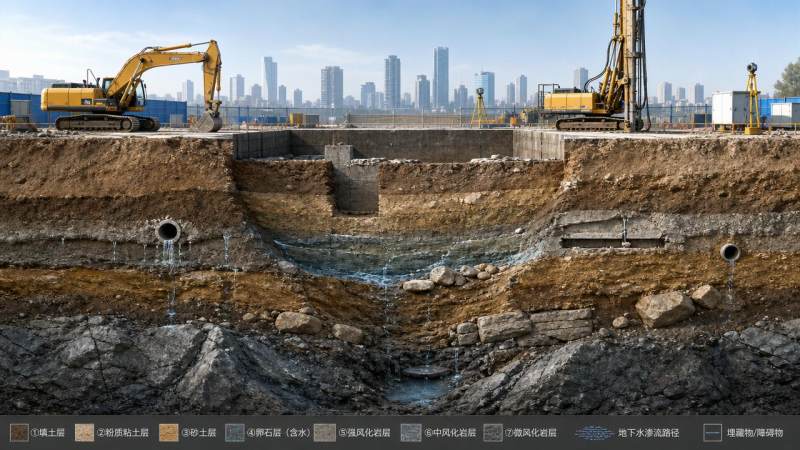
Before excavation begins, even a detailed geotechnical engineering report can overlook critical subsurface risks that affect safety, cost, and equipment performance. For technical evaluators, understanding these blind spots is essential when assessing project readiness, ground behavior, and machinery strategy. This article highlights what standard reports may miss and why deeper intelligence matters in complex earthworks and heavy infrastructure planning.
Why can a geotechnical engineering report still miss major excavation risks?
A geotechnical engineering report is often treated as the ground truth before excavation, but in practice it is a sampled interpretation, not a full underground map. Boreholes, test pits, and laboratory data only describe selected points. Between those points, soil transitions, groundwater behavior, weathered rock pockets, buried obstructions, and historical fill can change rapidly. For technical evaluators, this is the first blind spot: the report may be technically sound while still incomplete for construction reality.
Another reason is project timing. Many reports are prepared early for design approval, land acquisition, or budgeting. By the time excavation starts, seasonal groundwater, nearby construction vibration, traffic loading, or utility work may have altered site conditions. In urban corridors, reclaimed industrial land, mining zones, and mountain access roads, the ground can evolve faster than the reporting cycle.
A third issue is scope mismatch. A geotechnical engineering report may answer structural foundation questions well, yet provide limited detail for excavation sequencing, heavy equipment mobilization, dewatering demands, spoil handling, or machine-ground interaction. This matters in projects involving TBM launch shafts, open-pit access cuts, crawler crane pads, haul roads, or high-production earthworks where operational loads are different from static design assumptions.
What subsurface conditions are most likely to be underestimated before excavation?
Several conditions repeatedly escape full recognition in standard geotechnical engineering workflows. One common issue is localized variability. A site may be classified broadly as clay, mixed fill, or weathered rock, but excavation performance depends on lenses, seams, fractures, and abrupt layer changes. A hard boulder field inside soft overburden can slow trenching, damage cutters, or alter support requirements. A thin saturated silt layer can destabilize an otherwise competent excavation face.
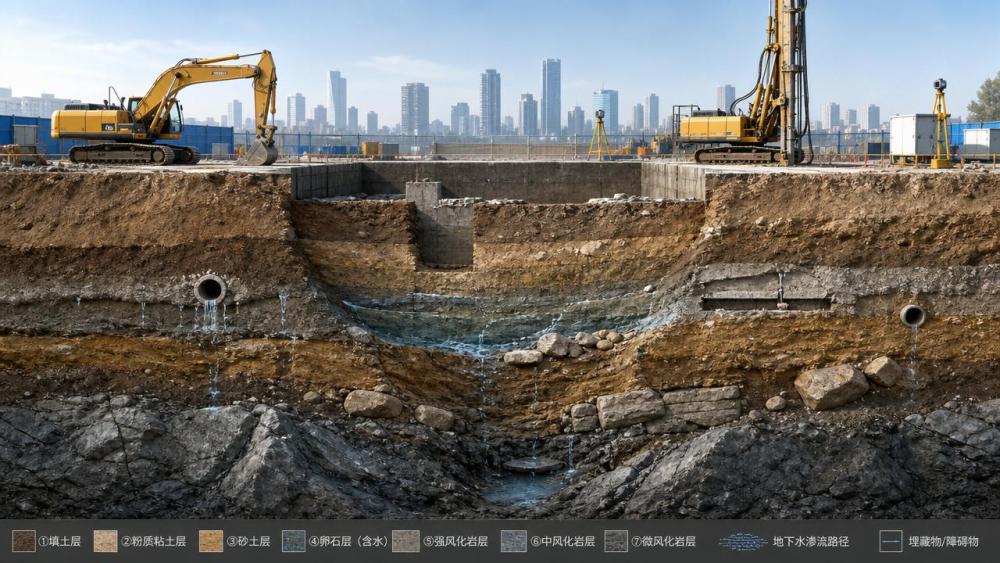
Groundwater is another major source of underestimation. Reports may identify water levels during drilling, yet those readings may not capture perched water, artesian pressure, seepage pathways, tidal influence, or intense rainfall response. Dewatering plans based only on static water table data often fail when excavation opens new flow routes. This can affect slope stability, base heave risk, mud generation, and machine productivity.
Buried anthropogenic material is also frequently underestimated. Old foundations, undocumented utilities, demolition debris, slag, scrap metal, and uncontrolled fill can disrupt excavation more than natural soil variability. In industrial redevelopment or transport expansion, such material can create sudden refusal, contamination handling obligations, or unexpected wear on buckets, teeth, cutters, and conveyors.
For rock excavation, the report may describe rock strength adequately but miss operationally critical discontinuities. Joint orientation, fault gouge, shear zones, cavity potential, and weathering along fracture networks influence blast outcomes, slope angles, ripping feasibility, and support needs far more than compressive strength alone.
How do these gaps affect excavation method, heavy equipment choice, and project cost?
This is where technical evaluation becomes strategic. A geotechnical engineering report is not only a document for designers; it is a decision input for machinery, sequencing, and risk allocation. If weak zones, unexpected rock, or unstable groundwater are missed, the selected excavation method may become inefficient or unsafe. An excavator fleet sized for uniform digging may struggle in mixed-face conditions. A planned cut-and-cover approach may require extra shoring, grouting, or dewatering. A TBM launch zone may need more pre-treatment than expected.
For open-pit mining and heavy civil works, these gaps affect cycle times, fuel consumption, tire and undercarriage wear, haul road maintenance, and the practical reach of large equipment. Crawler crane operations are also sensitive to subsurface assumptions because crane pad performance depends on bearing capacity, drainage, and localized settlement behavior. If the geotechnical engineering interpretation is too generalized, apparent “ground support” issues may actually be subsurface intelligence failures.
Cost impacts rarely appear as one dramatic event. More often, they arrive as cumulative friction: slower progress, additional pumping, unplanned support systems, standby machinery, spoil reclassification, change orders, and higher maintenance. Technical evaluators should therefore connect geotechnical engineering findings directly to construction productivity models, not just to code compliance or design adequacy.
What should technical evaluators review beyond the standard geotechnical engineering report?
The best practice is to treat the report as a baseline and build a broader evidence set around it. First, compare the investigation density with the excavation sensitivity. A shallow warehouse slab and a deep urban shaft do not require the same confidence level. If the consequence of variability is high, borehole spacing, in-situ testing, geophysics, trial excavation, or targeted supplementary drilling may need to increase.
Second, review historical land use in detail. Old maps, utility records, mining archives, aerial imagery, drainage changes, and previous foundation drawings often reveal hazards the geotechnical engineering report only mentions briefly. This is especially valuable in port zones, brownfield sites, mountain roads, and infrastructure corridors expanded in stages over decades.
Third, test the operational assumptions. Ask whether the report supports the actual excavation equipment, support installation method, spoil transport route, and temporary works loading. A technically acceptable soil parameter for design may still be too uncertain for high-output production planning. For example, moisture-sensitive material can turn from manageable to unworkable under repeated traffic and rain, even if classification tests look ordinary.
Fourth, check monitoring and trigger planning. If the ground model has uncertainty, the project should not rely on paperwork alone. Instrumentation, piezometers, settlement markers, slope radar, vibration monitoring, and observational method protocols can convert uncertainty into managed risk. In this sense, good geotechnical engineering is dynamic, not static.
Which warning signs suggest the report is not enough for excavation readiness?
Technical evaluators should be cautious when a report uses broad descriptions but offers little discussion of variability. Phrases such as “generally consistent,” “anticipated,” or “localized anomalies may occur” are not wrong, but they may hide uncertainty that matters operationally. Another warning sign is when groundwater is described from a limited seasonal window without recharge analysis or excavation-stage response.
Be alert if the geotechnical engineering report was prepared for a different design stage or a different asset type. A report developed for preliminary routing, building foundations, or permit support may not answer excavation-specific questions about face stability, temporary slope performance, or heavy equipment bearing conditions. Likewise, if the site has a long industrial history but the subsurface obstruction narrative is brief, more due diligence is usually justified.
Risk also rises when construction means and methods are changed after the report is issued. A deeper cut, larger crawler crane, altered haul alignment, or switch from conventional excavation to mechanized methods can invalidate the practical sufficiency of the original geotechnical engineering basis.
What is a practical checklist for comparing report content with real excavation risk?
The table below helps technical evaluators identify where geotechnical engineering documentation may be adequate for design but weak for execution planning.
What are the most common misconceptions about geotechnical engineering before excavation?
One misconception is that more pages mean more certainty. A long geotechnical engineering report can still be weak in the exact area that drives excavation risk. Another is that lab precision eliminates field uncertainty. Laboratory values are important, but excavation performance depends heavily on scale effects, moisture change, structure, and disturbance during construction.
A third misconception is that if similar projects nearby succeeded, the current site will behave similarly. Local geology can vary sharply over short distances, especially near river deposits, reclaimed land, faulted terrain, and old industrial zones. Finally, some teams assume risk can be transferred contractually even if it is not understood technically. In reality, poor subsurface intelligence usually reappears as dispute, delay, or equipment inefficiency.
How can organizations improve decision quality before excavation starts?
Organizations improve outcomes when geotechnical engineering is integrated with construction intelligence, not isolated within a design package. That means reviewing subsurface data together with excavation planners, equipment specialists, dewatering experts, and temporary works designers. It also means testing the ground model against real operational questions: Can the selected machinery maintain target productivity? Where are the likely change-order triggers? Which zones need contingency methods? What monitoring thresholds will trigger redesign or resequencing?
For technical evaluators in heavy infrastructure, the strongest approach is staged confidence building. Start with the report, then layer in field verification, historical intelligence, risk-ranked supplemental investigation, and construction-phase monitoring. This is especially relevant in TBM shafts, open-pit developments, large lifting platforms, road embankments, and mixed urban excavations where the cost of being wrong is high.
If deeper project readiness needs to be confirmed, the first questions to raise are practical: whether the current geotechnical engineering scope matches the actual excavation method, whether groundwater uncertainty has been stress-tested, whether hidden obstructions have been investigated, whether equipment-ground interaction has been modeled, and whether the project has a clear observational response plan. For organizations seeking better excavation certainty, lower TCO, and stronger delivery control, those are the conversations worth having before the first cut begins.
Related News
 Sep 22, 2026How to Evaluate a High-Altitude Mining Solutions Manufacturer for Remote ProjectsEvaluate a high-altitude mining solutions manufacturer with proven derating, cooling, service logistics, and lifecycle-cost support for remote projects.
 Sep 21, 2026Industrial Supplier Evaluation: A Risk-Based Scorecard for Quality, Capacity, and DeliveryIndustrial supplier evaluation made practical: use a risk-based scorecard to assess quality, capacity, and delivery reliability, reduce project risk, and select suppliers with confidence.
 Sep 20, 2026Comparing Heavy Equipment Warranty Suppliers: Coverage, Claims, and Downtime RiskSupplier comparison for heavy equipment warranty: evaluate coverage, claims speed, service networks, and downtime risk to protect uptime and project costs.
 Sep 19, 2026Mining Truck Technology Trends: What Fleet Managers Should Prioritize for 2026Mining truck technology trends for 2026: prioritize electrification, autonomy, predictive maintenance, and road intelligence to improve fleet uptime, safety, and cost control.

Ms. Elena Rodriguez
Weekly Insights
Stay ahead with our curated technology reports delivered every Monday.