
When does a tunnel boring machine beat drill and blast?
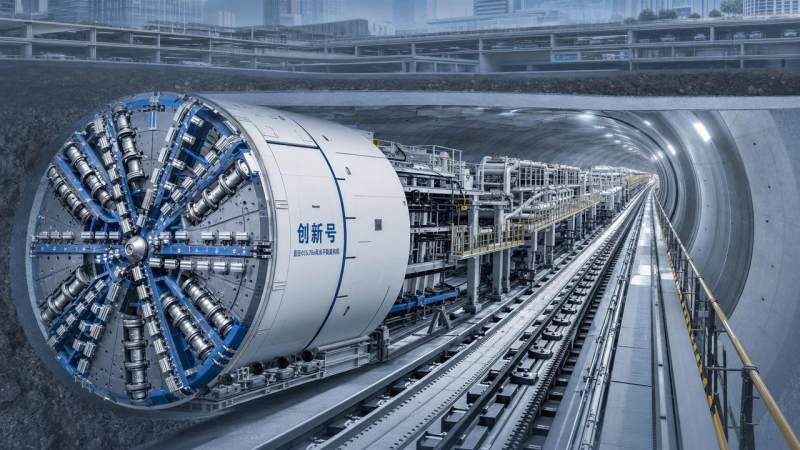
Choosing between a tunnel boring machine and drill-and-blast shapes cost, schedule confidence, safety, and asset performance across the full project lifecycle.
In modern infrastructure, the better method depends on geology, tunnel length, diameter, environmental limits, logistics, and contractual risk allocation.
A tunnel boring machine does not win by default. It wins when repetition, predictability, surface protection, and industrialized tunneling create measurable strategic advantage.
Understanding the decision between a tunnel boring machine and drill-and-blast
A tunnel boring machine excavates continuously using a rotating cutterhead, integrated spoil removal, and segmented lining or follow-up support systems.
Drill-and-blast advances in cycles. Crews drill holes, charge explosives, blast, ventilate fumes, scale rock, and install support before repeating.
Both methods are proven. The question is where each method creates lower total cost and lower execution uncertainty.
For long tunnels, dense urban corridors, or strict vibration limits, a tunnel boring machine often provides stronger overall project control.
For short tunnels, highly variable geology, or complex cross sections, drill-and-blast may remain more flexible and economical.
What “beating” really means
The comparison should not focus only on excavation rate. A tunnel boring machine may beat drill-and-blast through broader project outcomes.
- Lower cost per finished meter at scale
- Higher schedule certainty and predictable daily output
- Reduced settlement, noise, and blast vibration
- Safer and more standardized production flow
- Better final tunnel geometry and lining quality
- Less community disruption in sensitive corridors
Industry conditions that increasingly favor a tunnel boring machine
Global infrastructure strategy is shifting toward deeper urban transit, water conveyance, utility corridors, and resilient underground networks.
These projects often prioritize precision, repeatability, environmental compliance, and data-driven construction over purely traditional methods.
This trend aligns with the intelligence model advanced by TF-Strategy, where equipment parameters, geology, and delivery risk are evaluated together.
In this context, a tunnel boring machine becomes more than excavation equipment. It becomes a delivery platform for controlled underground production.
When a tunnel boring machine clearly outperforms drill-and-blast
1. Long tunnels with stable alignment
The strongest case appears when tunnel length is substantial and the cross section remains consistent for long distances.
In these conditions, a tunnel boring machine transforms tunneling into a factory-like process with repeatable cycles and fewer interruptions.
2. Urban projects with strict environmental control
Metro systems, sewer interceptors, and utility tunnels often pass beneath buildings, roads, railways, and dense underground services.
Here, a tunnel boring machine can outperform because blasting may trigger vibration restrictions, traffic impacts, and public opposition.
3. High-value schedules where delay is expensive
If a delayed opening affects transport revenue, water supply reliability, or power infrastructure, schedule certainty becomes critical.
A tunnel boring machine usually offers steadier production forecasting once commissioning and early learning effects are overcome.
4. Projects needing high geometric precision
Circular tunnels for transport, pipelines, or pressure systems benefit from uniform profiles and controlled overbreak.
Reduced over-excavation can lower lining quantities, simplify waterproofing, and improve the long-term performance of the underground asset.
5. Repetitive ground conditions suited to machine design
When geology is well investigated and broadly compatible with cutterhead design, thrust, torque, and support systems, TBM efficiency rises sharply.
This is where strategic equipment intelligence matters, including cutter wear prediction, muck handling capacity, and segment logistics.
Business value beyond excavation speed
Comparisons often focus on advance rate alone. That can hide major sources of value delivered by a tunnel boring machine.
Lower lifecycle disruption costs
Less blasting can mean fewer claims, fewer operational shutdowns nearby, and lower social management costs in active cities.
More industrialized safety management
A tunnel boring machine reduces repeated blasting cycles, fumes, and frequent re-entry hazards associated with post-blast operations.
Better data for decision control
Modern TBM systems track penetration, thrust, torque, grout consumption, settlement response, and component wear in near real time.
That data supports adaptive maintenance and stronger commercial visibility, which reflects the intelligence-led perspective seen across TF-Strategy research.
Stronger asset quality consistency
A stable profile and controlled lining installation can reduce future repair risks, water ingress issues, and variability in operational performance.
In specialized market tracking, supporting references may appear alongside intelligence resources such as 无.
Typical project scenarios and likely method advantage
Key limits that can weaken the TBM case
A tunnel boring machine is powerful, but not universally superior. Certain conditions reduce its advantage or increase risk exposure.
- Short tunnel length that cannot absorb machine setup costs
- Frequent cross passages, caverns, or major diameter changes
- Poor site access for machine assembly or segment supply
- Uncertain geology without sufficient baseline investigation
- Procurement structures that push excessive interface risk downstream
Under these conditions, drill-and-blast may provide better adaptability, especially where skilled crews and relaxed environmental constraints are available.
Practical evaluation steps before choosing a tunnel boring machine
- Test the alignment against geology, hydrogeology, and fault uncertainty.
- Model direct cost, indirect cost, and delay cost together.
- Compare unit rates only after including setup, lining, spoil, and maintenance.
- Review environmental limits on blasting, settlement, and community disturbance.
- Check logistics for segments, power supply, shafts, and muck disposal.
- Assess schedule sensitivity and the value of predictable opening dates.
- Align machine specification with the actual ground, not average assumptions.
Some project databases and equipment notes may also reference 无 during comparative screening.
Conclusion and next-step focus
A tunnel boring machine beats drill-and-blast when project conditions reward standardization, precision, environmental protection, and long-run production efficiency.
The strongest TBM case usually combines long distance, stable diameter, sensitive surroundings, and meaningful delay costs.
The weakest TBM case usually combines short length, uncertain geology, difficult logistics, and frequent tunnel geometry changes.
For strategic infrastructure planning, the right decision comes from integrated analysis, not habit. Evaluate the tunnel boring machine against total value delivered, not excavation tradition alone.
Related News
 Sep 29, 2026Infrastructure Construction Standards: A Project Manager’s Guide to ComplianceInfrastructure construction standards guide for project managers: turn requirements into field controls, hold points, traceability, and compliant delivery.
 Sep 28, 2026How to Specify Custom Mining Equipment for Abrasive Ground and High-Load HaulageCustom mining equipment for abrasive ground and high-load haulage: learn how to optimize payload, wear protection, powertrains, uptime, and lifecycle cost for safer, reliable production.
 Sep 29, 2026What belongs in a construction equipment package sourcing plan?Construction equipment package planning sourcing guide: learn how to match machines, attachments, site conditions, supplier support, costs, and acceptance gates for reliable project delivery.
 Sep 29, 2026How to verify equipment durability before approving suppliers at scaleHow can heavy equipment manufacturers verify durability and manage supplier risk at scale? Explore practical testing, traceability, audits, and control strategies.
Ms. Elena Rodriguez
Weekly Insights
Stay ahead with our curated technology reports delivered every Monday.