
Which thermal management design limits heat-related mining downtime?
Which Thermal Management Design Limits Heat-Related Mining Downtime?
Heat-related downtime rarely begins with a dramatic engine overheat alarm. More often, it starts with a hydraulic oil temperature that slowly climbs during a long loading cycle, an inverter that reduces torque on an uphill haul, a cooling pack that cannot clear dust after a shift change, or an operator who turns off the air conditioning to preserve machine performance. By the time a machine enters derate mode, the lost production time is already larger than the alarm event suggests.
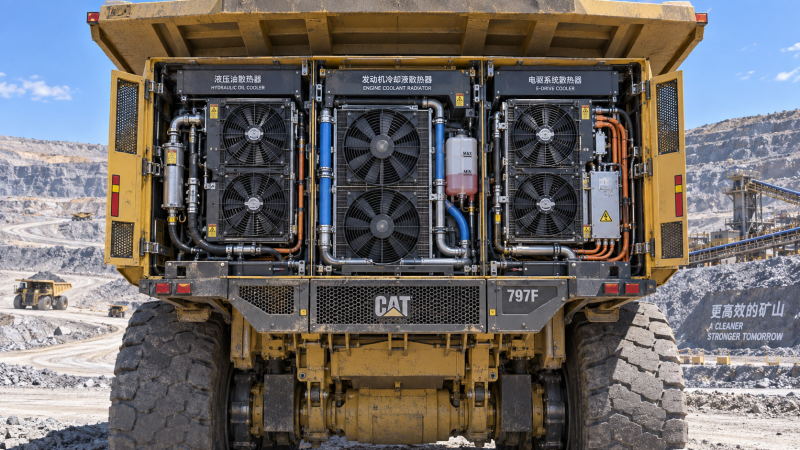
For technical evaluators, the question is not simply whether a machine has a larger radiator or a higher-rated fan. The thermal management mining equipment design that best limits downtime is usually an integrated, independently controlled cooling architecture: one that separates major heat circuits where practical, maintains usable airflow in dust and high ambient temperatures, measures temperatures at the right points, and remains serviceable under actual mine conditions.
That conclusion sounds straightforward, but the design choices underneath it are not. An open-pit excavator, a large haul truck, a battery-electric vehicle, and a tunnel machine can all fail thermally for different reasons. A cooling arrangement that works well on a temperate quarry bench may be inadequate at altitude, in deep pits, or in hot, fine-dust environments where airflow restriction develops faster than scheduled maintenance can address it.
Cooling capacity alone is not the right selection criterion
Mining equipment generates heat from several sources at once: combustion engines or electric drive motors, hydraulic pumps and valves, transmissions, braking systems, battery packs, power electronics, air compressors, and operator cabins. In heavy loading or hauling work, those loads do not peak at the same moment. That is precisely why a nameplate cooling figure, considered on its own, can be misleading.
A machine may have enough theoretical heat-rejection capacity at a clean cooling pack and moderate ambient temperature, yet still derate when it encounters the combined effect of altitude, prolonged grade, dust accumulation, recirculated hot air, and reduced fan effectiveness. At high altitude, lower air density reduces convective cooling performance. In confined or poorly ventilated areas, such as loading pockets and tunnel headings, the machine may draw in air that is already heated by adjacent equipment. The thermal system must be assessed as part of the machine’s operating envelope, not as an isolated component.
The more useful question is: How much thermal margin remains after the mine’s worst credible operating conditions are applied? This means examining ambient temperature, altitude, duty cycle, payload, road grade, dust type, operator behavior, service intervals, and the number of machines working close together. If those inputs are not available during evaluation, the design should be treated as unproven rather than assumed adequate.
The strongest design: separated circuits with coordinated control
For high-duty mining fleets, the most resilient approach is generally a modular thermal architecture with separate or partially separate circuits for the major heat sources. The exact layout varies by powertrain, but the principle is consistent: do not allow one overloaded circuit to destabilize the rest of the machine.
On diesel-powered equipment, engine coolant, charge-air cooling, hydraulic oil, transmission oil, and cabin HVAC often compete for airflow through the same cooling package. A conventional stacked arrangement can be compact, but it creates a familiar field problem: the circuit at the front of the airflow path collects debris, while downstream coolers receive warmer air and become harder to inspect. Once fouling develops, the hydraulic system or transmission may become the limiting factor even when engine coolant temperature still appears acceptable.
A better arrangement uses physical separation where the machine layout permits, or at least dedicated flow paths and controllable fan zones. This can include independently regulated fans, separate heat exchangers for high-sensitivity circuits, and bypass or mixing control that keeps each fluid within an appropriate operating range. The aim is not to keep every component as cold as possible. Excessively low operating temperature can also reduce efficiency, affect lubrication behavior, and complicate emissions or battery conditioning. The aim is stable temperature control with margin.
For battery-electric mining trucks and electrified auxiliary systems, separation becomes even more important. Battery cells, traction inverters, motors, and hydraulic or pneumatic systems may have different preferred temperature windows. A shared loop can simplify packaging, but it may force the entire system to respond to the most demanding component. In harsh duty cycles, dedicated low-temperature and medium-temperature loops, coordinated by a supervisory thermal controller, are often easier to protect against cascading derates.
Airflow architecture decides whether the design survives the mine
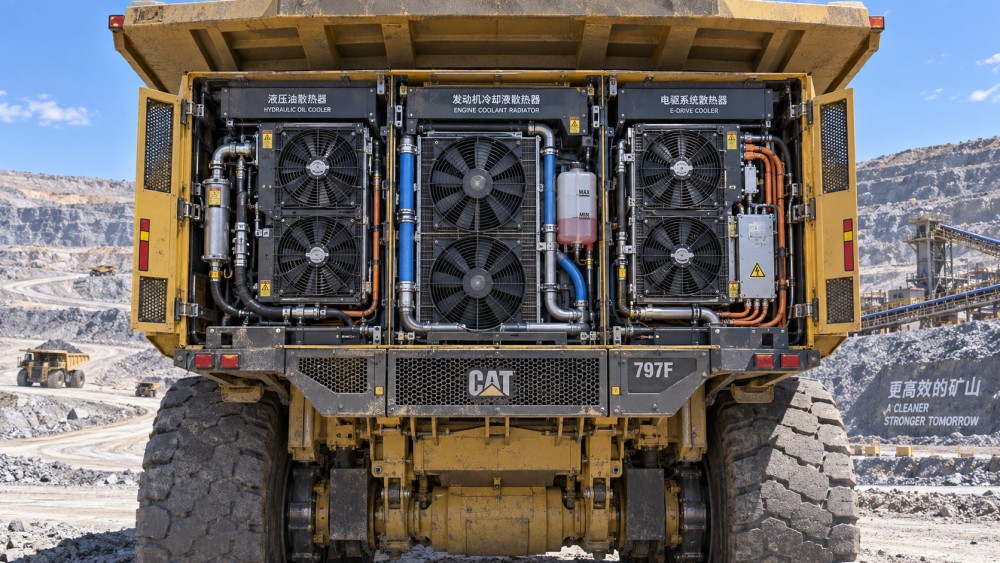
Many thermal failures blamed on “insufficient cooling” are really airflow failures. A large radiator cannot deliver its intended performance if the fan cannot maintain pressure across a blocked core, if hot discharge air is recirculated into the intake, or if guards and service structures make cleaning impractical.
Reversible fans are useful in dusty environments, but they should not be treated as a substitute for a cleanable cooling pack. Fan reversal can dislodge loose debris; it cannot reliably remove packed material, oily fines, or mud that has hardened between fins. The evaluator should look at core spacing, access panels, wash-down procedures, drain paths, and whether technicians can inspect both sides of the heat exchanger without removing major guards. If cleaning requires an extended shutdown or unsafe access, it will happen less often than the maintenance plan says.
Variable-speed or hydraulically driven fans can reduce parasitic power when cooling demand is low, but the control strategy matters more than the presence of the feature. A fan that waits for a single coolant sensor to cross a threshold may react too late during rapid load changes. More capable systems use temperature trends, hydraulic demand, ambient conditions, and fan speed feedback to anticipate load. They should also identify fan slip, abnormal current draw, actuator faults, or blocked airflow before the machine reaches a protection limit.
Air recirculation deserves particular attention on large excavators and haul trucks. It is easy to overlook during a static inspection. The issue appears when the machine is positioned near a berm, crusher, highwall, or another heat-producing unit. Computational airflow analysis can be useful during machine design, but site validation still matters. A cooling system should be assessed with the access doors closed, guards fitted, working attachments installed, and the machine operating in its normal orientation—not in an idealized workshop condition.
Hydraulic efficiency is part of thermal management
In open-pit excavation, hydraulic heat is often a system-design problem before it becomes a cooler-size problem. Pressure losses across restrictive valves, unnecessary throttling, poorly matched pumps, excessive case-drain flow, or relief-valve operation during repetitive cycles all convert useful engine or motor power into heat. Adding a larger oil cooler may postpone the alarm, but it does not address the energy loss that created the heat.
Technical reviews should therefore connect cooling decisions to the hydraulic circuit. Ask where the heat is generated, whether variable-displacement pumps operate efficiently across the expected load spectrum, and whether regenerative functions or load-sensing control reduce throttling losses. Pay close attention to attachments and non-standard operating modes. A boom, crusher, drill, or auxiliary tool can change return flow and pressure behavior enough to invalidate assumptions made for base-machine duty.
Oil cleanliness is linked to this issue as well. Contaminated fluid can accelerate wear, raise internal leakage, and create more heat over time. The thermal system may then appear to be at fault when the underlying deterioration is hydraulic. Temperature trends should be reviewed alongside fluid analysis, filter condition, pump efficiency indicators, and pressure data where the machine supports them.
Control logic should prevent derating, not merely report it
A basic overtemperature warning protects against catastrophic damage. It does not necessarily protect availability. The more effective thermal management mining equipment design uses staged control: early detection of an unfavorable temperature trend, active correction through fan and pump control, operator guidance where appropriate, and only then a controlled reduction in power if the thermal limit cannot be protected.
The distinction is practical. If an operator receives a vague high-temperature lamp when the machine is already close to derate, there is little useful action to take. If the display indicates that hydraulic oil temperature is rising because cooling-pack restriction is likely, or that traction power is being limited due to sustained inverter temperature, maintenance and operations teams can respond differently. The diagnostic message needs to identify the system and the likely operating consequence without overwhelming the operator.
Remote monitoring can add real value when it identifies repeatable thermal patterns across a fleet: a particular haul route, a shift-specific dust condition, a machine with deteriorating fan performance, or a seasonal rise in cooling demand. However, telemetry should support field inspection rather than replace it. A sensor may be accurate while the measured point is not representative of the actual hot spot. Sensor placement, redundancy for critical circuits, calibration practice, and fault-detection logic all deserve review.
What to examine during a technical evaluation
A practical evaluation should move beyond a brochure comparison. Request the machine’s thermal derate strategy, cooling circuit schematic, fan-control description, allowable ambient and altitude assumptions, and maintenance instructions for the cooling package. Then compare those documents with the mine’s actual duty cycle. If the equipment will operate near the edge of the stated envelope, ask what options change the result: larger cooling cores, higher-capacity fans, filtration, different hydraulic settings, insulation, software calibration, or altered service intervals.
Design choices change with machine type
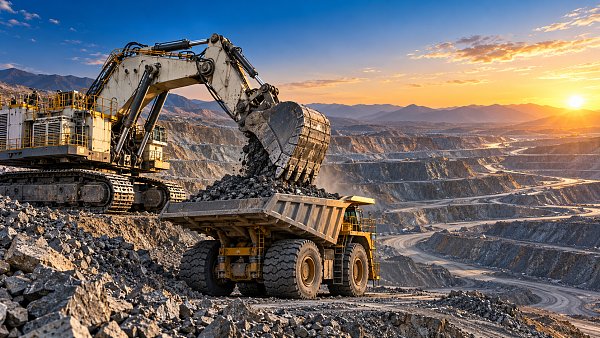
Large mining dump trucks need a thermal strategy that accounts for long uphill pulls, retarder or braking heat on descent, and frequent dust loading around the radiator zone. Ultra-large excavators place greater emphasis on hydraulic heat rejection, fan reliability, and maintaining cooling performance during continuous digging. Tunnel boring machines face a different constraint: limited ventilation, high humidity, confined heat rejection, and interactions between machine cooling and the tunnel’s broader environmental-control system.
This is why heavy-equipment intelligence needs to connect machine parameters with the construction method and operating setting. TF-Strategy’s work across TBMs, open-pit equipment, crawler cranes, road machinery, and heavy haulage reflects a useful engineering reality: thermal design cannot be judged independently from geography, geology, infrastructure constraints, and operational practice. The same component can be reliable in one project and chronically limiting in another.
The design most likely to reduce heat-related downtime is not necessarily the one with the most visibly oversized cooler. It is the one that manages heat at its source, protects sensitive circuits from one another, preserves airflow after hours of dust exposure, and gives the site enough diagnostic visibility to act before derating begins. That is the standard worth applying when equipment will be expected to work continuously under difficult conditions.
Related News
 Oct 02, 2026How to Evaluate Heavy Equipment Technology Suppliers for Fleet Uptime and SupportHeavy equipment technology suppliers can make or break fleet uptime. Learn how to assess diagnostics, data access, parts, service coverage, and support terms before you buy.
 Oct 01, 2026How to Use Technical References to Benchmark Industrial Equipment PricesIndustrial equipment technical reference pricing: learn how to normalize specifications, scope, service life, and operating costs to benchmark quotes accurately and choose the best-value equipment.
 Sep 30, 2026What Does an Ultra-Large Excavator Really Cost Over Its Service Life?Ultra-large excavators cost far more than purchase price. Explore lifecycle expenses, uptime risks, energy use, maintenance, and cost-per-tonne insights.
 Sep 29, 2026Infrastructure Construction Standards: A Project Manager’s Guide to ComplianceInfrastructure construction standards guide for project managers: turn requirements into field controls, hold points, traceability, and compliant delivery.
Ms. Elena Rodriguez
Weekly Insights
Stay ahead with our curated technology reports delivered every Monday.