
What key specs should project managers compare when selecting asphalt pavers for high-precision road projects?
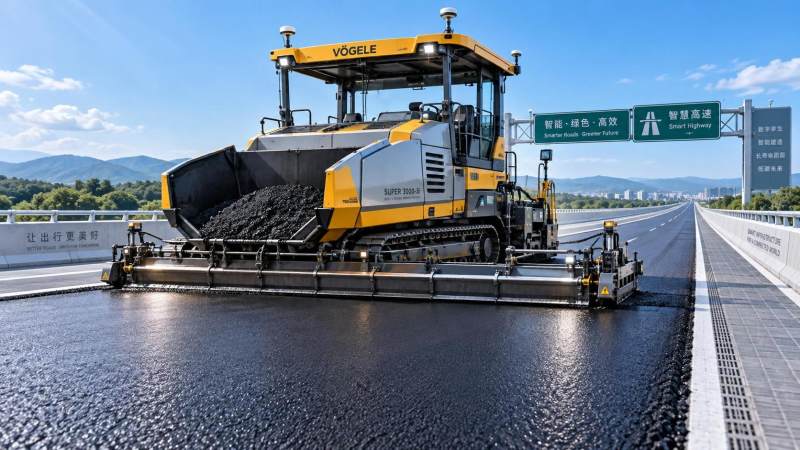
What are the key specs to compare when choosing road construction equipment? For high-precision road projects—especially smart highways and high-speed networks—selecting the right asphalt paver demands rigorous evaluation of grade accuracy, screed technology, thermal uniformity, GPS/BD integration, and real-time data interoperability. These parameters do not operate in isolation; their interaction determines whether a 20-km stretch meets ±1 mm cross-slope tolerance over 3 m or drifts into unacceptable ride quality zones.
Grade Accuracy: Beyond Static Leveling
Grade accuracy is often misread as a single-number specification—e.g., “±0.5 mm”—but that value applies only under tightly controlled lab conditions. In field practice, it degrades with base irregularity, material temperature drop, and machine speed variation. A paver rated at ±0.3 mm over 10 m may deliver ±1.2 mm on a subbase with 8 mm peak-to-valley deviation if its automatic grade control lacks adaptive filtering. True performance hinges on how the system compensates for dynamic disturbances: vibration from tracked drive units, hydraulic pulsation in lift cylinders, and even wind-induced screed deflection at speeds above 6 m/min. Pavers with inertial measurement units (IMUs) fused with laser or total station references maintain tighter control during transient loading than those relying solely on stringline or slope sensors.
Screed Technology: Not Just Width and Weight
Screed design dictates thermal homogeneity and density gradient across the mat. Floating screeds with independent heating zones allow localized temperature tuning—critical when paving multi-layer SMA mixes where binder viscosity shifts sharply between 140°C and 160°C. Fixed-geometry screeds may achieve uniform thickness but fail to manage lateral segregation when aggregate size exceeds 19 mm. Vibration frequency and amplitude settings interact directly with mix stiffness: too much vibration on polymer-modified asphalt causes binder bleed; too little yields insufficient particle rearrangement before compaction. Modern screeds integrate real-time infrared thermography to adjust heat output per zone, preventing cold joints without manual intervention.
Thermal Uniformity: The Hidden Driver of Density Consistency
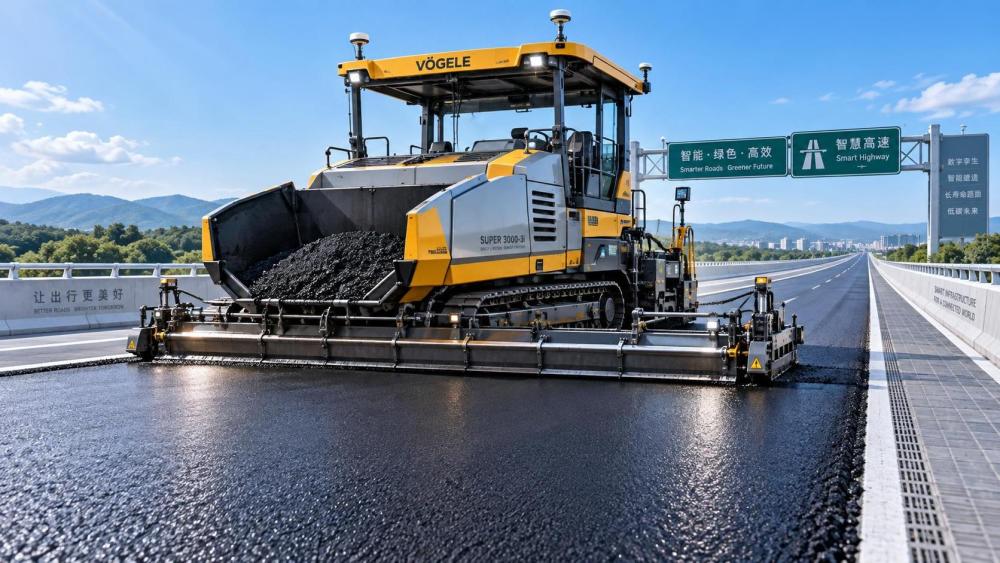
Thermal variance across the mat surface—even 5°C—triggers differential cooling rates, altering compaction windows by up to 45 seconds per meter. This variance arises not only from ambient conditions but from paver-specific heat loss paths: unshielded auger housings, uninsulated vibratory plates, and exhaust routing near the screed edge. Units with integrated thermal blankets over the hopper and auger chamber reduce surface temperature spread from ±12°C to ±3.5°C at discharge. Crucially, thermal uniformity affects infrared density mapping validity: if the IR sensor calibrates against a 155°C reference point while adjacent areas sit at 148°C, the reported density deviation reflects temperature artifact—not actual void content.
GNSS Integration: Precision ≠ Compatibility
GPS or BeiDou (BD) positioning capability is table stakes—but raw satellite accuracy matters less than how position data interfaces with the paver’s motion model. A system reporting 8 mm horizontal RMS may still produce 22 mm cumulative error over 500 m if its onboard Kalman filter does not fuse wheel encoder slip compensation and IMU pitch/roll correction. More critical is coordinate system alignment: mismatched geoid models (e.g., EGM2008 vs. local national datum) introduce vertical bias that compounds with each pass. High-precision projects require field verification of vertical datum registration—not just RTK lock status—before first lift.
Data Interoperability: Where Real-Time Feedback Breaks Down
Many pavers generate real-time data streams—temperature, speed, screed angle, material flow—but few expose them via standardized protocols like ISO 11783 (ISOBUS) or OPC UA. Proprietary APIs force contractors to build custom middleware to feed paver metrics into centralized QA dashboards alongside roller compaction passes and core density logs. Without semantic alignment—e.g., matching “screed temperature” tags across OEM systems—automated anomaly detection fails. One project recorded 17% false-positive density alerts because two paver models labeled identical thermal zones with non-interchangeable metadata schemas.
Material-Specific Interaction Points
Spec sheets rarely disclose how a paver responds to specific binders or aggregates. Polymer-modified asphalt demands slower auger rotation to prevent shear degradation; cold-mix foamed bitumen requires precise moisture-sensitive auger torque control to avoid clumping. When paving porous friction courses with 25-mm nominal maximum aggregate, screed extension depth must exceed 120 mm to prevent stone ejection—yet many mid-range pavers max out at 95 mm. Likewise, rubberized asphalt’s higher viscosity increases drag on floating screeds, requiring recalibration of hydraulic pressure thresholds to avoid “walking” behavior during start-up.
Operational Context Determines Spec Relevance
A spec that dominates selection on a mountainous smart highway—such as thermal zoning resolution—may be irrelevant on a flat urban arterial where speed consistency matters more. Similarly, GNSS vertical accuracy gains diminish when working within 50 m of tall buildings, making total station-guided operation more reliable despite lower headline specs. Maintenance access also reshapes priorities: pavers with modular hydraulic manifolds reduce downtime during bearing replacement versus monoblock designs requiring full screed disassembly. These context dependencies mean no single spec hierarchy applies universally—it emerges only when mapped to site geometry, mix design, and QA protocol requirements.
Ultimately, comparing asphalt pavers for high-precision work means evaluating how physical parameters translate into repeatable, verifiable pavement properties—not just machine capabilities in isolation. The difference between meeting contractual smoothness criteria and triggering costly rework lies in understanding which specs govern thermal stability, which enforce geometric fidelity, and how their interplay changes with material behavior, environmental load, and digital workflow integration.
Related News
 Sep 19, 2026Mining Truck Technology Trends: What Fleet Managers Should Prioritize for 2026Mining truck technology trends for 2026: prioritize electrification, autonomy, predictive maintenance, and road intelligence to improve fleet uptime, safety, and cost control.
 Sep 17, 2026How TBM Guidance Technology Maintains Alignment Through Curves and Variable GroundTunnel boring machine guidance technology helps teams maintain precise alignment through curves and variable ground, reducing risk, improving lining accuracy, and protecting schedules.
 Sep 16, 2026Infrastructure Equipment Market Reference: Demand, Pricing, and Supplier BenchmarksInfrastructure equipment market reference for buyers: assess demand signals, total cost, pricing risks, and supplier benchmarks for tunnels, mining, cranes, and road projects.
 Sep 15, 2026How to Evaluate Infrastructure Equipment Suppliers for Complex Project RequirementsInfrastructure equipment solutions supplier evaluation guide for complex projects: assess technical fit, lifecycle cost, reliability, local support, and contract risk.





Pavement Process Engineer
Weekly Insights
Stay ahead with our curated technology reports delivered every Monday.