
Electric Mining Trucks vs Diesel Fleets: How to Compare TCO, Range, and Payload
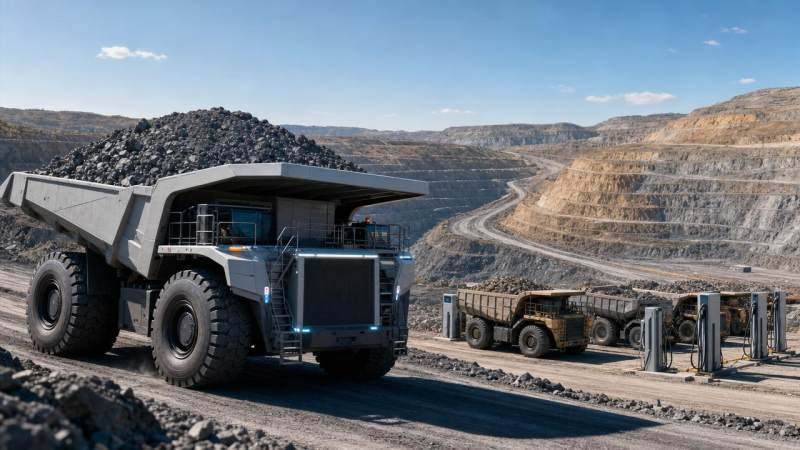
Electric Mining Trucks vs Diesel Fleets: where does the real cost gap come from?
For heavy haulage, the headline price rarely tells the full story.
Electric mining trucks may look expensive upfront, yet diesel fleets often carry hidden operating burdens across fuel, maintenance, ventilation, and uptime losses.
That is why the comparison has shifted from equipment preference to capital discipline.
In practice, the better question is not whether electric mining trucks are innovative.
It is whether they improve cash cost per ton, preserve payload, and reduce lifecycle risk under actual mine conditions.
TF-Strategy follows this transition closely because mining dump trucks sit at the center of open-pit productivity, energy transition pressure, and fleet modernization.
A useful evaluation connects machine parameters with haul road geometry, shift design, site altitude, and power availability.
Once those pieces are stitched together, TCO, range, and payload become measurable rather than theoretical.
When does TCO favor electric mining trucks instead of diesel?
The break point usually appears in high-utilization mines with stable cycles and expensive diesel.
Electric mining trucks tend to gain advantage when daily operating hours are long and idle time is controlled.
Their strongest TCO case comes from three areas.
- Lower energy cost per ton-kilometer, especially where power prices are predictable.
- Reduced maintenance exposure because electric drivetrains have fewer wear components.
- Potentially better asset availability if charging and dispatch are planned correctly.
Diesel fleets still hold an advantage in some short-horizon decisions.
They avoid major charging infrastructure, allow flexible redeployment, and fit sites with unstable grid access.
So the TCO result depends less on brochure savings and more on duty cycle discipline.
A simple model should include acquisition cost, charging assets, demand charges, maintenance labor, tire wear, productivity losses, battery replacement timing, and residual value.
Many comparisons fail because they count fuel savings but ignore charging downtime, or they assume battery life without matching it to route severity.
A practical TCO screen before deeper modeling
This kind of table does not replace a financial model.
It helps rule out weak candidates before time is spent on detailed assumptions.
How should range be judged under real mining conditions?
Range is one of the most misunderstood parts of the electric mining trucks discussion.
A quoted range number means little without grade, rolling resistance, temperature, payload, speed limits, and charging logic.
In real mines, energy use changes route by route.
An uphill loaded segment can dominate battery consumption, while downhill haulage may recover energy through regenerative braking.
That is why a shift-based view is often more useful than a single-trip view.
The right question is whether the truck can complete the planned production window without causing queue buildup at chargers.
Need to compare range properly? Focus on these variables:
- Net elevation change across the full cycle.
- Average payload and overload frequency.
- Ambient temperature and battery thermal management demand.
- Charging time, charger power, and queue probability.
- Road condition, especially rolling resistance after weather events.
A shorter nominal range can still work if fast charging aligns with shovel waiting time or shift changes.
By contrast, a truck with longer nominal range may underperform if the site cannot support battery conditioning or consistent charging slots.
This is where TF-Strategy’s intelligence-led approach matters.
Physical parameters only become useful when connected to the construction method and site logistics behind them.
Will payload suffer when moving from diesel fleets to electric mining trucks?
This is a fair concern, because battery mass changes vehicle design choices.
Some electric mining trucks may carry weight penalties if the platform was adapted from a diesel architecture.
Others are engineered to protect rated payload through chassis redesign, axle balance, and structural optimization.
So the answer is not universal.
What matters is effective payload per shift, not nameplate payload alone.
If electric mining trucks need fewer maintenance stops and deliver smoother torque on ramps, they may offset slight payload constraints with stronger cycle consistency.
On the other hand, if battery packaging reduces usable payload and charging interrupts dispatch, diesel fleets can still win on total tons moved.
A solid review should examine:
- Rated payload versus average real payload.
- Cycle time under loaded uphill segments.
- Availability loss from service or charging interruptions.
- Tons moved per shift, per truck, and per charger.
That last measure is often the clearest bridge between engineering data and financial evaluation.
What risks are often missed in electric mining truck comparisons?
The most common mistake is treating vehicle selection as a standalone purchase.
Electric mining trucks are part of a system that includes charging, power management, route planning, maintenance skills, and software visibility.
If one part is weak, projected savings can disappear.
Several risk areas deserve early attention.
- Battery replacement timing may arrive earlier than budgeted under harsh grades or extreme temperatures.
- Grid constraints can cap expansion, even when truck performance looks attractive on paper.
- Charging congestion may reduce fleet productivity during peak dispatch windows.
- Residual value assumptions remain less mature than for long-established diesel fleets.
- Emergency response and workshop safety protocols require practical adaptation.
More subtle risks also matter.
A mine may achieve lower energy cost but lose flexibility if the haul plan changes faster than charging infrastructure can be relocated.
That is especially relevant in developing pits, satellite deposits, and staged infrastructure programs.
The stronger decision process compares not just savings, but adaptability.
Quick FAQ decision guide
How can you build a cleaner comparison before approving fleet investment?
A reliable comparison starts with the mine plan, not the truck brochure.
Use at least one full operating year in the model.
Seasonal temperature shifts, road deterioration, and production changes can alter electric mining trucks economics more than expected.
It also helps to separate base case from stress case.
The base case shows expected savings under normal utilization.
The stress case tests delayed charging assets, higher battery degradation, lower power quality, or route extensions.
If the investment only works under perfect assumptions, it is not yet a strong fleet decision.
A useful approval checklist usually includes:
- Cash cost per ton under diesel and electric scenarios.
- Charging infrastructure capex and commissioning schedule.
- Battery warranty terms versus expected duty cycle.
- Sensitivity to diesel price, electricity price, and utilization swings.
- Residual value logic and replacement path after the first lifecycle.
TF-Strategy’s broader heavy equipment perspective is useful here.
Open-pit haulage decisions do not sit in isolation.
They connect with infrastructure sequencing, energy transition targets, remote control trends, and the wider commercial logic of earth engineering assets.
So, are electric mining trucks the right move now?
Often yes, but only in the right operating architecture.
Electric mining trucks make the most sense when haul cycles are well defined, site power is dependable, and lifecycle management is treated as a system decision.
Diesel fleets remain rational where flexibility, fast deployment, and uncertain infrastructure timelines carry more value than fuel savings.
The strongest next step is to build a site-specific comparison around TCO, range under real gradients, and effective payload per shift.
That gives a clearer basis for judging whether electric mining trucks will lower risk and strengthen long-term asset value, or whether diesel should remain the bridge technology for now.
In other words, the smarter choice comes from disciplined comparison, not from assuming every mine should electrify at the same pace.
Related News
 Oct 24, 2026Choosing Lifting Equipment for Middle East Petrochemical Plants in Hazardous AreasExplore petrochemical lifting equipment Middle East plants can rely on. Compare hazardous-area certification, capacity, and heat limits to make informed procurement decisions.
 Oct 23, 2026Selecting Lifting Equipment for Nuclear Component Transport: Key Safety CriteriaSelecting lifting machinery for nuclear component transport? Discover essential safety criteria, load control checks, and supplier requirements to guide confident procurement.
 Oct 22, 2026Tunnel Boring Machines in Southeast Asia: EPB vs. Slurry for Soft GroundCompare tunnel boring machines Southeast Asia projects rely on: EPB vs. slurry for soft ground. Discover how groundwater, settlement risks, and spoil handling shape the right choice.
 Oct 21, 2026Choosing Tunneling Equipment for the Middle East: Rock, Soil, and GroundwaterCompare underground tunneling equipment Middle East projects need. Explore rock, soil, groundwater, and TBM options to reduce risk and make confident procurement decisions.
Related News

Heavy Haulage Strategist
Weekly Insights
Stay ahead with our curated technology reports delivered every Monday.