
When does 5G remote excavation pay off in real projects
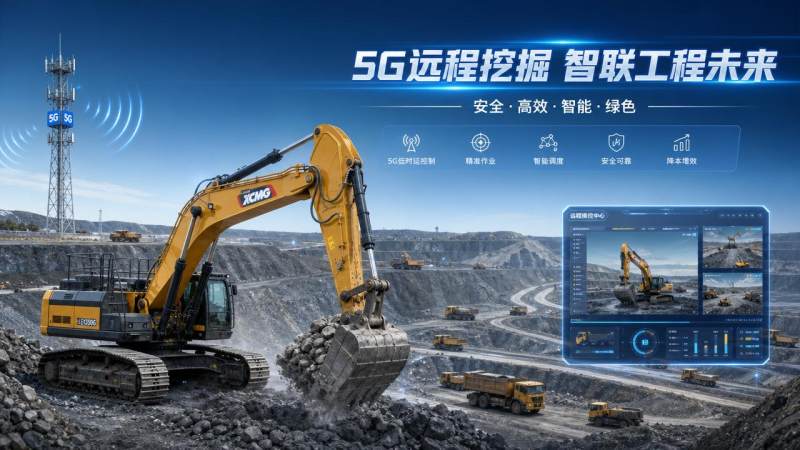
For business evaluators, the real question is simple: when does 5G remote excavation stop being a showcase and start improving project economics?
In heavy industry, commercial value appears only when safety, uptime, labor coverage, and cycle efficiency improve together.
That is why 5G remote excavation must be judged by site conditions, task repetition, hazard exposure, and network quality.
Across mining, infrastructure, emergency earthworks, and complex industrial zones, the payoff profile is very different.
For TF-Strategy, the topic matters because digital heavy equipment now links machine physics, construction methods, and strategic delivery risk.
This article explains where 5G remote excavation becomes commercially defensible, where it remains premature, and how to judge readiness.
Why project context decides whether 5G remote excavation pays off
The value of 5G remote excavation does not come from connectivity alone.
It comes from matching remote operation with a site where people face danger, travel delays, operator shortages, or unstable working windows.
A flat, low-risk project with stable staffing may see little benefit beyond technology branding.
A deep pit, contaminated zone, landslide corridor, or blast-adjacent workface may justify remote control much faster.
In practice, 5G remote excavation pays off when three conditions align:
- The site has measurable safety or access constraints.
- The excavator performs repeatable, high-hour tasks.
- The network and control system can deliver reliable low-latency response.
Without those factors, remote excavation may add complexity without enough return.
Open-pit mining is often the strongest case for 5G remote excavation
Open-pit mining often provides the clearest business case for 5G remote excavation.
The work is continuous, machine hours are high, and hazards are predictable but serious.
Examples include unstable benches, rockfall-prone edges, dust-heavy zones, and extreme temperature operations.
In these settings, remote operation can reduce operator exposure while keeping production active after blasting or during poor air quality.
Core payoff signals in mining sites
- Long shift durations that amplify fatigue and commuting losses
- Repeated loading or stripping patterns that suit remote control workflows
- Frequent weather, dust, or geotechnical interruptions
- High cost of downtime for large excavators and haulage systems
The economics improve further when 5G remote excavation integrates with dispatch, fleet management, and pit surveillance systems.
Then the gain is not only operator relocation.
It becomes a broader utilization improvement across loading, queuing, and maintenance planning.
Hazardous earthworks and disaster response can justify faster adoption
Hazardous earthworks create another strong scenario for 5G remote excavation.
This includes slope stabilization, flood-damaged embankments, landslide clearance, demolition-adjacent digging, and contaminated soil handling.
Here, the decision is often driven less by labor efficiency and more by risk reduction.
If sending an operator into the cab creates unacceptable danger, remote control moves from optional innovation to practical necessity.
What makes the business case work
The payoff comes from avoiding stoppages, reducing incident probability, and accelerating access to unstable zones.
A project can also gain schedule value when remote machines enter restricted areas earlier than manually operated equipment.
Even if absolute productivity is slightly lower at first, total project value may still be higher.
That is especially true when delay penalties or safety shutdowns are expensive.
Urban and industrial sites need a more selective 5G remote excavation approach
Urban excavation and industrial brownfield projects can benefit from 5G remote excavation, but only under tighter conditions.
These sites involve constrained space, utility protection, complex stakeholder rules, and frequent short-duration tasks.
Precision matters, but the workflow may be too fragmented for a full remote model to pay back quickly.
The stronger cases are enclosed hazardous zones, chemical plants, port yards, and demolition environments with persistent exposure risks.
By contrast, standard municipal trenching may not produce enough machine hours or enough risk reduction to justify the full stack.
Useful judgment points
- How many remote-operable hours are expected each month?
- Will the task be repetitive or constantly changing?
- Does the site require protected human standoff distance?
- Can the network remain stable around metal structures and interference sources?
Different project scenarios create different value drivers
Not every project buys 5G remote excavation for the same reason.
Some sites want fewer people in dangerous zones.
Others want higher machine utilization, easier staffing, or better continuity across shifts.
How to judge if 5G remote excavation fits a project before investment
A useful decision process should stay practical and site-based.
- Measure hazard exposure hours around the excavator work zone.
- Estimate annual remote-operable machine hours, not total fleet hours.
- Check whether latency, video quality, and redundancy meet task difficulty.
- Compare expected productivity change during ramp-up and steady-state periods.
- Include savings from incidents avoided, shift continuity, and staffing flexibility.
This framework keeps 5G remote excavation tied to operational facts instead of marketing assumptions.
It also prevents overinvestment in sites where manual operation remains the more efficient option.
Common mistakes that distort the payoff of 5G remote excavation
Several misjudgments appear repeatedly in early deployments.
Mistake 1: assuming connectivity alone creates value
A fast network does not guarantee a business case.
The site still needs enough risk, enough repeatability, and enough machine hours.
Mistake 2: ignoring human factors
Remote operators need training, ergonomic control stations, and clear camera perspectives.
Without this, productivity may drop and acceptance may weaken.
Mistake 3: evaluating only direct labor savings
The strongest gains often come from avoided stoppages, safer access, and better equipment availability.
A narrow wage comparison can hide the real project value.
Mistake 4: treating all excavating tasks the same
Bulk loading, trimming, slope recovery, and utility-adjacent digging have different control demands.
Some tasks suit 5G remote excavation well, while others need hybrid operation.
What a sensible rollout path looks like in real projects
The best rollout usually starts with one machine class and one clearly defined hazardous or high-hour use case.
A phased path lowers technical risk and produces cleaner evidence.
- Start with repetitive excavation zones and stable operating geometry.
- Build network redundancy before expanding machine count.
- Track uptime, incidents, cycle times, and operator adaptation.
- Scale only after proving site-specific return.
This is where intelligence-led evaluation matters.
For organizations following heavy equipment evolution, the strongest decisions come from technical fit, not trend pressure.
When reviewed through that lens, 5G remote excavation is not universally profitable.
It pays off most clearly in open-pit mining, hazardous earthworks, unstable terrain response, and controlled industrial risk zones.
In routine, low-risk, low-hour projects, the return may remain weak.
The next practical step is to score live projects by hazard intensity, annual machine hours, remote-task repeatability, and network readiness.
That approach turns 5G remote excavation from a promising concept into a disciplined capital decision.
Related News
 Oct 08, 2026How to Evaluate a Heavy Machinery Information Platform for Project Equipment SourcingHeavy machinery information platform guide: compare equipment fit, source reliability, lifecycle costs, supplier capability, and compliance to make smarter sourcing decisions.
 Oct 07, 2026How to Evaluate a Hydraulic System Component Supplier for Heavy Equipment UptimeChoose a hydraulic system component supplier with proven quality, technical fit, and reliable delivery to reduce heavy equipment downtime and lifecycle costs.
 Oct 06, 2026Selecting Petrochemical Overhead Cranes for Hazardous Areas and Heavy Process LoadsPetrochemical overhead cranes for hazardous areas: learn how to match capacity, duty, controls, corrosion protection, and maintenance access for safer, reliable lifts.
 Oct 05, 2026Tunneling Equipment Specification Planning: Key Criteria for Ground and Project RisksEquipment specification planning tunneling: learn how to match TBM systems to ground risks, geometry, safety, logistics, and lifecycle cost for more reliable project delivery.
Ms. Elena Rodriguez
Weekly Insights
Stay ahead with our curated technology reports delivered every Monday.