
How to judge heavy machinery components before replacement
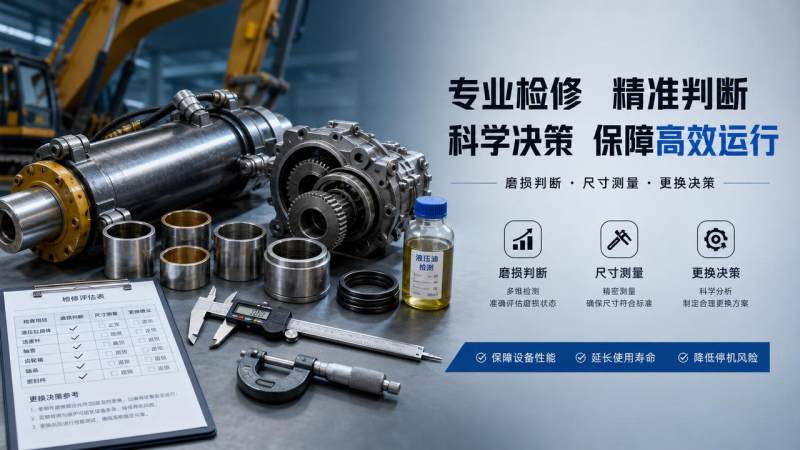
Before replacing heavy machinery components, aftermarket maintenance teams need more than a quick visual check. Accurate judgment helps prevent unnecessary downtime, avoid repeat failures, and control repair costs. This guide explains how to assess wear, structural damage, hydraulic performance, and service history so you can decide whether heavy machinery components should be repaired, monitored, or replaced with confidence.
For maintenance crews working on TBMs, ultra-large excavators, crawler cranes, road machinery, and mining dump trucks, the decision is rarely simple. A cracked housing may demand immediate replacement, while a worn bushing with 15% remaining tolerance may still be serviceable for one planned shutdown cycle. Good judgment protects uptime, safety, and total cost of ownership.
In high-load environments such as tunnel driving, open-pit mining, and heavy lifting, component failure often develops in stages. The most effective aftermarket teams combine inspection data, operating history, fluid analysis, and dimensional measurement before they replace heavy machinery components. That method is slower than guesswork, but far more reliable.
Why replacement decisions must be evidence-based
On heavy equipment, replacing parts too early increases spare inventory cost, labor hours, and planned downtime. Replacing too late can trigger secondary damage across adjacent systems such as pins, bores, pumps, seals, gear sets, or structural joints. In many field cases, one failed component creates 2 to 4 additional repair items.
Aftermarket maintenance personnel usually work under pressure. A machine may be scheduled to return to production within 8 to 24 hours, especially in mining or continuous tunneling operations. That is why replacement decisions should follow a repeatable process rather than personal instinct alone.
The 4 main consequences of poor judgment
- Unplanned downtime caused by sudden failure during the next operating shift
- Repeat repairs when the root cause was missed and only the visible part was changed
- Safety exposure, especially on lifting, pressure, rotating, or high-impact systems
- Higher TCO from excess parts consumption, rework, and production interruption
Key signs that heavy machinery components need deeper evaluation
A component should move beyond routine inspection when you see one or more of these indicators: vibration rising by 20% or more from baseline, oil contamination above normal trend, temperature running 10°C to 15°C above standard load condition, visible deformation, repeated seal leakage within 30 days, or abnormal noise under stable RPM.
These signals do not always mean immediate replacement. They do mean the part should be measured, tested, and reviewed against the service record before any decision is made.
Typical evidence sources used by maintenance teams
- Visual inspection under cleaned conditions
- Dimensional measurement against OEM or site tolerance
- Fluid, grease, or wear particle analysis
- Operating hours, duty cycle, and overload history
- Previous repair records and repeat failure frequency
How to inspect wear, damage, and serviceability
The practical question is not whether a part looks old. The real question is whether the wear pattern is stable, accelerating, or already outside safe limits. Heavy machinery components in high-force applications often show surface marks long before they become unsafe. Inspection must separate cosmetic wear from function-threatening damage.
Start with cleaning and controlled inspection conditions
Before measurement, remove mud, grease buildup, scale, and embedded fines. On excavators, dump trucks, and road machinery, dirt can hide hairline cracks or false oil leak paths. On TBM systems, abrasive slurry can mask edge loss and seal wear. A 15-minute cleaning step can prevent a wrong diagnosis that costs several shifts of lost availability.
Use basic controls: proper lighting, calibrated measuring tools, and the correct unloaded or locked-out position. A rushed inspection under poor access often misses bore ovality, mounting face distortion, or uneven contact patterns.
Measure, do not guess
Judging wear by eye alone is risky. Pins, bushings, rollers, wear plates, cutter holders, hydraulic rods, and slew-related parts should be checked against actual dimensions. Even a 0.5 mm to 1.5 mm loss can matter when the load path is concentrated or cyclic.
If OEM values are unavailable, maintenance teams should use site-approved thresholds based on historical performance. For example, some operations classify wear into three bands: under 40% of allowance consumed, monitor only; 40% to 80%, plan replacement; above 80%, replace at the next safe maintenance window or immediately if the duty is severe.
The table below helps maintenance teams classify common inspection findings before replacing heavy machinery components.
The key lesson is that the visible failed part may not be the primary problem. When a seal fails three times in 60 days, the correct replacement decision often depends on the condition of the rod, bore, fluid cleanliness, and pressure regulation, not the seal alone.
Check structural damage separately from wear
Wear is usually progressive. Structural damage can be sudden. On crawler cranes and ultra-large excavators, cracks near weld toes, pin bosses, boom foot areas, or track frame transitions should be treated differently from ordinary abrasion. Even a short crack of 8 mm to 12 mm can propagate quickly under cyclic load.
Use dye penetrant, magnetic particle testing, or site-approved NDT methods when a structural concern is suspected. If the machine has recently experienced shock loading, collision, overload, or abnormal vibration, expand the inspection radius to nearby brackets, fasteners, and welded joints.
Common structural red flags
- Cracks radiating from bolt holes or weld ends
- Permanent bend, twist, or loss of alignment
- Fasteners repeatedly loosening within 1 to 2 weeks
- Uneven gap growth across paired supports or mounting faces
How hydraulic and powertrain performance affects replacement decisions
Many heavy machinery components fail functionally before they fail visually. Hydraulic cylinders, pumps, valves, hoses, final drives, swing gear sets, and travel systems can lose performance gradually. If maintenance teams replace only the most visible worn part, the machine may return with the same complaint after 50 to 200 operating hours.
Hydraulic checks that matter in the field
For hydraulic components, compare actual pressure, drift, flow response, and operating temperature against known normal values. A cylinder that drifts under load, a pump that runs hot, or a valve that reacts slowly may indicate internal leakage or contamination. In many systems, a case drain trend or pressure drop is more useful than appearance.
As a practical guide, when oil temperature runs 10°C above baseline for the same duty, or when response time slows by more than 15%, the associated heavy machinery components should be inspected in the broader system context. Replacing a hose without checking relief pressure or contamination may only delay the next failure.
Powertrain and rotating parts need trend analysis
On mining dump trucks, road machinery, and excavators, bearings, couplings, drive gears, and final drives often show indirect warning signs first. Noise frequency changes, metal particles in oil, backlash increase, and heat concentration at one housing zone can all indicate a part that is near the replacement threshold.
If the machine runs in high altitude, high dust, or extreme temperature conditions, shorten the inspection interval. A component checked every 500 hours in mild service may need review every 250 hours in severe duty.
The following table shows a practical field framework for deciding whether to monitor, repair, or replace critical performance-related parts.
This type of structured review reduces “parts swapping,” a common problem in field service. The more expensive the machine and the tighter the shutdown window, the more valuable this discipline becomes.
Use service history to avoid repeat failures
A component should never be judged in isolation. Service history often explains why heavy machinery components wear faster on one machine than on another identical unit. The same travel motor or cutter-related part can last 3,000 hours in stable duty but only 1,200 to 1,800 hours under contamination, overload, or poor lubrication practice.
What to review in the maintenance record
- Total operating hours since new or since overhaul
- Hours since last part replacement or rebuild
- Duty severity: shock load, long idling, high dust, water ingress, steep grade
- Lubrication interval compliance, such as every 50, 100, or 250 hours
- Previous oil analysis, vibration notes, and recurring alarm codes
Patterns matter more than isolated events. If a slew bearing shows recurring grease contamination every inspection round, replacing only the bearing without correcting sealing or maintenance practice will not solve the problem. If a dump truck suspension component wears out 30% earlier than fleet average, the root cause may relate to haul road condition, loading method, or tire imbalance.
Three questions before approving replacement
- Is the part at end of life, or is another system damaging it prematurely?
- Will replacement restore function fully, or is an alignment, pressure, or structural correction also needed?
- Can the component safely run until the next planned outage, or is failure risk already unacceptable?
A practical decision framework for aftermarket teams
For field maintenance, the best process is simple enough to use during a short shutdown but detailed enough to prevent costly mistakes. A 5-step method works well across most heavy equipment categories, from tunnel boring support systems to large excavators and crawler cranes.
Step 1: Confirm the failure mode
Identify whether the issue is wear, fatigue, impact damage, heat damage, lubrication failure, contamination, or misalignment. If the failure mode is unclear, do not approve immediate replacement of expensive heavy machinery components without at least basic supporting evidence.
Step 2: Measure against tolerance or trend
Take dimensional, thermal, pressure, or fluid readings. Even 2 to 3 comparable data points are better than a subjective statement such as “looks bad.” Trend-based decisions are especially valuable for rotating assemblies and hydraulic systems.
Step 3: Inspect related parts
Always check mating surfaces, mounting condition, lubrication path, fastener preload, and nearby seals or hoses. Many repeat failures happen because the surrounding condition was not corrected during the first repair.
Step 4: Classify the action
Use one of three decisions: monitor, repair, or replace. Monitor means the part remains in service with a defined recheck interval, often 50 to 250 hours depending on severity. Repair means the part can be restored safely, such as by resealing, line boring, machining, or surface treatment. Replace means remaining life or safety margin is no longer acceptable.
Step 5: Record and close the loop
Document the condition, action, readings, and suspected root cause. Good records build the decision quality of future inspections. Over time, aftermarket teams can identify which heavy machinery components fail by normal wear and which fail because the operating environment or maintenance routine needs correction.
Common mistakes when judging heavy machinery components
Even experienced technicians can make errors when time pressure is high. Most mistakes come from incomplete diagnosis rather than lack of effort.
Mistake 1: Replacing the symptom, not the cause
Examples include changing seals without checking rod finish, replacing hoses without checking pressure spikes, or installing a new bearing without correcting alignment. This creates a false sense of completion and often leads to another stoppage within weeks.
Mistake 2: Treating all wear as equal
Uniform wear may be manageable. Uneven wear often signals misalignment, contamination, or load concentration. The pattern matters as much as the amount.
Mistake 3: Ignoring operating context
A component on a TBM working in abrasive geology, or a mining truck operating in extreme heat, should not be judged by the same interval as a lightly loaded machine. Duty cycle can change replacement timing by hundreds of hours.
Mistake 4: Approving replacement without documentation
Without records, teams cannot compare current wear to the last inspection, validate a supplier issue, or prove that a root cause has been removed. Documentation improves both maintenance quality and spare planning.
Final guidance for maintenance and sourcing teams
The smartest replacement decisions come from combining inspection, measurement, performance testing, and maintenance history. For aftermarket personnel, this reduces unnecessary part changes and improves machine availability across tunneling, mining, lifting, and road construction fleets.
When you judge heavy machinery components with a structured method, you protect safety, reduce repeat failures, and make spare budgets more effective. That is especially important for mission-critical assets where one wrong decision can affect a full shift, a contract milestone, or a large infrastructure delivery schedule.
TF-Strategy supports heavy equipment decision-makers with intelligence focused on component performance, operating conditions, and maintenance planning across global earth engineering sectors. If you need deeper guidance on inspection priorities, replacement strategy, or component application analysis, contact us now to get tailored support, discuss product details, and explore more practical solutions.
Related News
 Oct 06, 2026Selecting Petrochemical Overhead Cranes for Hazardous Areas and Heavy Process LoadsPetrochemical overhead cranes for hazardous areas: learn how to match capacity, duty, controls, corrosion protection, and maintenance access for safer, reliable lifts.
 Oct 05, 2026Tunneling Equipment Specification Planning: Key Criteria for Ground and Project RisksEquipment specification planning tunneling: learn how to match TBM systems to ground risks, geometry, safety, logistics, and lifecycle cost for more reliable project delivery.
 Oct 04, 2026Nuclear Lifting Equipment Cost: Budgeting for Compliance, Testing, and Lifecycle RiskNuclear lifting equipment cost explained: budget for compliance, proof-load testing, installation, documentation, and lifecycle risk to make confident procurement decisions.
 Oct 03, 2026How to Assess TBM Manufacturers for Hard-Rock Tunneling Projects?Choose the right tunnel boring machine manufacturer for hard-rock projects. Explore key criteria for design, lifecycle cost, factory quality, and service support.
Hydraulic Power Analyst
Weekly Insights
Stay ahead with our curated technology reports delivered every Monday.