
Crawler Cranes for Sale: How to Compare Load Charts, Boom Options, and Total Cost
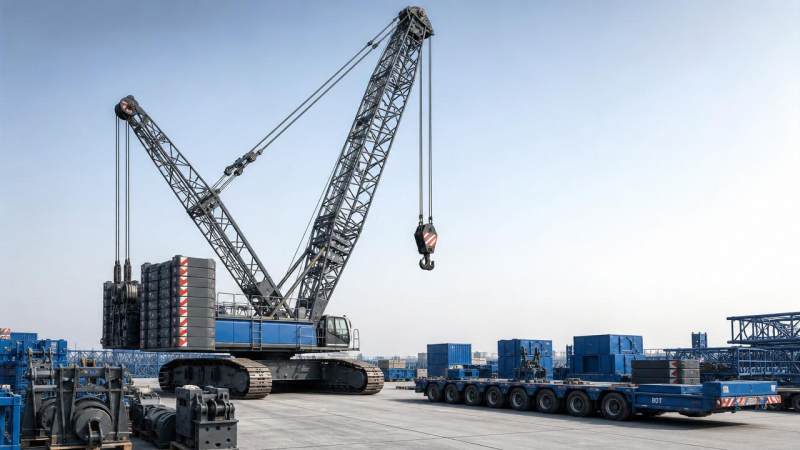
Crawler Cranes for Sale: How to Compare Load Charts, Boom Options, and Total Cost
When evaluating crawler cranes for sale, the biggest mistake is stopping at rated capacity. A 250-ton crane may look ideal on paper, yet fail in real site conditions.
That happens because lifting performance depends on radius, boom length, counterweight, ground setup, transport limits, and project cycle. In practical terms, the purchase decision is never just about tonnage.
This is where a structured comparison helps. For anyone screening crawler cranes for sale, the goal is to connect technical charts with commercial risk, utilization, and long-term return.
TF-Strategy tracks this market closely across wind power, petrochemical, mining, and heavy civil projects. The clearer signal is simple: better crane selection lowers idle time, protects margins, and improves delivery certainty.
Start with the Job, Not the Brochure
Before comparing crawler cranes for sale, define the lift profile. This includes maximum load, working radius, hook height, pick-and-carry needs, and expected ground conditions.
A crane selected for refinery modules differs from one used on wind farms. One may prioritize high capacity at shorter radius. The other may need long boom and flexible jib combinations.
In real procurement work, three questions usually clarify the shortlist fast.
- What is the heaviest lift, including rigging and dynamic allowance?
- At what radius and height must that lift happen?
- How many projects will actually use this configuration each year?
If those answers remain vague, comparing crawler cranes for sale becomes noisy. If they are clear, unsuitable models drop out quickly.
How to Read Load Charts Without Getting Misled
Load charts are the core decision tool. They show actual lifting capacity under defined conditions, not marketing capacity under ideal assumptions.
When reviewing crawler cranes for sale, focus on the chart rows that match your real operating radius. That is where true performance appears.
Key chart variables to compare
- Boom length and main boom angle
- Working radius under load
- Counterweight package installed
- Track extension or crawler width
- Jib or luffing attachment impact
- Whether capacity includes hook block limits
A common issue is comparing the top-line maximum capacities of different cranes. That number matters less than capacity at your actual lift radius.
For example, one crane may rate higher overall, yet lose more capacity as radius increases. Another may hold stronger performance in the 18 to 24 meter range.
That difference can decide whether a project runs with one crane or requires a larger backup unit. In cost terms, that is a major gap.
Useful comparison logic
Create a matrix using your top five expected lifts. Then map each model’s capacity against those lifts with the intended boom package and safety margin.
This keeps crawler cranes for sale in a decision framework, not a branding contest.
Compare Boom Options by Revenue Flexibility
Boom configuration shapes earning potential. A crane with limited boom options may work well on one project, then sit underused for the next contract.
That is why experienced buyers compare crawler cranes for sale by attachment ecosystem, not only base machine price.
Main options that matter
- Standard main boom for general lifting
- Fixed jib for added reach on lighter picks
- Luffing jib for high-rise or plant work
- Heavy boom packages for short-radius heavy lifts
- Superlift systems for extreme capacity scenarios
In business terms, more configuration range usually means broader deployment. However, it also means more transport pieces, more assembly time, and higher training demand.
So the right question is not, “What can this crane do at maximum?” The better question is, “Which boom options will generate repeat utilization?”
For many fleets, a flexible mid-range crawler crane outperforms a more specialized heavy model because it stays billable across more jobs.
Look Beyond Purchase Price to Total Cost
The purchase quote is only the visible layer. The real economics of crawler cranes for sale sit in total cost of ownership over several years.
This is where many decisions change. A cheaper crane can become more expensive if assembly takes longer, transport needs more trailers, or parts support is weak.
TCO elements worth modeling
- Acquisition price and financing structure
- Mobilization and demobilization cost
- Assembly crew time and support equipment
- Fuel burn or power efficiency
- Routine maintenance intervals
- Parts lead time and service coverage
- Operator training and safety compliance cost
- Residual value after target holding period
From recent market changes, transport has become especially important. Large crawler cranes may deliver strong lifting performance, yet oversize logistics can erode project margins fast.
This also means a slightly smaller unit may create better annual return if it moves faster between sites and achieves higher utilization.
Transport, Setup, and Site Constraints Matter More Than Many Expect
On complex projects, crawler cranes for sale should be reviewed like a system, not a standalone machine. Transport and setup often decide whether the crane is truly practical.
Check how many truckloads are needed. Check whether counterweights move separately. Check assembly crane requirements. Check the available laydown area on site.
For remote mining or wind projects, those questions are not secondary. They directly shape schedule certainty and cash flow.
A model that looks efficient in a yard may become difficult in mountainous access roads, soft ground, or restricted industrial sites.
Evaluate Supplier Strength and Lifecycle Support
Not all crawler cranes for sale come with the same support quality. Supplier capability can matter almost as much as the crane itself.
A strong support partner helps with commissioning, operator training, spare planning, technical troubleshooting, and resale channels. That lowers uncertainty across the equipment life cycle.
It is smart to ask for documented parts availability, field service response commitments, and references from similar projects. General promises are not enough.
- Review service footprint in your operating regions
- Check digital diagnostics and telematics capability
- Confirm local training and commissioning support
- Assess used market liquidity for exit planning
A Practical Decision Framework for Comparing Crawler Cranes for Sale
To keep decisions clear, score each shortlisted crane across technical fit, commercial fit, and risk fit. That creates a more balanced view than price comparison alone.
- List your critical lifts by load, radius, and height.
- Match each lift to load charts and boom combinations.
- Model transport, setup time, and support equipment needs.
- Estimate annual utilization by project type.
- Calculate TCO and expected residual value.
- Stress-test supplier support and delivery reliability.
This approach makes crawler cranes for sale easier to compare across brands, capacities, and application scenarios. More importantly, it keeps the discussion tied to business outcomes.
In today’s heavy equipment market, the best crane is rarely the one with the biggest headline number. It is the one that matches lifts, travels efficiently, stays utilized, and holds value.
For teams reviewing crawler cranes for sale, that is the difference between buying capacity and buying performance.
If the next step is a shortlist, build it around real lift cases, actual site limits, and full-life cost. That is where confident crane decisions begin.
Related News
 Oct 25, 2026Comparing Industrial Equipment Suppliers: Lead Times, Warranties, and ServiceMake a smarter industrial equipment supplier comparison. Explore lead times, warranty coverage, and service support to reduce downtime risk and choose with confidence.
 Oct 24, 2026Choosing Lifting Equipment for Middle East Petrochemical Plants in Hazardous AreasExplore petrochemical lifting equipment Middle East plants can rely on. Compare hazardous-area certification, capacity, and heat limits to make informed procurement decisions.
 Oct 23, 2026Selecting Lifting Equipment for Nuclear Component Transport: Key Safety CriteriaSelecting lifting machinery for nuclear component transport? Discover essential safety criteria, load control checks, and supplier requirements to guide confident procurement.
 Oct 22, 2026Tunnel Boring Machines in Southeast Asia: EPB vs. Slurry for Soft GroundCompare tunnel boring machines Southeast Asia projects rely on: EPB vs. slurry for soft ground. Discover how groundwater, settlement risks, and spoil handling shape the right choice.

Related News


Structural Load Expert
Weekly Insights
Stay ahead with our curated technology reports delivered every Monday.